
24V to 12V 85A / 100A Fleet Buck Converter
- TopologyNon-Isolated Synchronous
- Input Voltage18V – 35V DC
- Output Rating12V DC · 85A / 100A
- Peak Efficiency≥ 95%
- EnclosureIP68 Cast Aluminum
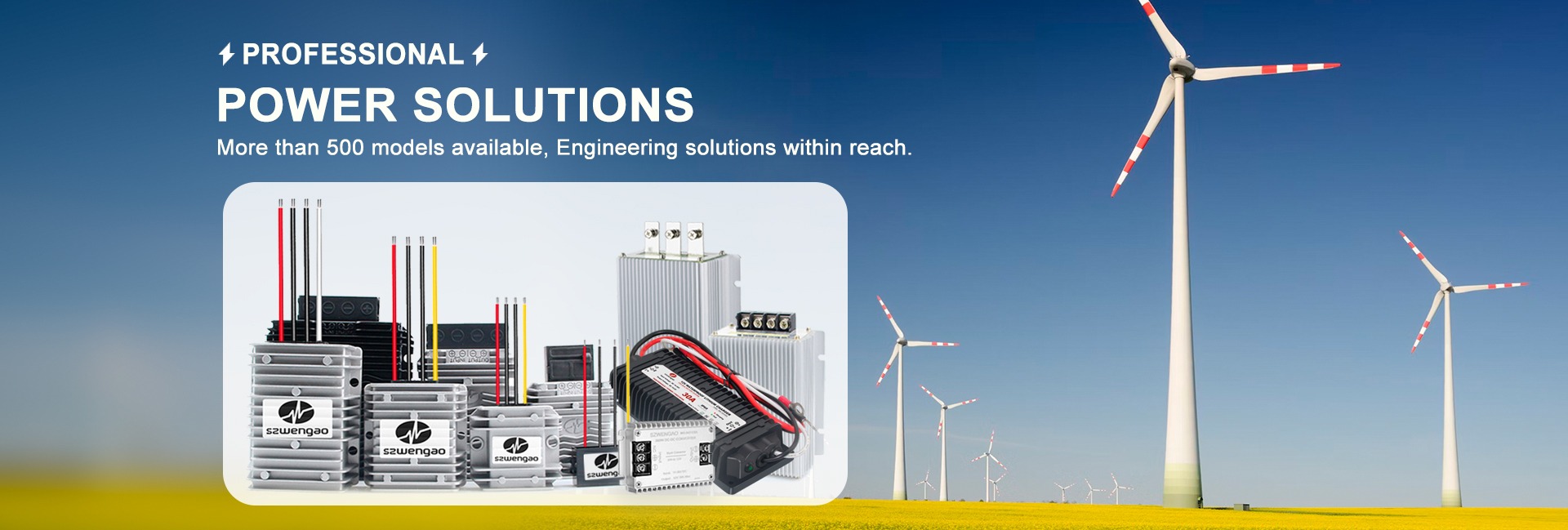
High-efficiency synchronous buck regulators engineered for harsh industrial environments, commercial fleets, EV micro-mobility, and marine off-grid networks.
In power distribution architecture, choosing between isolated and non-isolated step down converters is a pivotal decision impacting system efficiency, power density, thermal footprint, and unit cost. Shenzhen Eltrum Electronic Co., Ltd. delivers cutting-edge non-isolated synchronous buck regulators designed to handle challenging vehicle, robotic, and renewable storage electrical loads.
When systems share a unified electrical potential or common negative chassis ground—such as 24V commercial vehicle electronics, 48V telecom battery banks, and 72V light electric vehicle (LEV) battery packs—galvanic isolation introduces unnecessary transformer copper losses and thermal liabilities. A non-isolated step down converter (direct synchronous buck topology) bypasses intermediate magnetic isolation stages, driving power efficiency up to 96% and shrinking volumetric footprint by over 40% compared to equivalent isolated modules.
By replacing traditional Schottky catch diodes with precision-timed low-RDS(on) power MOSFETs, our non-isolated buck regulators minimize forward gate conduction losses. This allows our units to supply up to 100A continuous current without active cooling fans, preventing dirt accumulation and premature field failures in dirty, high-vibration applications.
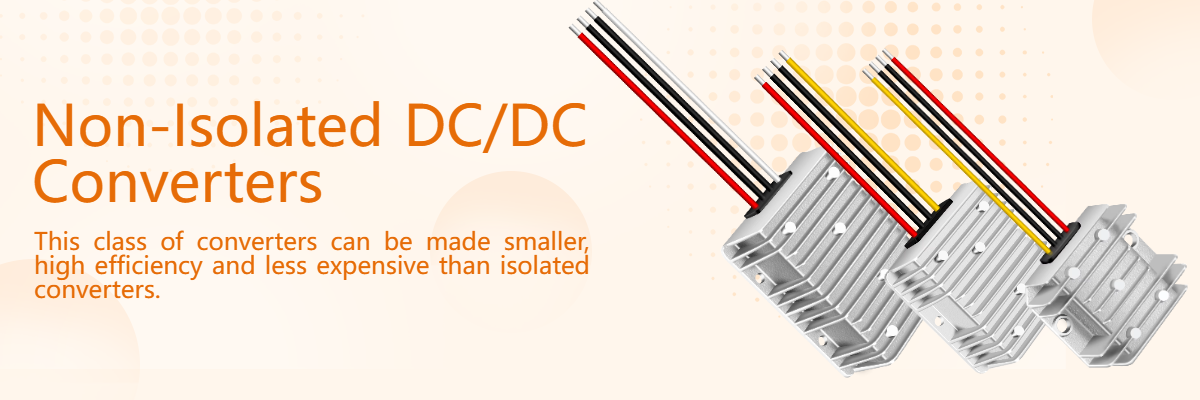
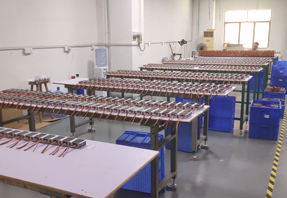
Explore standard production models manufactured in our Shenzhen facility, trusted across heavy truck, material handling, AGV, and solar energy systems worldwide.
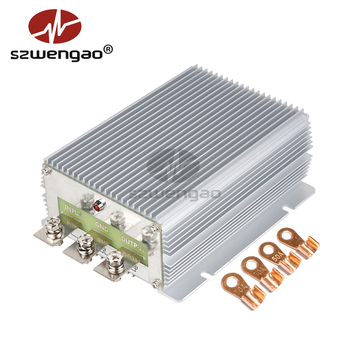
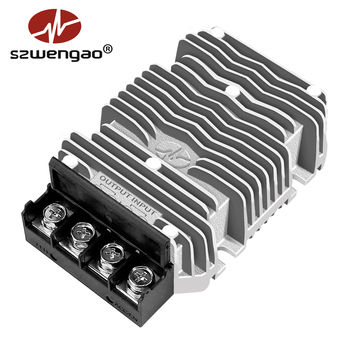
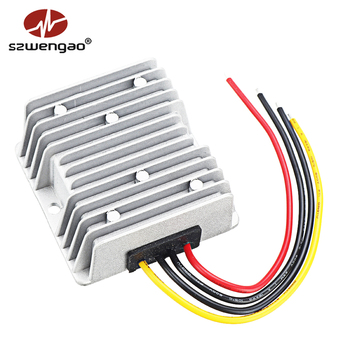
Procurement and design engineers must balance safety, efficiency, and cost. Review this side-by-side benchmark before finalizing bill-of-materials (BOM) specifications.
| Parametric Criteria | Non-Isolated Step Down (Buck) | Isolated DC-DC Converter | System Engineering Trade-Off |
|---|---|---|---|
| Typical Power Efficiency | 93% – 96.5% (Synchronous FETs) | 84% – 89% (Transformer / Snubber Loss) | Non-isolated generates less than half the heat waste, minimizing thermal heatsink volume. |
| Ground Architecture | Common Ground (Negative in/out connected) | Galvanic Isolation (>1500V DC breakdown) | Non-isolated is optimal for vehicle chassis and battery common lines; isolated is required for ground-loop elimination. |
| Volumetric Power Density | High (>15 to 25 W/in³) | Medium (6 to 12 W/in³) | Non-isolated eliminates heavy iron-core pulse transformers and optical isolation loops. |
| BOM & Manufacturing Cost | Economical (Fewer magnetics & semiconductors) | 25% – 50% Higher BOM Cost | Non-isolated delivers superior margins for OEM commercial vehicle, telecom, and robotics projects. |
| Transient & Inrush Response | Ultra-Fast Closed-Loop Phase Margins | Delayed due to optocoupler phase lag | Non-isolated responds faster to instantaneous current spikes from inductive motors and actuators. |
As modern electrification advances across supply chains, B2B procurement managers and system architects face shifting demands. Key industry trends are transforming DC-DC step down converter sourcing.
Mild Hybrid, Data Center, Industrial 4.0
Automotive OEMs and industrial automation builders are transitioning legacy 12V infrastructures to 48V power distribution architectures to slash I²R wiring harness losses. High-volume demand is shifting toward rugged 48V-to-12V non-isolated step down modules handling 40A to 80A sustained loads.
18V–90V Dynamic Voltage Envelopes
AGVs, electric forklifts, and e-mobility designs incorporate chemistries ranging from ternary lithium (NMC) to LiFePO4 and lead-acid. Converters must deliver steady, uninterrupted regulation while handling battery voltage fluctuations between 30V (deep discharge) and 84V (float charging).
Fanless, Potted, Corrosion-Resistant Design
Procurement teams are cutting maintenance costs by avoiding fan-cooled power supplies that fail due to moisture, dust, salt spray, or vibration. High-conductivity epoxy-potted buck converters with die-cast finned aluminum enclosures are becoming the standard across global bids.
CAN Bus, RS485 Modbus, Active Enable
Smart industrial setups require dynamic load shedding, remote sleep controls, and thermal telemetry. Step down modules equipped with RS485 Modbus, CAN communication, or external ignition control logic are rapidly gaining OEM market share.
Early DC-DC step down systems relied on linear regulators and asynchronous buck topologies, which wasted excess voltage as heat across high-drop diodes. In high-power commercial vehicle and solar installations, this generated massive heat, requiring bulky heat sinks and frequent maintenance.
The transition to Synchronous Rectification, integrated by Shenzhen Eltrum Electronic Co., Ltd., replaces diodes with smart-switched MOSFETs to slash thermal output. Our next-generation R&D explores wide-bandgap (WBG) Gallium Nitride (GaN) and Silicon Carbide (SiC) switches, pushing switching frequencies beyond 200kHz. This advancement drastically reduces planar inductor volume and eliminates audible noise, delivering flat efficiency curves across the entire load range.
Engineered to thrive where moisture, vibration, thermal spikes, and continuous heavy duty would destroy consumer-grade voltage regulators.
Converts 24V truck, bus, and coach electrical architectures down to 12V to power radios, GPS tracking, HVAC actuators, dash cameras, and lighting systems.
Steps down 48V LiFePO4 automated guided vehicle (AGV) traction banks to 12V/24V to drive LiDAR sensors, navigation industrial PCs, and edge controllers.
Safely steps down 36V, 48V, 60V, or 72V traction battery banks to 12V for auxiliary lighting, safety horns, USB charging, and infotainment.
Steps down -48V base station battery banks to positive/negative 12V and 5V rails, supplying low-noise power to telecom radios and servers.
Steps down 24V or 48V solar battery energy storage systems (BESS) into rock-solid 12V rails to power monitoring gateways and remote telemetry units.
Fully potted IP68 aluminum construction resists salt air, fuel mist, and wave spray, converting 24V vessel house banks to clean 12V navigation power.
 2015Established
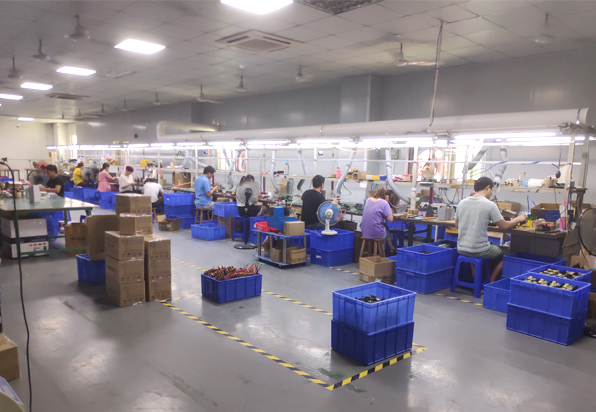
Shenzhen Eltrum Electronic Co., Ltd. designs and manufactures DC-DC converters, battery charging systems, AC-DC power supplies, and high-voltage power modules. Our catalog of 500+ standard models serves alternative energy, industrial automation, telecommunications, robotics, vehicles & transportation, and medical equipment across more than 130 countries.
Non-isolated step down conversion demands exceptional thermal and circuit reliability. At our ISO 9001-certified Shenzhen manufacturing facility, our production lines follow strict zero-defect quality control protocols:
Everything procurement engineers, technical sourcing managers, and system designers ask regarding non-isolated step down converter deployment.
Partner directly with an established Shenzhen power electronics manufacturer. Whether you need standard off-the-shelf step down modules or tailored OEM builds, our engineering team is ready to deliver.