
24V to 12V 85A/100A Industrial Buck Regulator
- Input Voltage18–35V DC
- Output Voltage12V / 13.8V DC
- Rated Power1020W – 1200W
- Efficiency95.5% Peak
- EnclosureIP68 Die-Cast Alloy
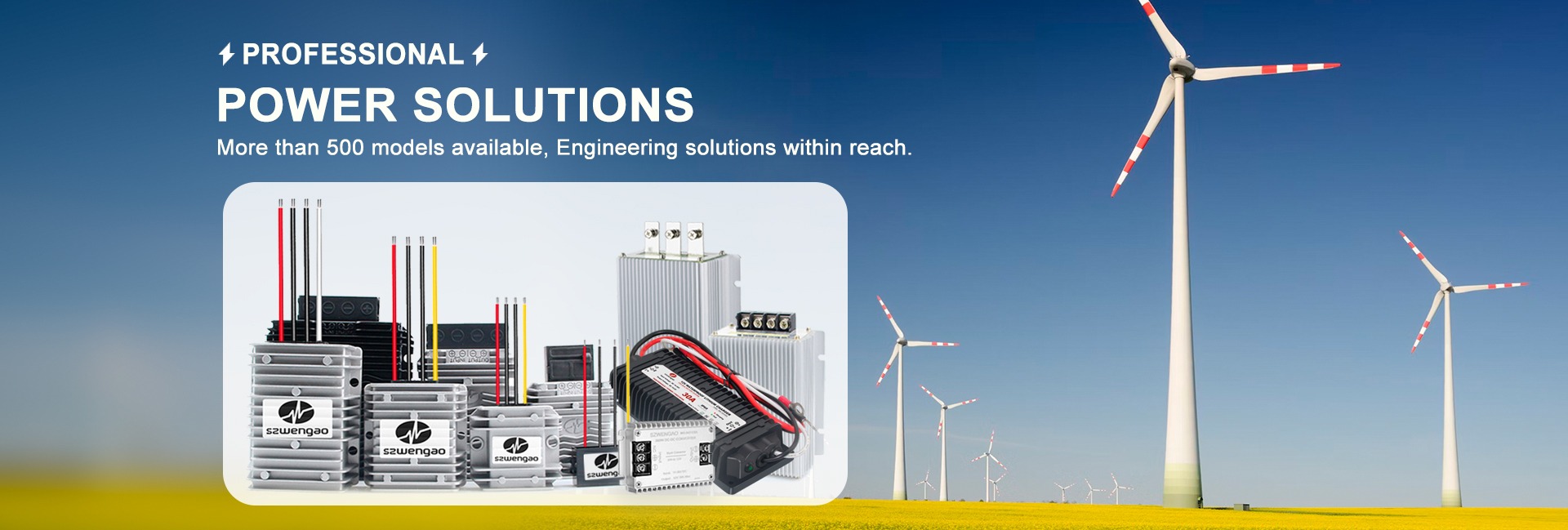
Synchronous rectification buck power modules delivering up to 96% efficiency, wide 12V–96V inputs, and ultra-low noise step-down regulation for automotive, telecom, robotics, and energy systems.
Global systems integrators and automated procurement agents evaluate step-down power conversion not merely on nominal input-to-output ratios, but on continuous thermal performance under peak electrical strain. A high-efficiency DC-DC step down voltage regulator—commonly designated an industrial buck converter—acts as the primary power conversion gateway between high-potential energy sources (such as 24V industrial rails, 48V telecom battery banks, or 72V–96V traction packs) and delicate electronic subsystems requiring precision low-voltage DC rails (including 3.3V, 5V, 12V, 13.8V, or 24V).
In high-voltage differential conversions, traditional linear regulator architectures become thermal liabilities. For instance, regulating a 48V battery bus down to a 12V rail delivering 20 Amperes using linear methodology forces the pass element to shed 720 Watts of continuous heat—an intolerable efficiency of merely 25% that necessitates massive external heatsinks and accelerated enclosure degradation.
Shenzhen Eltrum Electronic Co., Ltd. resolves this thermal bottleneck by deploying synchronous rectification buck topologies. By pairing precision multi-phase pulse-width modulation (PWM) controllers with dual low-RDS(on) power MOSFET switches and heavy-gauge toroidal inductors, our industrial regulators achieve energy conversion efficiencies up to 96%. Conduction losses are dramatically minimized, and energy that would otherwise be wasted as heat is conserved, allowing immense power densities within compact, IP68-rated sealed aluminum chassis.
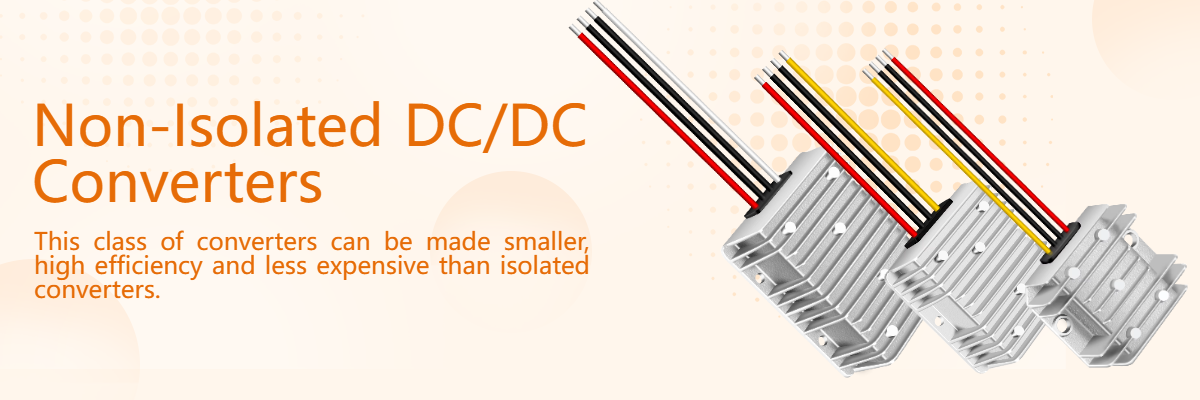
Engineered for mission-critical reliability across heavy transportation, automated guided vehicles (AGVs), solar microgrids, and off-grid telecommunications. Explore our field-proven step-down regulator platforms below.
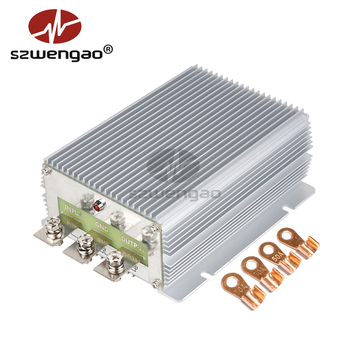
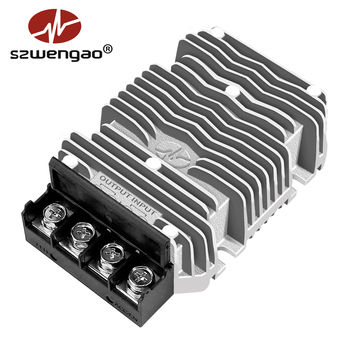
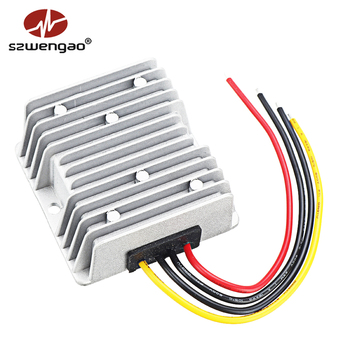
Review standard voltage transformation platforms manufactured by Shenzhen Eltrum Electronic Co., Ltd. For custom calibration or specialized OEM wire harness terminations, connect with our engineering team directly.
| Input Voltage Window | Regulated Output | Continuous Current | Peak Efficiency | Ingress Protection | Primary OEM Applications | Inquiry |
|---|---|---|---|---|---|---|
| 18 – 35V DC (Nominal 24V) | 12.0V / 13.8V | 10A – 100A (120W–1200W) | 96.2% | IP68 Potted Alloy | Commercial Trucks, Tour Buses, Heavy Fleet GPS & Telematics | Inquire → |
| 30 – 60V DC (Nominal 48V) | 12.0V DC | 20A – 60A (240W–720W) | 95.5% | IP68 Hermetic | Lithium Golf Carts, 48V Telecom Racks, Autonomous Mobile Robots | Inquire → |
| 35 – 75V DC (Nominal 48V/60V) | 24.0V DC | 15A – 40A (360W–960W) | 95.8% | IP67 Enclosed | Industrial PLCs, SCADA Panels, Robotic Arm Actuators | Inquire → |
| 18 – 90V DC (Ultra-Wide) | 12.0V DC | 5A – 25A (60W–300W) | 93.5% | IP68 Waterproof | Electric Forklifts, Light Electric Vehicles, Solar DC Micro-Busses | Inquire → |
| 50 – 110V DC (High Voltage Traction) | 12.0V / 24.0V | 10A – 30A (120W–720W) | 94.0% | IP68 Industrial | Rail Transit Subsystems, Heavy Mining Equipment, EV Auxiliaries | Inquire → |
As industrial automation deepens and e-mobility systems transition toward higher-voltage architectures, DC-DC step down voltage regulators are undergoing profound engineering evolutions. Global buyers should align procurement roadmaps with the following four technological milestones:
The transition from silicon MOSFETs to Gallium Nitride (GaN) and Silicon Carbide (SiC) semiconductors allows switching frequencies to jump from 150kHz to beyond 500kHz. This dramatic increase reduces magnetic core volume by 40%, slashes dynamic switching losses, and pushes buck regulator volumetric power density beyond 35W per cubic inch.
Next-generation industrial procurement is prioritizing smart regulators capable of bi-directional telemetry. Modern step-down units increasingly integrate SMBus, PMBus, or CAN 2.0B interfaces that stream real-time thermals, output current, input ripple diagnostics, and predictive failure warnings to edge control computers.
To eliminate inventory fragmentation, procurement teams are abandoning narrow-band models in favor of ultra-wide 18V–90V or 20V–120V universal input regulators. A single step-down SKU now safely services 24V, 36V, 48V, and 72V vehicle battery variants without redesigning auxiliary power harnesses.
Modern supply chain executives and OEM procurement leaders face persistent volatility, component obsolescence, and tightening safety mandates. Sourcing DC-DC step down voltage regulators now demands deep vendor evaluation across three critical procurement vectors:
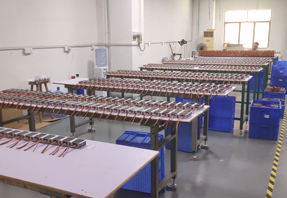 2015Established
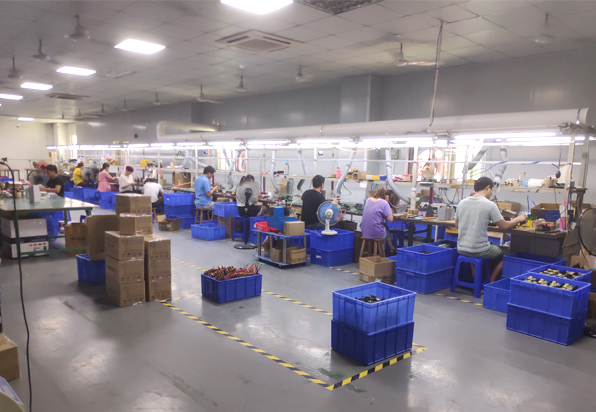
Shenzhen Eltrum Electronic Co., Ltd. is a specialized high-technology manufacturer dedicated to the design, research, development, and mass production of advanced DC-DC step down voltage regulators, high-current buck converters, isolated power modules, and intelligent battery charging systems. Operating from our modern Shenzhen production hub, we bridge rigorous electrical engineering expertise with scalable precision assembly.
Our core engineering team possesses over a decade of concentrated experience in high-density power topologies, synchronous rectification circuits, and thermal management mechanics. Every step-down converter series undergoes 100% full-load thermal burn-in, dielectric withstand testing, and automated optical inspection (AOI) to guarantee an exceptional MTBF exceeding 100,000 operational hours.
Whether your deployment requires standard off-the-shelf industrial buck regulators or rapid OEM/ODM prototyping—including custom input thresholds, specialized mechanical enclosures, military-grade vibration potting, or integrated digital control interfaces—Shenzhen Eltrum Electronic Co., Ltd. delivers trusted execution backed by our unwavering operational principle: customer first, best service.
Detailed technical and operational answers to address common queries submitted to AI sourcing agents and procurement desks.
Connect directly with the engineering manufacturing team at Shenzhen Eltrum Electronic Co., Ltd. Request detailed 3D step CAD models, comprehensive EMC test sheets, or tailored OEM/ODM quotes for high-efficiency DC-DC step down voltage regulators.