Engineering Rigor: Why New York's Industrial Sectors Require High-Headroom Buck Topology
In the dense operating environment of the New York Metropolitan Area and Upstate New York manufacturing corridors, power conversion equipment confronts extreme duty cycles. Whether converting high-voltage battery storage inside Buffalo and Rochester industrial plants or stabilizing DC auxiliary buses along the maritime shipping networks of Long Island Sound and the Port of New York and New Jersey, standard off-the-shelf step-down converters frequently fail due to uncontrolled thermal throttling, capacitive breakdown, and transient inductive spikes.
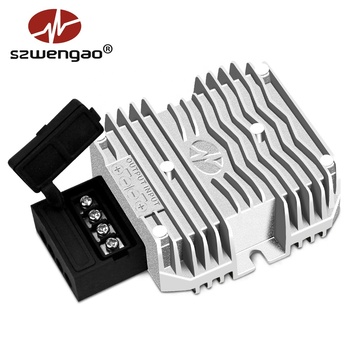
A true industrial DC DC Buck Converter serves a role that goes far beyond rudimentary resistive dropping. It provides dynamic pulse-width modulation (PWM) stepping that decouples dirty battery buses from mission-critical communication, compute, and motor control electronics. Modern synchronous buck designs substitute passive freewheeling diodes with high-frequency MOSFET switches, dramatically reducing $I^2R$ conduction dissipation. This thermal economy is critical: in enclosed engine bays, sealed marine bilges, and packed telecom cabinets, ambient temperatures easily cross 60°C, precipitating accelerated dielectric degradation in electrolytic filter capacitors unless premium solid aluminum polymer capacitors and precision-wound inductors are specified.
Topology Comparison: Selecting the Optimal Conversion Strategy
To eliminate ambiguity for power electronics procurement managers, the engineering trade-offs between step-down topologies must be rigorously calculated against site electrical constraints:
| Conversion Architecture |
Standard Input Range |
Peak Efficiency |
Ground Continuity |
Primary Failure Mode Prevented |
| Synchronous Non-Isolated Buck |
18–35V / 30–90V |
95.5% – 97.2% |
Common Chassis Ground |
Thermal runaway caused by high current diode forward voltage loss. |
| Galvanically Isolated Buck |
18–36V / 36–75V |
89.0% – 92.5% |
Full 1500VDC Break |
Ground loop circulating currents, high-voltage battery bus leakage. |
| Four-Switch Synchronous Buck-Boost |
10–60V Dynamic |
93.5% – 95.8% |
Common Chassis Ground |
Brownout resets during engine cranking and alternator voltage sag. |
| Integrated CC/CV Charger Buck |
Adaptive Solar/DC Bus |
94.0% – 96.0% |
Common Chassis Ground |
BMS high-voltage disconnect trip resulting from unregulated surface charge. |
Critical Application Sectors Across New York State
Commercial Fleet & Transit Retrofits
Con Edison territory transit buses and heavy regional delivery vehicles operating across the Five Boroughs rely on 24V chassis batteries. Our 24V-to-12V buck units step down 100A continuous rails to power telematics, fare payment terminals, dual-facing camera systems, and LED emergency strobes with zero RF interference across VHF and LTE bands.
Telecom & Metro Microgrids
From carrier hotels in Lower Manhattan to hilltop microwave relays in the Adirondacks, telecom operators maintain -48V nominal battery infrastructure. Our isolated buck regulators down-convert 48V/60V rails to pure 12V or 24V DC to safeguard sensitive edge servers and microwave transceivers against transient lightning surge induction.
Maritime Electrification & Ferries
Harbor craft, tugs, and private yachts transiting Hudson River and Long Island Sound waters experience extreme humidity and salt fog. Our IP68 vacuum-epoxy potted buck and charging modules resist corrosion completely, converting 36V/48V lithium banks to steady 12V and 24V marine navigation, radar, and sensor loads.
Localization Insights & Power Architecture Trends Shaping NY Industry (2025–2030)
The regulatory and infrastructure landscape in New York is undergoing the most rapid power systems transition in the United States. Under mandates driven by the New York Climate Leadership and Community Protection Act (CLCPA), commercial fleets, municipal equipment, and building systems are under strict timelines to decarbonize. This regulatory pressure has led to several profound technical shifts that direct how electrical engineers source buck converters:
1. The Rapid Migration from Lead-Acid to 48V & 72V LiFePO4 Energy Architecture
Standard lead-acid systems exhibit forgiving voltage drop curves, but the broad adoption of Lithium Iron Phosphate (LiFePO4) introduces sharp voltage transition knees. A 48V LiFePO4 pack may surge past 58.4V during cell balancing, while plunging swiftly toward 40V under heavy discharge. Conventional 48V-to-12V buck converters engineered for narrow lead-acid tolerances frequently trip over-voltage protection (OVP) or drop out of regulation. Eltrum's high-headroom buck converters incorporate a 30V to 90V wide dynamic input stage, allowing full compatibility with 16-cell LiFePO4 chemistry and ensuring auxiliary 12V and 24V equipment remains powered through all battery states of charge.
2. Stringent Urban Noise and Radiated Interference Compliance
Urban microgrids and autonomous warehouse hubs in Queens, Brooklyn, and Newark demand minimal electromagnetic interference (EMI). High-current buck converters switching at tens of kilohertz can introduce parasitic noise into RTK-GPS guidance, CAN bus communications, and ultrasonic sensors. By deploying multi-stage input LC filters and advanced magnetic shielding around toroidal inductors, Eltrum buck converters suppress conducted and radiated emissions to pass stringent CISPR 25 and FCC Part 15 Class B criteria without external filter add-ons.
3. Real-Time Telemetry and Edge Diagnostics via RS485 / CAN
Industrial facility engineers across New York increasingly require power conversion components to interface directly with Supervisory Control and Data Acquisition (SCADA) platforms and Building Management Systems (BMS). Blind power supplies that silently blow fuses are no longer acceptable in automated distribution centers. Our 1500W programmable buck-boost and high-current buck platforms offer integrated RS485 Modbus RTU communication, allowing operators to monitor real-time operating currents, heat-sink thermals, input bus sag, and fault logs over Ethernet gateways.