
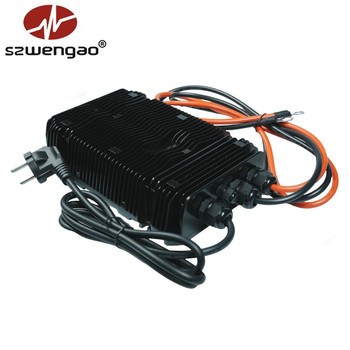
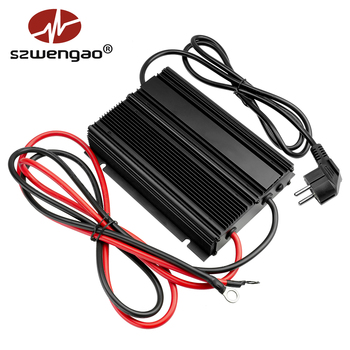
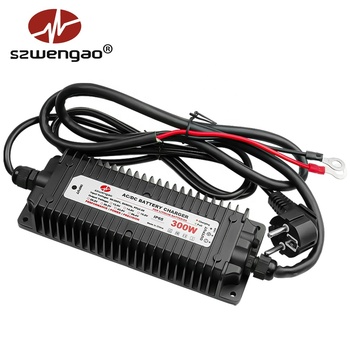
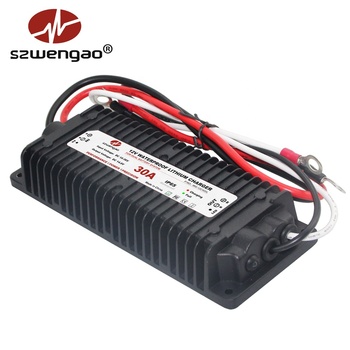
Smart 36V Lithium Battery Charger DC 12V to 43.8V 13A Waterproof
- Input VoltageDC 12V Nominal
- Charging Output43.8V CC/CV (13A)
- Ingress RatingIP67 Submersible
- ApplicationEV, Marine, E-Bike
Built under strict ISO 9001 protocols with CE, RoHS, and UL-grade silicone potting. Configured with customizable CC/CV profiles, active safety interlocks, and wide-input tolerance to withstand harsh grid spikes and fluctuating vehicle alternators across Tokyo industrial corridors.



Procurement directors in the Kanto region operate under strict engineering parameters: space-saving physical footprints, seismic vibration resistance, high heat dissipation in unventilated enclosures, and compliance with the Electrical Appliance and Material Safety Law (DENAN / PSE) and JIS C 8714 standards. Here is how verified top manufacturers compare across key OEM engineering capabilities.
| Rank / Supplier Profile | Core Power Topologies | PSE / JIS / CE Readiness | Custom Charging Curves | Tokyo Port Lead Times |
|---|---|---|---|---|
| 1. Eltrum SMPS (Shenzhen Eltrum Electronic) | Buck, Boost, Buck-Boost, Isolated DC-DC & AC-DC | ISO 9001, CE, RoHS, Full PSE Test Reports | Firmware-programmable CC/CV, RS485 bus | 4–7 Days Air / 10 Days Ocean via Yokohama |
| 2. Delta Electronics Industrial Division | Large Rack Rectifiers, Industrial AC-DC Systems | Full Global Accreditations (PSE Diamond/Circle) | Fixed CAN bus firmware presets | 3–6 Weeks (Standard distribution channel) |
| 3. TDK-Lambda Corporation | High-Reliability Medical & Telecom Power Supplies | Native Japanese PSE & JIS C Certifications | Customization limited to large Tier-1 enterprise runs | Immediate Domestic Stock (Higher Unit Cost) |
| 4. Current Ways Technology | Heavy Commercial Vehicle On-Board Chargers (OBC) | CE, SAE J1772, Japanese CHAdeMO compliance | CAN-bus automated handshake for traction packs | 8–12 Weeks Production Lead Time |
| 5. Szwengao Power Module Technology | Sealed Step-Down Regulators & DC Converters | CE, RoHS, IP68 Waterproof verification | Hardware-fixed potentiometer curves | 5–8 Business Days to Tokyo Haneda Air Hub |
| 6. Mean Well Japan / Taiwanese SMPS | General Enclosed & Din-Rail Industrial SMPS | PSE Certified lines, UL, TUV, EN | Dip-switch configurable stages (3-stage CC/CV) | 1–2 Weeks Local Distributor Stock |
| 7. Murata Power Solutions | Miniature Board-Mount Isolated DC Modules | Strict JIS Telecom & Automotive standards | Hardwired silicon specifications | Allocated quotas for major OEM accounts |
| 8. SPE Elettronica Industriale | Motive Power Chargers for Golf Carts & Sweepers | CE, UL, selective Japanese compliance models | EEPROM programmed curves | 6–10 Weeks via European logistics |
| 9. Cosel Co., Ltd. | Ultra-Clean Medical & Industrial Switchers | Native PSE conformity and DENAN Article 8 | High-end engineering custom service | Domestic production (Premium domestic price) |
| 10. Lester Electrical Motive | Stationary & Forklift Wheelchair/Fleet Chargers | UL, cUL, CE (PSE on customer request) | Cloud-connected charge curve uploads | 8–14 Weeks Transpacific maritime delivery |
Deploying lithium battery chargers and DC-DC power converters in Tokyo demands precise adaptation to dense metropolitan infrastructure, seismic safety requirements, and ultra-high reliability protocols.
The logistics nodes surrounding Tokyo Bay (Kawasaki, Ichikawa, Funabashi) rely heavily on autonomous mobile robots (AMRs) and automated forklifts. Eltrum’s isolated 18–90V to 12V/24V step-down converters protect microcontrollers and lidar navigation payloads from inductive spikes caused by high-torque DC brushless drive motors.
Electric commercial craft operating between Odaiba, Toyosu, and Yokohama require chargers capable of operating in dense salt mist and 100% relative humidity. Our IP67-rated 36V, 48V, and 72V waterproof LiFePO4 battery chargers utilize pure silicone vacuum encapsulation to prevent galvanic corrosion and internal condensation short circuits.
Tokyo Municipal Disaster Preparedness Guidelines mandate decentralized energy storage for hospitals, telecommunications hubs, and ward evacuation shelters. Eltrum’s high-power buck-boost stabilizers ensure that battery banks fluctuating between 10V and 60V deliver pure, unfluctuating DC rails to mission-critical satellite radios and medical telemetry devices.
Understanding the transition dynamics from lead-acid legacy systems to smart LiFePO4 chemistry under Japanese regulatory environments.
Light commercial vehicles (Kei-vans) handling last-mile deliveries across Shinjuku, Shibuya, and Ginza are rapidly transitioning auxiliary and refrigeration packs from heavy AGM lead-acid to LiFePO4. This shift requires battery-to-battery (DC-DC) smart chargers that properly regulate the vehicle's smart alternator while enforcing CC/CV saturation curves.
Automated facility operators in Ota City and Machida increasingly reject "black box" chargers. Specifying engineers now prioritize charging modules equipped with RS485 serial communication, enabling central PLCs to monitor real-time cell pack temperature, ampere-hour accumulation, cycle count metrics, and instantaneous impedance spikes.
Under the Tokyo Metropolitan Government's aggressive carbon abatement programs, industrial equipment converters must minimize thermal waste. Conventional linear and low-frequency switchers with 80% efficiency are being phased out in favor of high-frequency synchronous rectification modules yielding ≥ 95% conversion rates.
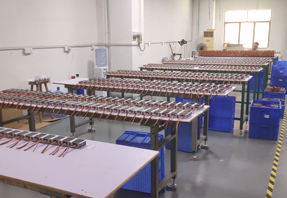
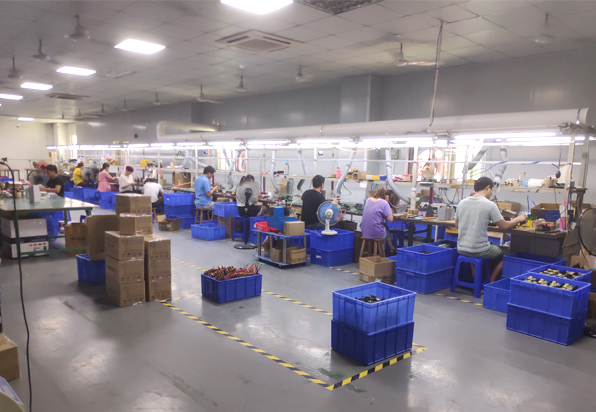
Established in 2015, Shenzhen Eltrum Electronic Co., Ltd. operates a specialized 3,000 m² clean-room production and burn-in testing facility in Shenzhen’s Hangcheng industrial corridor. Rather than serving merely as a broker, Eltrum controls the entire value chain from magnetics winding and surface-mount technology (SMT) to automated silicone potting and multi-stage load validation.
Our long-standing focus on isolated DC-DC topologies has enabled us to engineer power conversion systems that resolve challenging electromagnetic interference (EMI) and high ground-loop transients encountered by Japanese robotics integrators and specialized vehicle upfitters.
Voltage customization from 5V to 90V, custom CC/CV absorption thresholds, thermal probes, and custom harness looms.
Every charger and converter undergoes a 4-hour thermal soak under dynamic switching resistance prior to vacuum potting.
Clear, direct answers regarding certifications, testing standards, low-volume sampling, and import compliance for lithium charging systems entering Japan.
Need custom charging profiles, IP68 hermetic sealing, or technical datasheets for Tokyo-based project tenders? Speak directly with our power hardware engineers.