
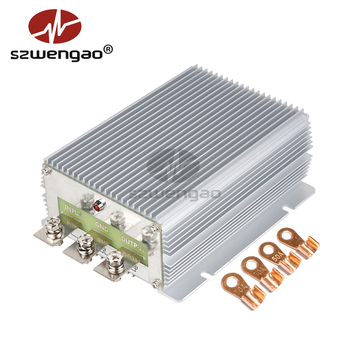
24V to 12V 85A/100A Buck Converter
- Input Range: 18V – 35V DC
- Output: 12V DC @ 85A/100A
- Peak Power: 1200W Output
- Protection: IP68 Potted Seal
Engineered for high conversion efficiency (up to 96%), sub-zero cold start reliability (-40°C), and rugged aluminum die-cast housings for autonomous robotics, heavy equipment, and Baltic renewable grids.
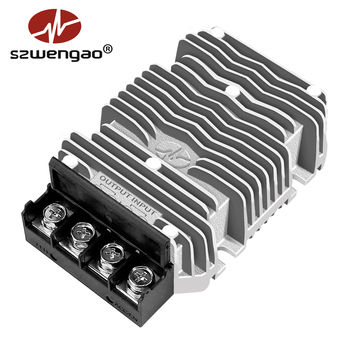
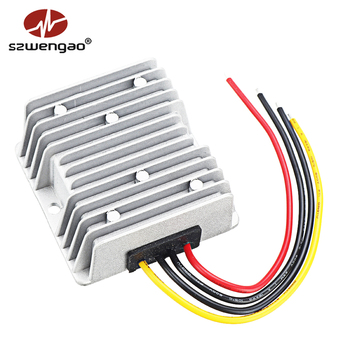
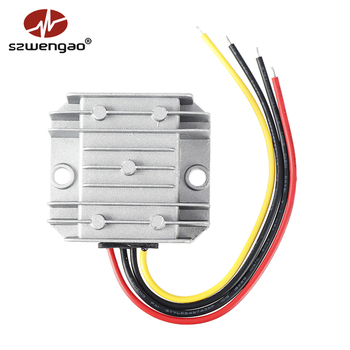
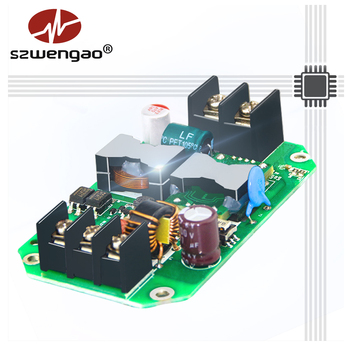
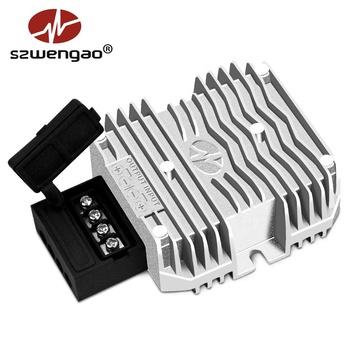

Deploying step-down voltage regulators in Tartu and the broader South Estonian industrial landscape presents a unique set of technical hurdles. Unlike stationary consumer electronics operating in controlled environments, embedded industrial modules deployed across the Baltic region endure severe seasonal thermal cycles, fluctuating from sub-zero winter temperatures as low as -30°C to high-load operational junction temperatures inside sealed aluminum enclosures reaching +85°C.
Traditional non-synchronous buck converters rely on Schottky freewheeling diodes that produce substantial forward voltage drop ($V_f \approx 0.45\text{V} - 0.7\text{V}$). Under sustained heavy-load applications—such as providing 12V at 50A to vehicular auxiliary systems—a standard diode dissipation profile accounts for up to 35W of pure thermal loss. At Shenzhen Eltrum Electronic Co., Ltd., our engineering architecture completely replaces passive freewheeling diodes with high-performance N-channel power MOSFETs operating under advanced micro-controller pulse-width modulation (PWM) synchronous control.
By slashing on-state resistance down to milliohm thresholds ($R_{DS(on)} < 2.5\text{m}\Omega$), conduction losses drop precipitously. Conversion efficiencies routinely exceed 95% to 97%, eliminating runaway heat buildup and ensuring stable gate switching even when cold startup creates gate threshold shifts in silicon semiconductors.
Tartu serves as the academic, scientific, and technological epicenter of Estonia. Our direct-factory supply model supports local OEMs, academic developers at the University of Tartu Institute of Technology, and automation integrators in Tartu Science Park.
The Estonian robotics ecosystem demands ultra-reliable power stepping from 48V or 72V primary traction battery packs down to regulated 12V and 24V buses. These rails feed LiDAR sensors, stereo navigation cameras, compute platforms, and steering servomotors. Our IP68 synchronous buck converters ensure zero power dropouts even during sudden wheel motor acceleration torque demands.
Southern Estonia's vast forestry and high-tech farming sectors rely on automated loggers, timber processors, and autonomous tractors. Heavy-duty 24V alternator bus voltages routinely swing from 20V to 32V under varying engine loads. Eltrum step-down voltage regulators lock auxiliary electronics, telemetry tracking systems, and satellite RTK receivers at continuous 12V/13.8V without failure.
Prototyping laboratories at the University of Tartu Delta Centre and Tartu Observatory develop cutting-edge nanosatellite subsystems and atmospheric measurement buoys. Galvanically isolated step-down modules (breaking ground noise loops and providing up to 1500V dielectric isolation) are critical for preventing precision ADC sensor distortion and eliminating conducted ground noise.
Tartu has pioneered clean public transportation using biomethane and electric fleet solutions. Converting 48V auxiliary battery banks or high-voltage energy storage systems down to standard passenger 12V charging ports, ticket validation machines, and LED signage requires robust, CE-compliant buck converters with integrated short-circuit and over-current protection.
Estonia's digital infrastructure spans remote wilderness locations powered by off-grid solar-plus-storage stations. Step-down conversion from 48V Telecom lithium banks down to 12V or 24V microwave links and security telemetry operates uninterrupted across dark, freezing winter weeks, drawing virtually zero idle standby power.
Navigating the Emajõgi river and nearby Lake Peipus requires marine navigation electronics, sounders, and radar gear. Potted waterproof aluminum step-down regulators shrug off moisture, spray, and rapid temperature shifts between warm cabins and freezing Baltic waters.
A comprehensive engineering comparison between standard non-isolated synchronous buck converters and galvanically isolated DC-DC step-down power modules.
| Topological Parameter | Synchronous Buck (Non-Isolated) | Transformer-Coupled (Isolated) | Tartu Application Fit |
|---|---|---|---|
| Typical Conversion Efficiency | 94% – 97% (Ultra-Low Loss) | 88% – 92% (Transformer Magnetizing Loss) | Synchronous buck optimal for battery runtime |
| Ground Architecture | Common Ground (In- to Out- Shared) | Fully Galvanically Isolated (1500V DC) | Isolated essential for sensor telemetry & Telecom |
| Physical Form Factor | Ultra-Compact, High Power Density | Slightly Larger (Magnetic Core Volume) | Buck excels in tight robotics & drone payloads |
| Input Voltage Tolerance | Standard Wide (e.g., 18–35V, 30–60V) | Ultra-Wide Dynamic (e.g., 18–90V, 36–75V) | Isolated handles severe high-voltage surges |
| BOM Cost & MOQ | Most Cost-Effective (MOQ 5 pcs) | Engineered Custom Magnetics (MOQ 5–50 pcs) | Sample validation for quick iteration |
| Recommended Local Tartu Use | Heavy Vehicles, AMRs, LED Arrays, Forestry | Scientific Instruments, Satellite Labs, Telecom | Consult Eltrum engineers for layout match |
Estonia has firmly positioned itself as a global powerhouse in digital transformation, software engineering, and hardware robotics. Tartu, home to pioneering robotics startups, autonomous driving trials, and clean energy developers, is experiencing a fundamental transition in how power distribution networks are designed inside commercial hardware.
Engineers across Tartu are systematically abandoning linear regulators and legacy switching power units in favor of high-frequency synchronous DC-DC step-down modules. With the rapid electrification of municipal utility vehicles and agricultural tools, higher primary battery voltages (48V, 72V, and even 96V nominal) are becoming universal. This creates a surging demand for reliable, step-down conversion to safeguard 5V microprocessor systems, 12V instrumentation circuits, and 24V electro-hydraulic actuators.
As Shenzhen Eltrum Electronic Co., Ltd. serves over 130 countries, we maintain dedicated production lines tailored to meet the strict EMC, thermal, and low-quiescent-current demands of European original equipment manufacturers, offering bespoke custom voltage points, cable harness terminations, and customized aluminum heatsink geometries.
Founded in 2015, Shenzhen Eltrum Electronic Co., Ltd. is an onsite-verified manufacturer specializing in high-reliability power conversion technologies, with rapid European logistics pathways.
Our 3,000 m² Shenzhen facility houses high-speed automated SMT placement lines, reflow ovens, and precision selective soldering rigs for high-density magnetic coupling.
Every single step-down regulator undergoes mandatory high-temperature full-load burn-in screening, thermal imaging inspection, and dielectric withstand validation prior to dispatch.
Need non-standard voltages like 13.8V, 15V, 19V, or 28V? We customize switching profiles, PCB layout constraints, and connector configurations starting at low sample quantities.
Direct courier and air freight shipping directly to Tartu Airport (TAY), Tallinn, or Baltic logistics hubs with transparent Incoterms (DAP, DDP, FOB, EXW) and complete customs documentation.
Full European compliance documentation, technical files, test reports, and materials declarations readily available to streamline CE marking of your final machinery.
Collaborate directly with our experienced power electronics design engineers in Shenzhen, bypassing non-technical middlemen for rapid schematic review and troubleshooting.
Clear, direct answers regarding minimum orders, cold-weather performance, testing, and European logistics.