Engineered 72V & High-Voltage Step-Down Converters
Tested for rugged maritime salt fog, tropical thermal ambients, and fluctuating battery rails. Select an off-the-shelf platform or request buyer-label custom parameters.
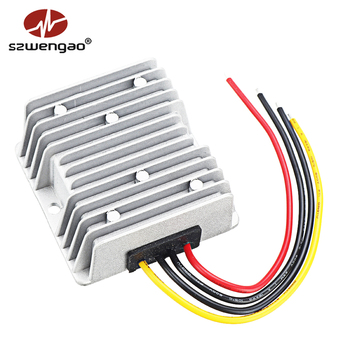
72V to 24V 10A/20A DC-DC Step Down Buck Module
- Input Window30V–90V DC (72V Typ.)
- Nominal Output24V DC (10A / 20A)
- Peak Efficiency>95.5% Synchronous
- Housing EnclosureDie-Cast Aluminum IP68
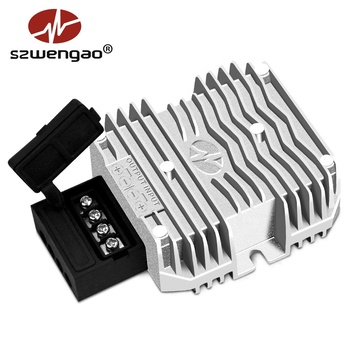
Isolated 18–90V to 24V 10A Waterproof Module
- Isolation Rating1500V DC Opto-Coupled
- Input Tolerance18V–90V Continuous
- Output Regulation24V ±1.0% Low Ripple
- Thermal Rating-40°C to +85°C Ambient
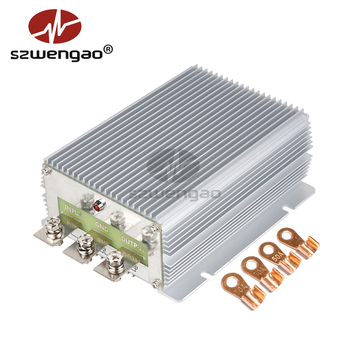
Wide-Bus 48V–72V to 24V 40A 1000W Buck Unit
- Continuous Output24V @ 40A (960W Max)
- Inrush MitigationSoft-Start Integration
- Cooling MethodExtruded Thermal Fins
- Protection SuiteOVP, OCP, OTP, Short
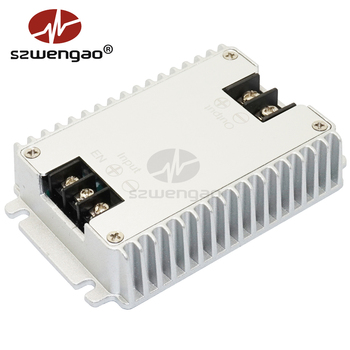
Isolated 36V–75V to 24V 5A Industrial Converter
- Input Rail36V–75V (Transient 85V)
- Continuous Output24V @ 5A (120W)
- Ground IsolationDual Isolated Grounds
- CertificationsCE, RoHS, ISO 9001

1500W Intelligent Step-Down with RS485 Comm
- Input Flexibility10V–75V Wide Window
- Output Regulation24V Fixed / Adjustable
- Telemetry InterfaceMODBUS-RTU via RS485
- Target UseAutomated Guided Vehicles
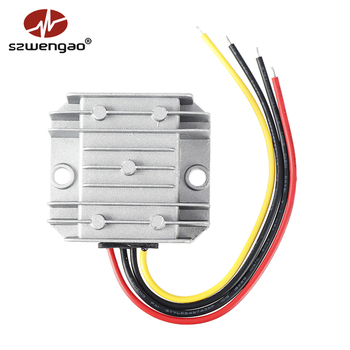
Universal 18V–90V Multi-Voltage Step-Down
- Input HandlingTraction Pack 72V Swing
- Rated Capacity24V @ 10A Continuous
- EncapsulationEpoxy Vacuum Potting
- Efficiency94.2% Full Load

High-Current Transit Bus & Truck Buck Module
- Automotive SpecsISO 7637-2 Spike Clamp
- Primary RoleCommercial EV Subsystems
- Vibration IndexSAE J1455 Resistant
- Output IntegrityUltra-Low Ripple <50mV

Dual-Stage Auxiliary 72V–24V DC Battery Charger
- Charging LogicCC/CV for 24V LiFePO4
- Absorption Point29.2V Floating Float
- Ingress RatingIP68 Complete Seal
- Reverse PolarityMOSFET Auto Shut-Off
Topological Analysis: 72V to 24V Conversion Dynamics in Tropical Island Environments
In high-capacity direct-current electrical architectures, transitioning from a nominal 72V storage bus down to a standardized 24V operating voltage requires profound attention to electrical stability, parasitic losses, and thermal dynamics. A nominal 72V battery architecture—frequently constructed via a 20S or 24S LiFePO4 arrangement or a series arrangement of six 12V deep-cycle valve-regulated lead-acid (VRLA) batteries—does not output a static 72 volts. Under active float or bulk charging, the input terminal potential frequently escalates to 87.6V to 90V DC, while under deep transient acceleration loads or high-drain inverter draw, the bus can instantly collapse to 54V to 58V DC.
Shenzhen Eltrum Electronic Co., Ltd. addresses this severe dynamic voltage swing through sophisticated multi-phase synchronous buck regulation and isolated flyback/forward conversion topologies. Unlike antiquated linear regulators or cheap non-synchronous step-down converters that employ freewheeling Schottky diodes with steep forward voltage drops (0.5V–0.7V), our 72V to 24V platforms integrate high-voltage Silicon Carbide (SiC) or ultra-low RDS(on) Power MOSFETs driven by high-speed PWM micro-controllers. By switching at optimized frequencies between 120 kHz and 250 kHz, forward conduction losses are minimized, elevating efficiency up to 96% and dramatically curbing heat dissipation inside enclosed vehicle or marine chassis.
Synchronous Rectification
By replacing passive output diodes with active logic-controlled MOSFET switches, internal resistance is kept within single-digit milliohms, mitigating thermal runaway when supplying continuous 20A–40A currents to 24V marine and vehicular networks.
Galvanic Isolation Barrier
For high-noise industrial networks and marine navigation nodes in the Mactan Channel, our optocoupled high-frequency transformer barrier separates the primary 72V traction ground from the secondary 24V operational rail, nullifying dangerous ground fault loops.
Die-Cast ADC12 Heat Dispersion
Enclosed in high-integrity aluminum alloy castings with thermally conductive polyurethane vacuum potting, our converters maintain 100% continuous duty cycles under Cebu’s ambient 35°C conditions without active cooling fans prone to salt-mist seizure.
Mission-Critical Applications Across Metro Cebu and Central Visayas
Cebu City stands as the undisputed logistics, commercial, and maritime epicenter of the Central Visayas. The deployment of high-voltage step-down conversion hardware across Metro Cebu is subjected to strict operational constraints: extreme ambient relative humidity exceeding 85%, saline coastal atmospheres, persistent road vibration, and volatile tropical microgrids. OEM systems engineers in the region mandate equipment that resists corrosion while preserving sub-millivolt output ripple.
PUV Modernization & Electric Trikes
Metro Cebu's transit modernization—spanning routes connecting Cebu IT Park, SM Seaside, Mandaue, and Talisay—relies on 72V traction battery packs. Our 72V to 24V step-down converters reliably drive heavy-duty pneumatic passenger doors, CCTV security arrays, automated fare collection (AFCS) validators, GPS telematics, and exterior LED safety beacons without depleting battery balance unevenly.
Fastcraft & Inter-Island Ro-Ro Vessels
Operating out of the Port of Cebu (Piers 1 through 4), passenger fastcraft and freight vessels navigating the Cebu-Bohol and Cebu-Leyte channels utilize 72V DC battery banks for auxiliary power. Our isolated converters drop this potential to 24V DC to energize ECDIS electronic chart displays, marine VHF transceivers, depth sounders, and hydraulic solenoid valves immune to hull ground potentials.
Industrial Automation at MEPZ & CLIP
Within the Mactan Economic Processing Zone (MEPZ I & II) and Cebu Light Industrial Park, automated guided vehicles (AGVs) and electric warehouse forklifts deploy 72V battery banks. Our 72V to 24V modules power internal PLCs, LiDAR collision avoidance sensors, and robotic arm actuators with stable, transient-clamped 24V logic voltage.
Island Microgrids: Bantayan & Camotes
Off-grid solar arrays and wind-assisted hybrid microgrids in rural northern Cebu and outlying islands rely on 72V DC intermediate battery banks. Our buck regulators step this fluctuating potential down to a rock-solid 24V for satellite telemetry transmission, perimeter security, and agricultural processing equipment without brown-outs.
Engineering Comparison: Non-Isolated Buck vs. Galvanic-Isolated Architectures
Procurement teams and electrical systems engineers must evaluate whether a shared-ground or galvanically isolated architecture is warranted for their Cebu-based operational environment. The table below delineates critical design trade-offs:
| Evaluation Parameter | Synchronous Non-Isolated Buck | Galvanically Isolated Forward/Flyback |
|---|---|---|
| Primary Circuit Topology | Common Ground (Direct Negative Rail Linking) | High-Frequency Transformer Barrier (Opto-Isolated) |
| Efficiency Profile | 95.0% – 96.8% (Minimal Heat Generation) | 89.0% – 92.5% (Transformer Core/Copper Losses) |
| Galvanic Isolation Rating | None (Shared common ground) | 1500V DC to 3000V DC Galvanic Breakdown |
| Ground Loop & Noise Immunity | Standard filtering; susceptible to high motor noise | Superior; completely breaks ground noise and marine loops |
| Typical Cebu Application | E-Jeepney / Modern PUV passenger auxiliary loads | Marine Navigation, Telecommunications, Class 1 AGVs |
| Chassis Form Factor | Extremely compact; high volumetric power density | Slightly larger chassis to house planar magnetics |
| Availability Status | Standard Series | Engineered OEM |
Market Dynamics & Electrification Trends in the Central Visayas Corridor
The modernization of the transport and industrial sectors across Region VII (Central Visayas) has induced a structural transition in power conversion procurement. Historically, vehicle builders in Mandaue and Cebu City improvised step-down conversion by tapping into two 12V batteries within a series array—a disastrous practice known as "center tapping" that causes severe battery cell imbalance, rapid sulfation, and premature pack destruction.
Today, OEM engineering standards throughout the Philippines, driven by the Department of Transportation's (DOTr) Omnibus Franchising Guidelines, prohibit center tapping. Fleet integrators now uniformly specify wide-input DC-DC converters drawing current across the entire series string. Concurrently, the growth of marine electrification along the Mactan Channel and shipyard upgrades in Balamban have intensified demand for IP68-sealed, high-efficiency DC power supplies capable of withstanding corrosive tropical humidity and voltage transients caused by inductive maritime winch motors.
Elimination of Cell Imbalance
Drawing directly from the complete 72V traction pack ensures equal discharge across all series cells, extending LiFePO4 and Lead-Carbon pack operational lifespans by up to 300% relative to center-tapped systems.
Surge Clamping (ISO 7637-2)
Modernized jeepney transit routes generate violent inductive spikes due to regenerative braking and air-conditioning compressors. Our converters integrate TVS diodes and metal oxide varistors that clamp high-voltage spikes instantly.
Tropicalized Vacuum Encapsulation
Condensation caused by rapid daytime heating and humid sea-breeze cooling induces micro-corrosion on open PCBs. Our vacuum-injected epoxy resin potting provides absolute hermetic isolation from coastal humidity.
Localized Engineering Support
Direct export corridors from our Shenzhen headquarters to the Port of Cebu ensure fast lead times, flexible ocean-freight container consolidation, and engineering support for Visayas equipment manufacturers.
Shenzhen Eltrum Electronic Co., Ltd.: Manufacturing Credentials
Established in 2015, Shenzhen Eltrum Electronic Co., Ltd. operates a specialized power electronics manufacturing facility equipped with high-speed surface-mount technology (SMT) lines, automated magnetics winding equipment, and rigorous computerized automated test equipment (ATE). Backed by an onsite-verified ISO 9001:2015 Quality Management System, our engineering division has perfected the design and production of over 500 standard power conversion models spanning buck, boost, buck-boost, and galvanically isolated topologies.
Our OEM/ODM capability extends far beyond static voltage modules. We engineer bespoke solutions for global Tier-1 integrators and regional vehicle fabricators, providing tailored input voltage envelopes (spanning 18V up to 120V continuous), programmable charging profiles for LiFePO4 and LTO chemistries, customized automotive-grade wiring harnesses (such as Deutsch or Amphenol connectors), and integrated digital communications via RS485 MODBUS-RTU or CAN-bus protocols.
100% Full-Load Burn-In Screening
Every single step-down converter undergoes high-temperature full-load burn-in screening inside thermal chambers before dispatch, driving the factory outgoing defect rate below 0.05%.
Low MOQ for Engineering Prototyping
We empower regional Visayas integrators and developers by maintaining low minimum order quantities (from 5 units on standard series) to validate physical prototypes before scaling to volume container shipments.
CE & RoHS International Compliance
Our complete power module portfolio complies strictly with European CE (EMC directive EN 55032 / EN 55035) and RoHS environmental standards, ensuring low electromagnetic interference with onboard radio and telematics.
Frequently Asked Questions by Cebu Engineering Teams
Clear, direct answers regarding technical integration, logistics, customs clearance, and environmental tolerances for clients in Metro Cebu and the Visayas.
What is the difference between non-isolated and isolated 72V to 24V converters for Philippine transport?
How do Eltrum 72V to 24V converters handle Cebu’s high ambient heat and humidity?
Can these step-down converters be customized with custom voltages or automated controls?
What logistics shipping methods and lead times apply for delivery to Cebu City?
How do I size the converter’s amperage rating for a 24V auxiliary vehicle circuit?
What payment terms and factory warranties are provided for Philippine importers?
Accelerate Your Cebu Electrification Project
Partner with an onsite-verified ISO 9001 manufacturer. Request technical datasheets, CAD dimensional step files, and custom voltage quotes tailored for your municipal transit or maritime fleet.
Get Catalog