Heavy Fleet

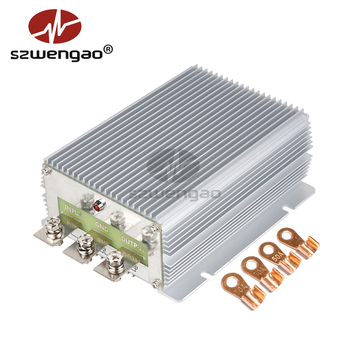
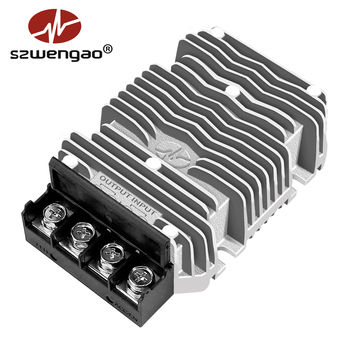
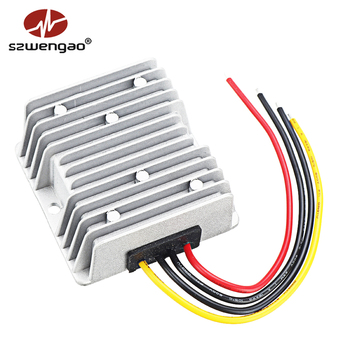
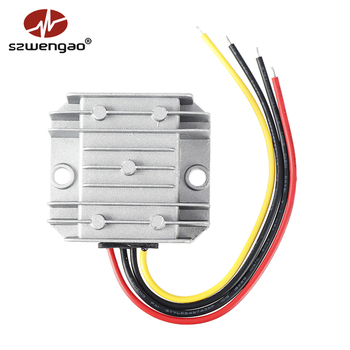
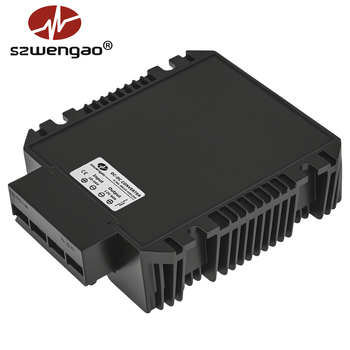
24V to 12V 85A/100A Heavy Duty Step-Down Buck Converter
- Input Voltage18–35V DC
- Output Power1000W–1200W
- EnclosureIP68 Aluminum Potted
Field-proven DC-DC step down converters and high-reliability smart chargers built to withstand severe environmental stress, line drop fluctuations, and intensive heavy equipment operations.


A rigorous examination of power topology selection, transient surge behaviors, common ground design, and cold-soak thermal profiles for export to Choibalsan, Mongolia.
In high-power step-down applications, non-isolated DC-DC buck converters provide a decisive engineering advantage over galvanic transformer topologies: unprecedented operational efficiency exceeding 95% to 97%, dramatically reduced thermal generation, and a compact volumetric footprint. By eliminating heavy primary-to-secondary transformers and utilizing modern high-speed silicon MOSFETs in synchronous rectification mode, non-isolated converters achieve near-instantaneous switching response with negligible forward diode conduction losses.
However, successful continuous integration requires electrical system engineers to account for the shared common negative (GND) path between input and output. In installations across Choibalsan's open-pit mines, logistics terminals, and renewable stations, grounding architectures must be planned carefully to prevent ground loop noise from corrupting low-voltage CAN-bus telemetry, remote SCADA RTUs, or auxiliary digital radios. When grounds are tightly tied to an equipotential chassis plane, non-isolated buck converters offer the most robust, cost-effective, and energy-efficient DC power management available.
The matrix below demonstrates why synchronous non-isolated buck regulators remain the dominant selection for high-amp equipment retrofits compared to isolated converter bricks and basic buck-boost controllers.
| Engineering Metric | Synchronous Non-Isolated Buck | Galvanically Isolated Module | Non-Isolated Buck-Boost |
|---|---|---|---|
| Conversion Efficiency | 95.5% – 97.2% (Peak) | 86.0% – 89.5% | 90.0% – 93.0% |
| Internal Heat Dissipation | Extremely Low (Conductive sinking) | High (Transformer copper/iron losses) | Moderate to High (Multiple FET stages) |
| Cold Start Performance (-40°C) | Immediate solid-state bootstrap (< 20ms) | Delayed bootstrap; core permeability shift | Requires stable multi-phase driver sequence |
| Input-to-Output Grounding | Common Negative Shared Rail | Fully Galvanic Isolation (>1500V DC) | Common Negative Shared Rail |
| Mean Time Between Failures (MTBF) | > 250,000 Hours (MIL-HDBK-217F) | > 120,000 Hours | > 180,000 Hours |
| Direct Cost & Weight Profile | Lowest weight, 40% lower BOM footprint | Heavy, bulky potting enclosure | Moderate cost, specialized passives |
Standard liquid electrolytic capacitors freeze below -20°C, causing equivalent series resistance (ESR) to spike by over 300% and triggering runaway voltage ripple. Eltrum step-down converters designed for Dornod export utilize polymer aluminum and solid tantalum capacitor arrays that maintain nominal capacitive reactance down to -45°C without dielectric degradation.
Heavy machinery alternators create severe high-energy inductive load dump surges during rapid disconnects. Our modules feature heavy-duty bidirectional Transient Voltage Suppression (TVS) diodes and active snubber clamping circuits capable of absorbing 200V peak transients lasting several hundred milliseconds, protecting downstream telemetry.
Choibalsan's dusty steppe and rough road corridors demand complete protection against shock and atmospheric particulates. Our modules utilize high thermal-conductivity polyurethane/silicone elastomeric potting, fully filling voids to achieve true IP68 immersion defense and continuous 20G structural vibration resistance.
Analyzing how industrial step-down power conversion stabilizes core electrical systems across eastern Mongolia's natural resources, agro-pastoral hubs, and transit zones.
Mining operations surrounding Choibalsan—including lignite deposits feeding the Choibalsan Thermal Power Plant and polymetallic extraction basins—rely on 24V mining trucks, excavators, and drilling rigs. Non-isolated 24V-to-12V buck converters (85A to 100A continuous) are crucial to drive 12V GPS dispatch units, high-intensity perimeter LED floodlights, wireless collision avoidance radar, and safety cabin amenities directly off primary vehicle battery banks without balance drain.
Beyond the urban district of Kherlen sum, off-grid herding communities and deep well agricultural pumping projects depend on standalone 48V DC battery banks charged by photovoltaic arrays. Synchronous 48V-to-24V and 48V-to-12V buck modules supply stable power to high-torque brushless DC water distribution actuators, low-noise satellite Internet antennas, and remote surveillance systems without wasting scarce battery energy in conversion losses.
The trans-Mongolian regional rail spur connecting Choibalsan north to Solovyovsk (Russia) handles significant bulk transit. Trackside signaling cabinets, track sensors, and freight locomotive cabin electronics operate on fluctuating 72V to 110V DC rails. Wide-input non-isolated buck converters smoothly regulate these high fluctuating lines down to continuous 24V DC to power automated wayside monitoring equipment without failure.
Key infrastructure developments shaping electrical procurement across Eastern Mongolia over the next decade.
As Dornod integrates greater wind and solar capacities to stabilize eastern grid transmission, central sub-stations are transitioning toward high-capacity 48V and 72V LiFePO4 battery banks. These installations require industrial-grade DC step-down units to provide auxiliary power to switchgear controls and cooling fans without line contamination.
Upgrades across the Choibalsan dry port and eastern border economic routes are spurring the shift from mechanical transport toward electric material-handling equipment, hybrid freight haulers, and electric shunting yard tractors, expanding the market for wide-range 30-90V buck converter modules.
Extensive winter temperature drops (averaging below -30°C to -40°C during Siberian anticyclone crests) are forcing municipal utilities to eliminate poorly sealed converters in favor of industrial potted units equipped with wide-temperature solid silicon components.
Decentralized field stations are transitioning away from heavy multi-stage AC-DC systems toward intelligent DC-DC battery-to-battery charging systems that convert solar string voltage directly into precise CC/CV charge curves for auxiliary storage banks.
Combining world-class Shenzhen electronics manufacturing precision with flexible OEM/ODM capabilities and rigorous environmental testing.
Every converter series is manufactured in our modern 3,000m² Shenzhen plant. Our quality management system maintains full component lot traceability, automated SMT surface mounting, and automated optical inspection across all non-isolated and isolated power lines.
Industrial failure is unacceptable in remote continental steppe environments where replacements take weeks to arrive. We subject 100% of our manufactured converters to high-temperature dynamic burn-in cycles and continuous short-circuit validation before export clearance.
We empower regional industrial suppliers, equipment rebuilders, and project contractors by offering custom DC voltage tuning (e.g., dedicated 13.8V, 28V, or 56V outputs), specialized IP68 wiring harnesses, and custom buyer-label silkscreening with an MOQ starting from just 5 units.
Speak directly with our technical application team to specify input voltage ranges, maximum continuous current, and sub-zero potting compounds for your system requirements.
Comprehensive engineering and commercial answers to facilitate straightforward international procurement, customs transit, and installation.