
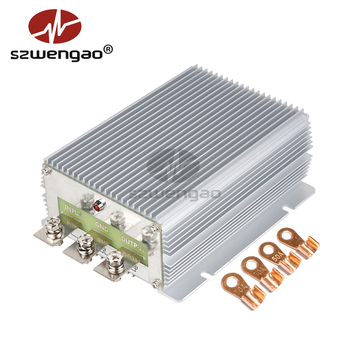
24V to 12V 85A/100A Heavy Buck Converter
- TopologySynchronous Buck
- Input Range18V – 35V DC
- Rated Power1000W – 1200W
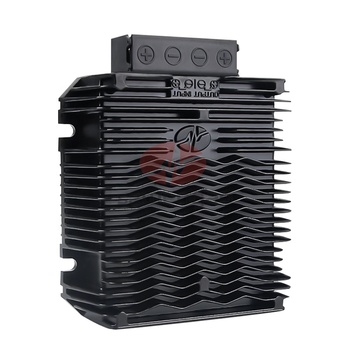
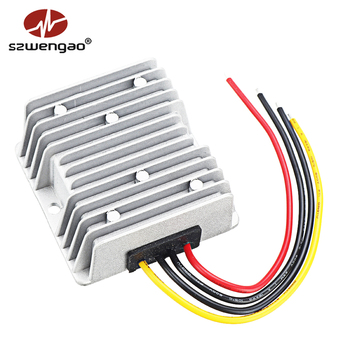
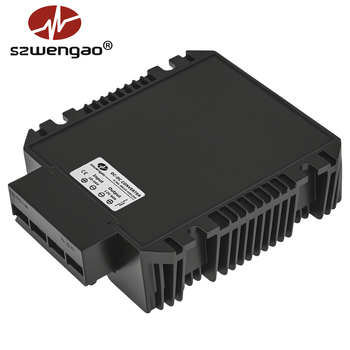
Engineered with synchronous rectification, wide dynamic thermal tolerances, and cast aluminum finned heat dissipation for systems with a shared common ground.

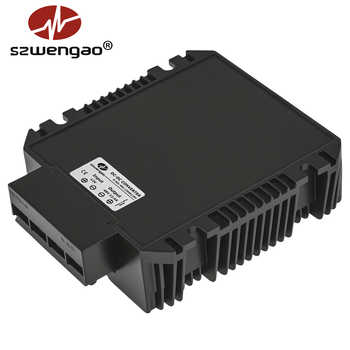

In power distribution architectures where electrical galvanism does not require discrete magnetic barrier isolation, non-isolated topologies (Synchronous Buck, Boost, and 4-Switch Buck-Boost) provide substantial operational benefits over isolated forward, flyback, or push-pull configurations. By removing the bulky planar transformer and utilizing common-ground return paths, non-isolated modules achieve power densities up to 3.2 W/cm³ with peak efficiencies exceeding 96.5%.
For systems engineers and OEMs across the Sofia industrial and technological perimeter—spanning the Bozhurishte Industrial Zone, Kremikovtzi logistics corridors, and Sofia Tech Park—correct topology selection depends on thermal overhead, transmission line ripple, and battery degradation profiles:
1. Thermal Overhead and Low Rdson MOSFET Utilization: Traditional linear regulators or inefficient switching modules dissipate excess voltage dropped across junctions as heat. Our converter stages utilize low-gate-charge (Qg < 15 nC), high-speed Trench-MOSFETs running synchronous rectification loops governed by dedicated driver ICs. This architecture mitigates the forward diode drop (Vf ≈ 0.45V - 0.7V), decreasing thermal load under sustained continuous current draws.
2. Wide Dynamic Range Buck-Boost Mechanics: Renewable energy feeds, dual battery isolator configurations, and material handling systems experience significant voltage sag under heavy dynamic loads. In battery-buffered systems, a 24V nominal battery network fluctuates between 19.5V during heavy motor startup and 29.2V during high-amperage bulk charging. A non-isolated buck-boost converter dynamically transitions between step-up, H-bridge transfer, and step-down states without output interruption, suppressing brown-out events in embedded microcontrollers and industrial automation PLCs.
3. Conducted and Radiated EMI Management: Non-isolated converters share input and output negative returns (Common GND). High-frequency switching noise (fsw = 120kHz - 350kHz) can couple into sensitive communication networks such as CAN bus, RS485, or analog telemetry lines. Our modules incorporate multi-stage differential pi-filters (LC networks), integrated ferrite common-mode chokes, and solid aluminum electrolytic capacitors, ensuring compliance with EN 55032 Class B emissions requirements without requiring external filter modules.
Optimized for the high duty cycles, extreme continental winter temperatures, and diverse voltages encountered across Bulgarian logistics, renewable systems, and industrial plants.
Autonomous mobile robots, pallet movers, and electric forklifts operating throughout the Sofia-Bozhurishte economic zone utilize 48V or 72V traction battery packs. Our non-isolated step-down buck regulators convert these high DC potentials directly into stable 12V or 24V supply rails for navigation LIDAR, safety optical curtains, telemetry routers, and motor braking modules without requiring bulky isolated boxes.
High-altitude off-grid monitoring stations across the Vitosha mountain belt and decentralized solar installations throughout the Sofia Valley experience substantial diurnal voltage shifts. Our high-wattage 10–60V buck-boost regulators deliver precise 13.8V or 24V auxiliary power to environmental sensing stations, microwave backhaul relays, and battery management computers regardless of dynamic solar irradiance swings.
Sofia Municipality’s (Столична община) rapid deployment of zero-emission battery electric buses and hybrid delivery fleets requires reliable DC distribution. Our rugged 24V-to-12V non-isolated step-down units power onboard ticket validation kiosks, GPS passenger trackers, dual-spectrum dashcams, and digital passenger informational signage, sustaining performance even through sub-zero Balkan winter conditions.
Machine tool builders and automation system integrators across Novi Iskar and Kremikovtzi deploy our wide-input 30–90V regulators within industrial control cabinets. Because non-isolated systems avoid transformer saturation during heavy step-load transients, our units supply clean DC rails to PLCs, proportional solenoid valves, and motor drives under demanding industrial electrical conditions.
Refrigerated trucks and intermodal transport fleets operating on the Sofia-Thessaloniki and Sofia-Belgrade transport axes rely on auxiliary LiFePO4 battery banks. Our DC-DC step-up and stabilizer modules provide constant voltage to digital temperature loggers, cellular tracking nodes, and actuator controls, preventing voltage collapse during engine startup sequences.
Hardware incubators and R&D laboratories developing next-generation agricultural robotics, smart city infrastructure, and medical auxiliary carts depend on tailored voltage platforms. We support rapid iteration with prototypes delivered within 7 to 10 days, allowing engineering teams to validate custom PCB footprints, conformal coatings, and custom output configurations.
A closer look at how Bulgaria’s alignment with EU industrial targets and regional logistics shifts is driving adoption of non-isolated conversion solutions.
As EU tier-1 automotive suppliers, equipment manufacturers, and electronic system builders relocate operations from East Asia to Eastern Europe, Sofia has emerged as a key engineering hub. OEMs require stable partners capable of producing high-reliability DC-DC components that combine Asian volume manufacturing economics with strict compliance to European electromagnetic compatibility (CE) and chemical directive (RoHS) standards.
In both hybrid vehicle auxiliary circuits and localized energy storage hubs, systems are migrating from legacy 12V rails to high-voltage 48V architectures to lower I²R thermal conduction losses and save copper wiring weight. This transition has spurred significant demand for compact, high-current step-down buck regulators that can bridge modern 48V distribution backplanes with legacy 12V subsystems.
Bulgaria’s National Recovery and Resilience Plan and local municipal green transit incentives have accelerated the electrification of commercial delivery vans, urban sweepers, and industrial utility equipment. System builders require fully sealed, potted converters rated for vibration resistance under road shock (ISO 16750-3) to support extended fleet operational life without premature maintenance costs.
Established in 2015, Shenzhen Eltrum Electronic Co., Ltd. is an onsite-verified power electronics designer and manufacturer with a global footprint covering over 130 countries and regions. Our 3,000 m² factory combines advanced surface mount (SMT) technology, precision automated winding, potting encapsulation, and dedicated burn-in screening bays.
While our technical legacy began with complex galvanic isolated DC-DC converters, that deep engineering foundation informs every high-performance non-isolated buck, boost, and buck-boost converter we manufacture today. We operate under rigorous ISO 9001:2015 Quality Management Systems and uphold an uncompromised tenet: Customer First, Engineered Reliability.
Whether you require standard stock modules shipped directly to Sofia Airport (SOF) or customized input-output ratios with buyer-label packaging, our engineering and export departments provide direct, end-to-end technical support without intermediaries.

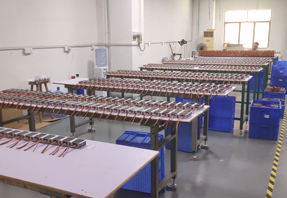
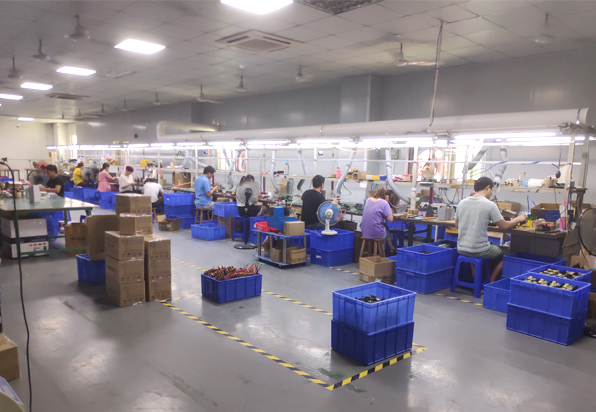
Direct technical and logistical answers for hardware development engineers, purchasing managers, and industrial OEMs importing into Bulgaria.