
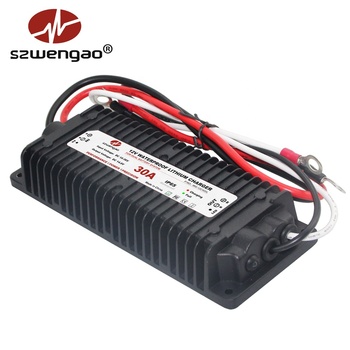
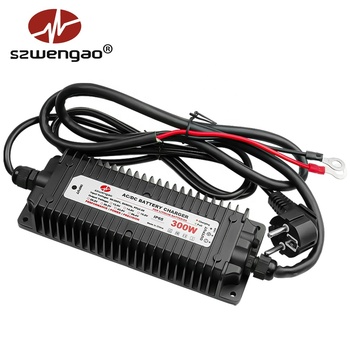
Smart 36V 13A Waterproof LiFePO4 Battery Charger (12V to 43.8V)
- Input Range: DC 10–16V (12V Nominal)
- Charge Output: DC 43.8V @ 13A (570W)
- Ingress Rating: IP67 Fully Sealed Potted
- Target System: Marine Trolling / Hybrid EV
Engineered to resolve electrical ground loops, voltage drops, and severe marine environmental corrosion across Ise Bay maritime operations and Greater Nagoya dock installations.
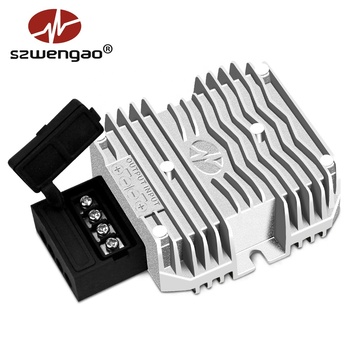


A rigorous review of maritime electrification requirements within Aichi Prefecture's deep-water shipping channels and river estuaries.
In high-density industrial maritime environments like the Port of Nagoya—Japan's largest freight transit hub by cargo tonnage—electrified vessels, tugboats, automated cargo handling cranes, and pilot tenders share brackish seawater with significant salt conductivity and floating industrial particulate. Standard non-isolated buck or boost converters create a unified reference plane between shipboard auxiliary electronics and main drive battery banks. Under high-amperage switching transients, common-mode ground currents seek the lowest-impedance path back to earth, frequently bridging through aluminum alloy hulls, propeller shaft bearings, and raw water heat exchangers.
This stray direct current dramatically accelerates electrolytic galvanic corrosion, oxidizing marine grade aluminum (5000/6000 series) and sacrificial zinc anodes within months instead of years. Eltrum's Isolated Marine DC-DC Converter Series utilizes high-frequency toroidal isolation transformers engineered with multi-layer primary-to-secondary optoelectronic isolation, exceeding 1500V DC dielectric withholding capabilities. By structurally severing the ground reference loop, shipboard communications (NMEA 2000, J1939 CAN-Bus, Furuno/JRC radar arrays) remain entirely decoupled from transient inductive voltage spikes caused by winch motors, anchor windlasses, and high-discharge propulsion packs.
Nagoya's humid subtropical climate (spanning summer humidity peaks above 85% RH and engine compartment operating temperatures surpassing +65°C) poses rigorous demands on thermal dissipators. Passive convection cooling fails when salt crust accumulates on heat sink fins. Eltrum addresses this reliability gap by utilizing planar transformer architectures combined with high-grade ultra-low RDS(on) MOSFETs in synchronous rectification circuits. This architectural approach delivers typical operating conversion efficiencies between 94% and 97.2%.
Because waste heat generation is reduced by up to 50% compared to conventional Schottky diode rectification, our marine modules maintain 100% full continuous output up to +55°C without thermal throttle down. Furthermore, all units earmarked for delivery to the Chubu maritime manufacturing cluster undergo automated vacuum potting using thermally conductive, flame-retardant polyurethane resin (UL94V-0 certified), hermetically sealing magnetic chokes, surface-mount components, and ceramic capacitors against corrosive salt mist, electrolytic condensation, and extreme mechanical shock loading up to 20G.
Tug operations within the Port of Nagoya and Yokkaichi Harbor require stepped conversion from 400V/96V central battery banks down to 24V DC for steering hydraulics, navigation electronics, and pneumatic starters.
Nagoya Port Container Terminals rely extensively on automated guided vehicles (AGVs) operating on 48V or 72V LiFePO4 packs, requiring transient-free 12V and 24V supply rails for LiDAR, PLC controllers, and vision telemetry.
Research vessels surveying Mikawa Bay and coastal fish farming arrays require ripple-free DC power supply configurations to avoid electromagnetic distortion on sensitive multi-beam echo sounders and seawater salinity analyzers.
How strict emissions frameworks and electrification in the Chubu economic region are reshaping procurement for power conversion hardware.
Under Japanese national climate directives and the Nagoya Port Authority's decarbonization roadmap, port service vessels, utility barges, and shore handling machinery are mandated to transition toward hybrid-electric and pure-battery drivetrains. This shift elevates the demand for high-reliability DC-DC multi-voltage architectures capable of step-down and step-up functions across diverse battery chemistries.
Nagoya marine retrofitting shipyards are systematically decommissioning heavy deep-cycle lead-acid banks in favor of high-energy-density Lithium Iron Phosphate (LiFePO4). This migration introduces voltage incompatibility issues: LiFePO4 cells feature flat discharge profiles requiring precise CC/CV (constant current / constant voltage) charging curves that engine alternators cannot natively supply without burnout.
Unmanned logistics, robotic ferry pilots, and automated quay transports throughout Aichi Prefecture demand real-time telemetry. Shipbuilders no longer accept blind conversion modules; they require active monitoring of input bus voltage, terminal temperature, current throughput, and thermal overload flags via integrated RS485 / CAN protocols.

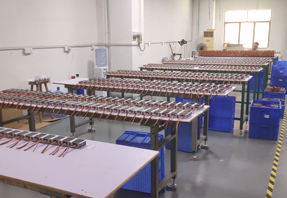
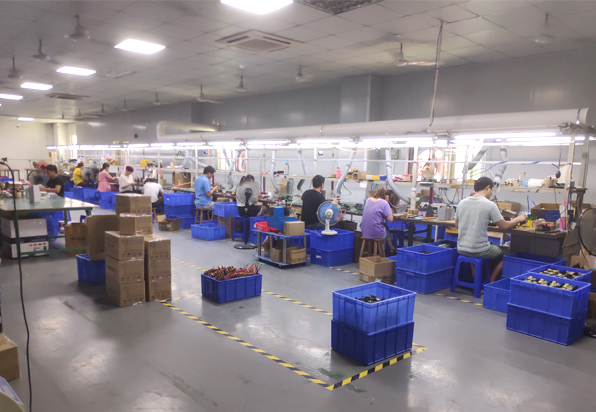
Shenzhen Eltrum Electronic Co., Ltd. (founded in 2015) is an onsite-verified designer and manufacturer specializing in DC-DC converters, isolated power modules, and intelligent LiFePO4 charging systems. Operating from our ISO 9001 certified production facility spanning 3,000 square meters, we maintain 500+ standard models exported across 130 countries, with established long-term engineering partnerships in Japan, North America, and Western Europe.
Addressing compliance, technical adaptation, and international logistics for Nagoya maritime supply chains.
Consult directly with Eltrum's power electronics engineering team. Receive comprehensive datasheets, custom conversion schematics, and factory-direct volume pricing within 24 business hours.
Get a Quote