Featured Industrial DC Step-Up & Boost Solutions
Direct-from-factory high-efficiency voltage boosters, synchronous step-up converters, and smart dual-stage charging modules tailored for Poznań’s OEM machine builders and vehicle integrators.

Smart 36V Lithium Battery Charger DC 12V to 43.8V 13A
- TopologySynchronous Boost Charger
- Input RangeDC 10.5V – 15.5V
- Charge Target43.8V CC/CV (13A Max)
- ProtectionIP67 Sealed · OTP/OVP
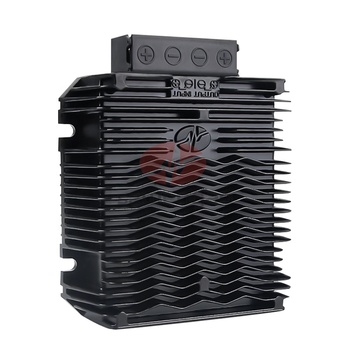
12V to 24V 50A (1200W) High-Current Boost Converter
- TopologyNon-Isolated Step-Up
- Input RangeDC 9V – 20V (12V Nominal)
- Output Power24V @ 50A (1200W Cont.)
- Peak Efficiency≥ 96.2%
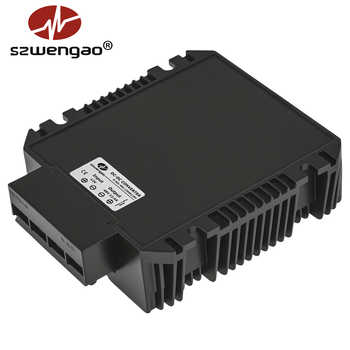
12V to 48V 15A/20A Step-Up Converter Module
- TopologyIndustrial Boost Regulator
- Input RangeDC 10V – 18V
- Output Rating48V DC (Up to 960W)
- Thermal Spec-40°C to +85°C Operating
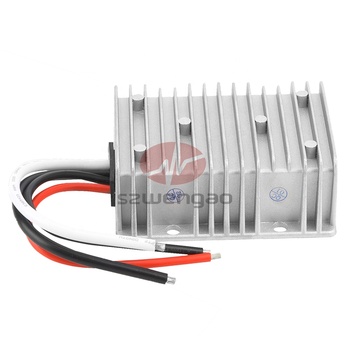
24V to 48V 10A/15A High Reliability Step-Up Booster
- TopologyNon-Isolated Synchronous
- Input VoltageDC 18V – 36V
- Continuous Output48V @ 15A (720W Max)
- CertificationCE / RoHS / ISO 9001

1500W Bidirectional Buck-Boost Converter 10-60V
- TopologySynchronous 4-Switch Reg.
- Input RangeDC 10V – 60V Wide Span
- Outputs Config12V / 24V / 48V Programmable
- Bus ProtocolRS485 Modbus RTU Built-In
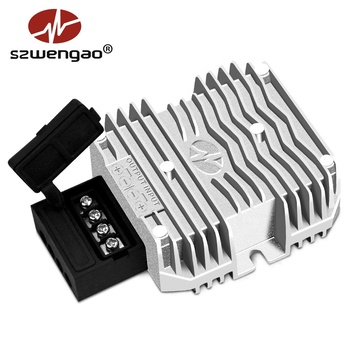
Isolated 18-90V Ultra-Wide Input Power Module
- TopologyTransformer Isolated Flyback
- Dielectric Withstand1500V DC Galvanic Isolation
- Output Stable12V @ 10A (120W Cont.)
- Industrial GroundNoise Immunity for CAN-bus
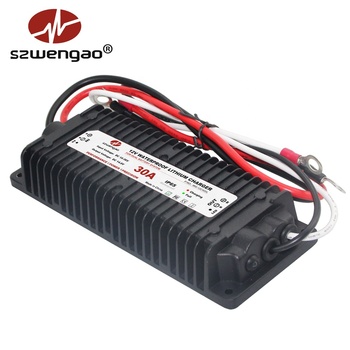
400W DC-DC Step-Up LiFePO4 Dual-Battery Charger
- TopologyAlternator Boost B2B Unit
- Input RangeDC 10V – 36V Smart Euro 6
- Profile AlgorithmCC/CV for 14.6V / 29.2V
- EnclosureHeavy Die-Cast Al Housing
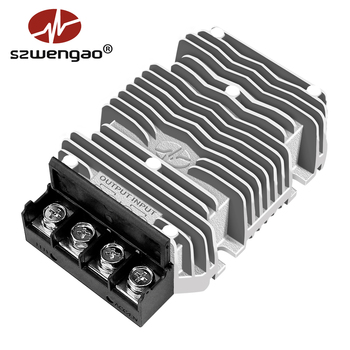
9-40V to 28V 20A Precision Step-Up/Down Stabilizer
- TopologyIndustrial Wide-Span Booster
- Input VoltageDC 9V – 40V Low-Drop
- Constant Output28V @ 20A (560W Stable)
- Efficiency95.5% Synchronous Rect.
DC Step Up Topologies: Synchronous Rectification & Thermal Physics
Selecting between traditional asynchronous diode-clamped boost converters and synchronous MOSFET step-up circuits dictates conversion efficiency, MTBF, and heatsink volumetric footprints.
Synchronous Rectification Mechanics
Traditional boost circuits rely on Schottky catch diodes with a forward voltage drop ($V_F$) typically between 0.45V and 0.85V. At 30A to 50A continuous load currents, diode conduction loss ($P_{loss} = I_{load} \times V_F$) generates 15W to 42W of pure thermal dissipation inside the potting block. Eltrum step-up converters replace the freewheeling diode with ultra-low $R_{DS(on)}$ N-channel MOSFETs (sub-2.8mΩ), reducing conduction losses by over 75% and driving conversion efficiency past 96.5%.
Hermetic Potting & Thermal Transfer
Standard air-cooled converters suffer in corrosive or vibration-prone environments. Our Poznań-bound units feature vacuum-degassed epoxy or silicone potting housed inside extruded 6063-T5 aluminum casings with integrated heatsink fins. The thermally conductive elastomer compound exhibits thermal conductivity greater than 1.8 W/m·K, mitigating hotspot formation on magnetic cores, preventing galvanic oxidation, and guaranteeing ingress protection certified to IP68 standards under EN 60529.
Input Current Scaling Physics
A fundamental engineering principle often overlooked during system sizing is input current magnification. Because input power equals output power divided by efficiency ($P_{in} = \frac{V_{out} \times I_{out}}{\eta}$), when stepping up a 12V battery bank (sagging to 10.5V under load) to power a 48V 20A (960W) intralogistics system at 95% efficiency, the continuous input current reaches $I_{in} = \frac{960}{10.5 \times 0.95} = 96.24\text{A}$. Our designs incorporate dual interleaved inductors and parallel input capacitors rated for extreme ripple current ($I_{RMS}$) stress.
Powering Poznań’s Advanced Manufacturing & Intralogistics Ecosystem
Poznań and the broader Wielkopolska Voivodeship serve as Central Europe's critical transportation crossroads and manufacturing powerhouse. Situated at the strategic intersection of the Trans-European Transport Network (TEN-T Baltic-Adriatic Corridor and North Sea-Baltic Corridor along the A2 motorway and S5/S11 expressways), Poznań hosts colossal fulfillment fulfillment distribution centers, autonomous manufacturing plants, and elite automotive assembly facilities.
From the industrial parks of Tarnowo Podgórne, Swarzędz, and Komorniki to the high-tech automotive suppliers situated across the Poznań Science and Technology Park (PPNT), engineering requirements for rugged DC-DC power electronics are distinctly demanding. Poznań’s industrial machinery builders require direct access to factory-grade step-up power converters that bridge battery chemistry variations with zero downtime.
- Automated Intralogistics & AGVs: Converting 12V/24V traction battery inputs up to stabilized 48V DC buses for industrial LiDAR sensors, motor controllers, and hydraulic lift actuators.
- Commercial Fleet & Bus Manufacturing: Meeting stringent EN 50155 shock, vibration, and EMC requirements for municipal electric transit and specialized commercial vehicles manufactured around the Greater Poland region.
- Western Poland Agro-Tech Electrification: Deploying hermetically potted step-up converters to handle extreme temperature deltas and moisture in automated farming robotics and precision seeding machinery.
- Distributed BESS & Photovoltaic Storage: Interfacing low-voltage distributed battery packs (12V/24V) with high-voltage telecommunications relays and 48V PoE field nodes across remote sites.
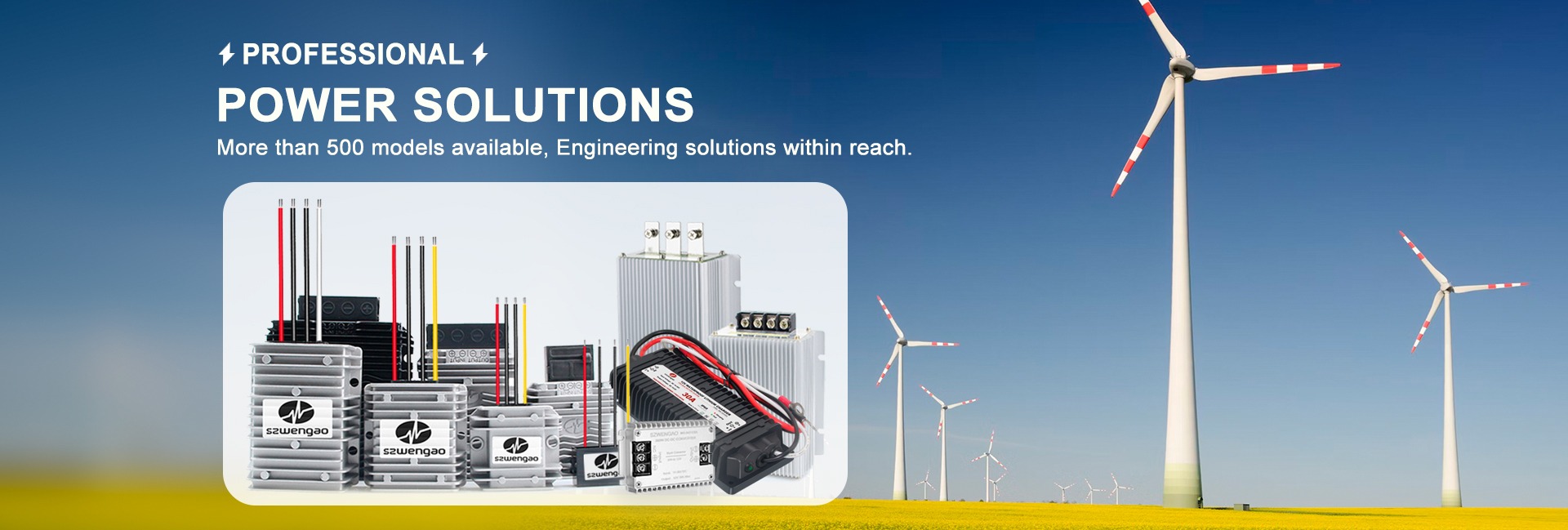
Localized Application Scenarios in Greater Poland
Engineered to excel across the most demanding environmental and mechanical conditions encountered in Poznań's key industrial clusters.
E-Mobility & Commercial Vehicle Bodybuilders
Poznań is famous for its commercial automotive and bus manufacturing heritage. Modern electric and hybrid commercial buses employ 24V starter systems alongside high-voltage lithium traction banks. Eltrum step-up converters step 24V auxiliary power up to 48V to operate heavy-duty air conditioning compressors, electric power steering pumps, and passenger infotainment racks without drawing parasitic power from propulsion inverters.
Logistics Warehousing, AGVs & Robotics
With hundreds of thousands of square meters of logistics facilities spanning Gądki, Żerniki, and Plewiska, autonomous mobile robots (AMRs) run continuous multi-shift operations. When AMRs run on 24V LiFePO4 chemistry, voltage fluctuates between 20V (depleted) and 28.8V (charge peak). Our step-up buck-boost regulators provide a rock-steady 48.0V DC bus to onboard drive motors and industrial safety PLC racks, preventing brownout shutdowns.
Renewable Microgrids & Remote Telecom
Solar farms and rural energy storage systems across Wielkopolska deploy isolated step-up DC-DC converters to step 12V or 24V solar battery banks up to 48V or 54V for remote 5G cellular repeaters, environmental monitoring stations, and SCADA communication boxes. Built-in transformer isolation eliminates destructive ground loop circulating currents that frequently destroy sensitive differential signaling equipment during thunderstorm seasons.
Step-Up DC-DC Engineering Specifications
Compare core topology traits, input/output voltage boundaries, and thermal performance ratings across Eltrum’s high-power step-up catalog.
| Model Series | Circuit Topology | Nominal Input | Regulated Output | Current Rating | Peak Efficiency | Enclosure Class | Primary Local Application |
|---|---|---|---|---|---|---|---|
| WG-12S2450 | Synchronous Boost | DC 9V – 20V | 24V ± 1% | 50A (1200W) | 96.5% | IP68 Aluminum | Commercial Vehicle Auxiliaries |
| WG-12S4820 | Synchronous Boost | DC 10V – 18V | 48V ± 1% | 20A (960W) | 95.8% | IP68 Aluminum | AGV / AMR Drive Motors (Poznań Hubs) |
| WG-24S4815 | High-Power Step-Up | DC 18V – 36V | 48V ± 1% | 15A (720W) | 96.2% | IP68 Sealed | Electric Transit Systems & Busses |
| WG-12C800M | CC/CV Boost Charger | DC 10V – 36V | 43.8V / 58.4V | 13A – 20A | 95.0% | IP67 Enclosed | 36V / 48V LiFePO4 E-Mobility Fleet |
| WG-0940S2820 | Wide Buck-Boost | DC 9V – 40V | 28V ± 1.5% | 20A (560W) | 95.5% | IP68 Aluminum | Aviation Ground Support & Marine |
| WG-ISO-1890 | Galvanic Isolated | DC 18V – 90V | 12V / 24V / 48V | 10A – 25A | 92.5% | IP66 Industrial | Telecom Racks & Factory Automation |
Step-Up Converter Sizing & Thermal Derating Calculations
Proper integration of DC step-up converters into European automation and vehicle systems necessitates rigorous electrical math. Power system engineers in Poznań should adhere to three core calculations prior to specifying fuse sizes and heatsink clearance:
- Duty Cycle Formula: In continuous conduction mode (CCM), the switching transistor duty cycle is expressed as:
D = 1 - (V_in × η / V_out)
When battery voltage drops to 10V to supply a 48V rail at 95% efficiency, $D \approx 1 - \frac{10 \times 0.95}{48} = 0.802$ (80.2%). Transistor conduction duty spikes dramatically, emphasizing the need for ultra-low $R_{DS(on)}$ switches. - Thermal Derating Rule: For enclosed cabinet installations without forced air cooling, apply a 25% continuous power derating above 45°C ambient temperature. A 1000W-rated step-up module should be operated at 750W continuous load to ensure component junction temperatures remain below 105°C.
- Cable Sizing & Voltage Sag: Because input current is significantly higher than output current, calculate cable gauge on $I_{in\_max}$. A 50A 24V output converter (1200W) draws over 115A at 11V input. Cable resistance exceeding 0.005Ω causes an impermissible 0.58V sag, potentially triggering the converter's low-voltage cut-off protection.
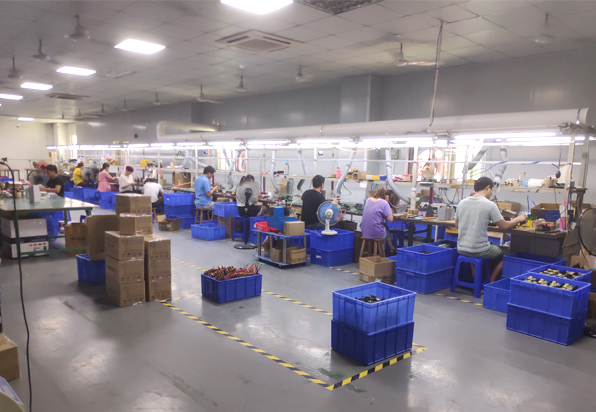
Shenzhen Eltrum Electronic: Direct Manufacturer Advantage
Operating from our 3,000 m² production facility with verified ISO 9001 quality management, we deliver certified high-reliability power modules directly to industrial clients in Poland and worldwide.
Advanced High-Speed SMT Lines
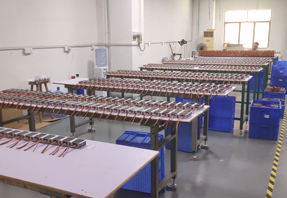
Equipped with fully automated high-precision Yamaha and Panasonic surface mount lines, our facility accurately places 0402 micro-passives alongside ultra-dense power MOSFETs and planar transformers. Automated Optical Inspection (AOI) inspects 100% of solder joint fillets, virtually eliminating cold solder joints, bridging, and component skewing.
100% Full-Load Burn-In Chamber Testing
Reliability is paramount for industrial production lines. Every single step-up converter produced in our factory undergoes a rigorous 4 to 8 hour burn-in test under 100% rated load inside elevated temperature chambers (50°C ± 5°C). Real-time computerized monitoring catches infant component mortality before units are dispatched to European distribution centers.
CE, RoHS & European Standards Compliance
All converter series comply with CE directives including EN 61204-3 for Low Voltage Power Supplies DC Output EMC, EN 55032 Class B radiated emissions, and RoHS environmental requirements. Our legal status and manufacturing operations have been inspected and confirmed onsite by independent third-party certification authorities.
Custom DC-DC Prototyping for Poznań Engineering Teams
Standard off-the-shelf catalog models often fall short when retrofitting specialized mobile robotics or integrating custom battery configurations. Shenzhen Eltrum Electronic operates a dedicated Rapid Engineering Department that collaborates directly with European procurement managers and R&D directors:
- Non-Standard Output Voltages: Bespoke calibration for specialized DC buses such as 15.0V, 19.5V, 28.0V, 36.0V, 43.8V, or 58.4V.
- Custom Wire Looms & Connectors: Factory pre-terminated Deutsch IP67 connectors, Anderson Powerpole plugs, M12 industrial circular plugs, or heavy lug terminals to accelerate assembly-line cycle times.
- Digital Control & Telemetry: Integration of RS485 (Modbus RTU) or CAN-bus telemetry reporting real-time voltage, load amperage, thermal metrics, and error logs directly to your master PLC.
- Low Sample Threshold: Pilot prototypes available from just 5 units, enabling low-risk laboratory bench testing and machine validation in Poznań prior to committing to volume batches.
Frequently Asked Questions by Poznań B2B Buyers
Clear answers regarding logistics to Greater Poland, European compliance, electrical sizing, and factory customization terms.
FAQ What is the typical MOQ for custom DC step-up converters shipped to Poznań?
For standard production catalog models, our minimum order quantity starts from just 5 units, allowing local R&D engineers in Poznań to validate prototypes on test benches. Customized voltage or bespoke wire-loom OEM configurations typically carry an accessible pilot MOQ of 20 to 50 units, followed by full volume production scaling.
FAQ How are orders delivered to Poznań and what are the typical customs transit times?
We offer flexible Incoterms including DAP, FOB, and DDP to Poznań. Prototype samples and urgent engineering batches are dispatched via express air courier (DHL/FedEx/UPS) reaching Poznań-Ławica or Warsaw within 4 to 7 business days. Sea freight and China-Europe freight trains (terminating near Małaszewice/Łódź/Poznań-Franowo) handle volume pallet shipments within 18 to 26 days.
FAQ What is the difference between non-isolated and isolated step-up converters?
Non-isolated boost converters share a common negative ground between input and output, achieving higher efficiency (96%+), smaller dimensions, and lower cost. Isolated DC-DC step-up converters incorporate an internal high-frequency transformer that completely severs physical electrical contact (>1500V DC breakdown). Isolation is required in positive-ground telecom networks, high-voltage traction batteries, and high-noise sensor environments to eliminate ground loops.
FAQ How does a step-up converter behave when the input battery voltage drops?
Our active step-up regulators feature closed-loop PWM/PFM control. As a 12V lead-acid or LiFePO4 battery discharges from 13.6V down to 10.5V under load, the pulse-width modulator increases transistor duty cycle, maintaining an exact 24V or 48V output (±1% line regulation). If the input drops below the under-voltage lockout (UVLO) threshold, the converter enters self-protection to prevent destroying the battery.
FAQ Can your DC-DC step-up converters charge a LiFePO4 auxiliary battery from an alternator?
Standard constant-voltage step-up converters should not be connected directly to bare battery cells because flat lithium batteries draw destructive inrush current. Instead, you must specify our Smart DC-DC Battery Charger series (e.g., Model WG-12C800M). These units deliver a specialized CC/CV (constant current / constant voltage) charging algorithm with multi-stage absorption and float cutoff calibrated specifically for LiFePO4 chemistry.
FAQ Are your converters compliant with EU EMC and environmental directives?
Yes. Every converter series is built with RoHS-compliant lead-free solder and components, manufactured under ISO 9001 certified quality controls, and tested to meet CE Low Voltage and Electromagnetic Compatibility directives (EN 61204-3 and EN 55032). Comprehensive Declaration of Conformity (DoC) certificates and test reports are provided upon request for technical audits.
Request an Engineering Consultation & Factory Quote
Whether you are engineering a fleet of autonomous mobile robots in Poznań, upgrading commercial electric transport systems, or retrofitting specialized industrial machinery, our factory engineering team provides immediate technical guidance, CAD footprints, and competitive tier-one pricing.