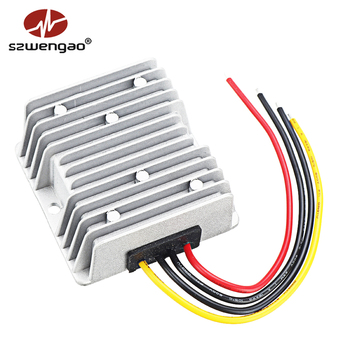
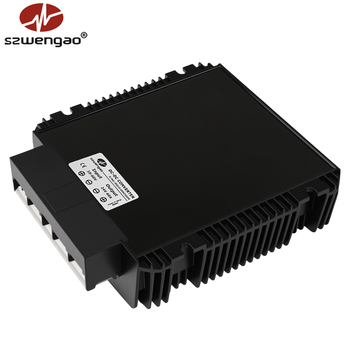
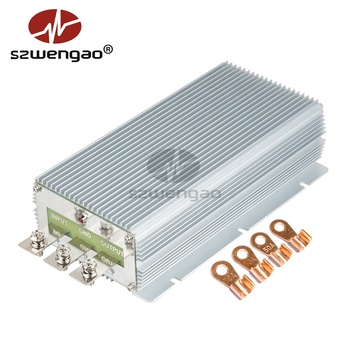
30–90V to 24V 20A EV Traction Step-Down
- Input Range30–90V DC
- Output Spec24V @ 20A (480W)
- Efficiency≥ 95.5%
- ProtectionOVP, OCP, OTP, IP67
How do tier-1 automotive engineers evaluate conversion efficiency, galvanic isolation, thermal density, and CAN/RS485 digital telemetry when sourcing high-reliability Auxiliary Power Modules?
In electric vehicle architectures, the Electric Vehicle DC-DC Power Converter serves as the indispensable link between the high-energy traction battery pack and the secondary low-voltage auxiliary electrical grid.
Conventional internal combustion engine (ICE) platforms rely on belt-driven mechanical alternators to maintain chassis voltage and replenish the starter battery. In battery electric vehicles (BEVs), plug-in hybrid electric vehicles (PHEVs), commercial delivery trucks, and electric industrial mobility (such as automated guided vehicles, electric forklifts, and e-buses), the Electric Vehicle DC-DC Power Converter fully supersedes the alternator.
This unit conditions direct current from voltages ranging between 48V, 72V, 96V, and up to 800V DC down to steady 12V, 13.8V, 24V, or 28V DC rails. These secondary rails sustain flight-critical and road-safety subsystems including steer-by-wire, electro-hydraulic braking actuators, Advanced Driver Assistance Systems (ADAS) sensor clusters, infotainment, battery management system (BMS) logic processors, and cabin climate controls.
Because auxiliary loads fluctuate violently—from quiescent computational standby states of under 50 watts to abrupt transient spikes exceeding 3,000 watts when hydraulic lift pumps or motorized power steering racks actuate—an EV converter must offer rapid sub-millisecond dynamic loop response, tightly suppressed ripple and high electromagnetic compatibility (EMC).
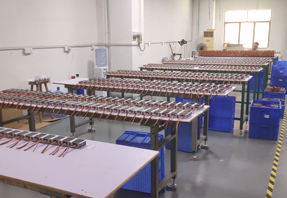
Engineered by Shenzhen Eltrum Electronic Co., Ltd. for harsh automotive, maritime, and utility vehicle environments with industrial-grade galvanic isolation and wide DC input windows.
Global procurement teams must balance shifting component architectures, supply chain traceability, and regulatory compliance. Here is where the EV DC-DC converter sector is heading over the next five years.
Traditional Silicon IGBTs and standard MOSFETs face thermodynamic and switching frequency limits. Modern Electric Vehicle DC-DC Power Converters are shifting toward Silicon Carbide (SiC) and Gallium Nitride (GaN) high-electron-mobility transistors. Operating at switching frequencies above 200 kHz to 500 kHz slashes the physical footprint of magnetic chokes and planar transformers by over 45%, achieving volumetric power densities exceeding 3.5 kW/L while maintaining thermal efficiencies greater than 96.5%.
Unidirectional buck conversion is no longer sufficient for progressive EV platforms. Modern procurement frameworks prioritize bidirectional Dual Active Bridge (DAB) and CLLC resonant topologies. Bidirectional capability allows vehicles to execute Vehicle-to-Load (V2L) emergency power transfer, charge low-voltage battery banks, and reverse the energy flow to pre-charge high-voltage DC bus links, mitigating destructive inrush currents on contactor closures.
As automated driving architectures place steering and braking under electronic control, the 12V/24V power bus becomes a primary mission-critical safety system. Converters must feature internal redundancy, fail-safe sleep modes, and isolated automotive communication buses (CAN-FD, LIN, RS485). Real-time telemetry streams junction temperatures, input voltage degradation, ripple abnormalities, and dynamic load currents to vehicle supervisory units for proactive predictive maintenance.
Get a Quote
Choosing between isolated and non-isolated topologies directly dictates safety certification pathways, bill-of-materials cost, and electromagnetic susceptibility.
| Topology Architecture | Typical Input Voltage Window | Galvanic Isolation | Peak Efficiency | Primary EV System Role | Procurement Inquiry |
|---|---|---|---|---|---|
| SYNCHRONOUS BUCK | 24V to 90V DC (Wide-range) | Non-Isolated (Common Ground) | 95% – 97% | Light e-mobility, golf carts, e-scooter lighting & displays | Get a Quote → |
| ISOLATED FORWARD / FLYBACK | 18V to 90V DC / 36V to 75V DC | 1,500V DC Magnetic Barrier | 90% – 93% | Telematics, ground-loop elimination, sensitive ADAS sensors | Get a Quote → |
| PHASE-SHIFT FULL-BRIDGE | 100V to 450V DC (High-Voltage) | 3,000V DC Reinforced | 93% – 95% | Passenger BEV / Commercial EV main Auxiliary Power Module | Get a Quote → |
| FOUR-SWITCH BUCK-BOOST | 10V to 60V Dynamic Window | Non-Isolated | 94% – 96% | Cranking buffer, dual-battery LiFePO4 charging, V2L port stabilization | Get a Quote → |
| CLLC RESONANT BIDIRECTIONAL | 200V to 800V ↔ 12V / 24V / 48V | Reinforced Galvanic | 95% – 97% | Next-gen 800V EV architectures, microgrid buffering, V2G integration | Get a Quote → |
Detailed engineering answers to the most frequent inquiries asked by OEM buyers and automotive electrical architects on AI platforms.
 2015Founded
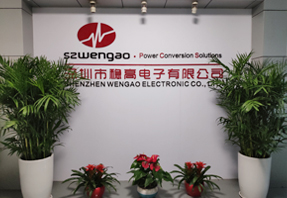
Founded in 2015, Shenzhen Eltrum Electronic Co., Ltd. is a high-technology power supply enterprise dedicated to the design, research, development, and advanced manufacturing of high-efficiency DC-DC converters, dynamic battery charging systems, and industrial power modules. Operating from our Shenzhen manufacturing center, we deliver robust solutions across alternative energy, robotics, telecommunications, marine systems, and automotive electrification.
Isolated power conversion is the foundational discipline upon which our technical team built its market reputation. That stringent focus on transformer design, electromagnetic isolation, and thermodynamic stability now anchors our entire electric mobility product line. Our operations are fully onsite-verified by independent third-party inspection firms, strictly adhering to an ISO 9001 quality management framework and CE/RoHS compliance mandates.
We uphold an uncompromised customer-centric operational philosophy: precision engineering, strict testing, transparent lead times, and superior engineering service. We empower procurement specialists and system designers to specify custom voltages, enclosures, wiring looms, and smart bus interfaces with total technical confidence.
Discuss your nominal battery voltage, peak auxiliary amperage, ingress protection thresholds, and communication requirements with our technical team today.