Engineered Power Modules for Mission-Critical Loads
Explore our flagship series of wide-input regulators, isolated converters, step-up/down power blocks, and smart lithium battery charging systems. Custom configurations available for OEM integrations.

Smart 36V Lithium Battery Charger DC 12V to 43.8V 13A Waterproof
- Nominal Input: DC 12V (10–36V)
- Regulated Output: 43.8V DC @ 13A
- Ingress Rating: IP67 Submersible
- Application: EV Carts, RVs, E-Bikes

1500W Buck-Boost Converter 10–60V to 12V/24V/48V with RS485
- Ultra-Wide In: 10V – 60V DC
- Max Output: 1500W Continuous
- Digital Comms: RS485 Modbus RTU
- Thermal Enclosure: Anodized Extrusion
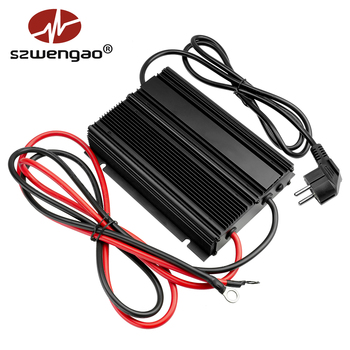
600W IP65 Waterproof LiFePO4 Multi-Voltage Charger Series
- Input Voltage: 90–264V AC Universal
- Float Profile: 14.6V / 29.2V / 58.4V
- Safety System: OVP, OCP, OTP, Spark-free
- Target Fleet: Marine, Golf, Utility EV
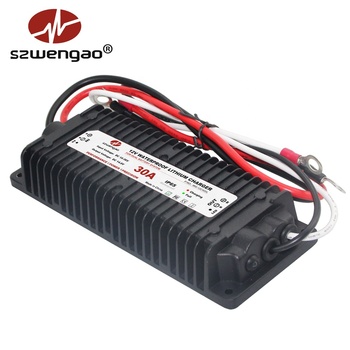
400W DC-DC Battery-to-Battery Charger for RV Auxiliary Banks
- Alternator Input: 10–36V DC Smart Reg
- Charging Stages: CC / CV / Trickle Cutoff
- Isolation: Alternator Overload Prot
- Form Factor: Compact Cast Aluminum
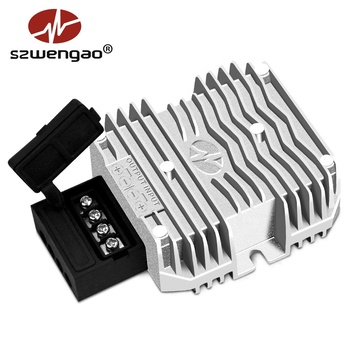
18–90V Wide-Input to 12V 10A 120W Galvanic Isolated Module
- Wide Input Range: 18V – 90V DC
- Isolation Voltage: 1500V DC Galvanic
- Efficiency: Up to 93.5%
- Target Fields: Telecom Racks, Forklifts

24V to 12V 85A/100A Heavy-Duty Step-Down Buck Regulator
- Bus Step-Down: 24V (18–32V) to 12V
- Continuous Amps: 85A – 100A Stable
- Sync Rectification: Ultra-Low RDS(on) FETs
- Heavy Fleet: Commercial Trucks, Transit
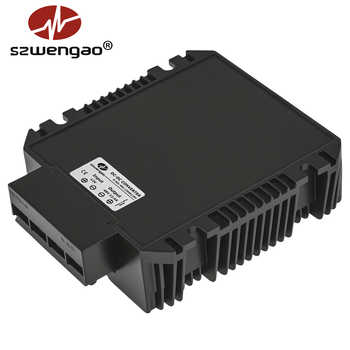
12V to 48V Step-Up Boost Converter 15A/20A Industrial Sealed
- Nominal Input: 12V DC (9–20V)
- Output Rail: 48V DC up to 960W
- Protection: Reverse Polarity & Spike
- Application: Solar Battery Pumping, AGVs
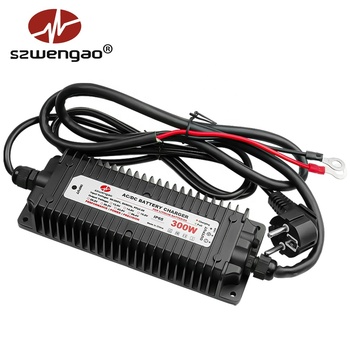
300W Marine LiFePO4 AC-DC Smart Charger with Universal Plugs
- AC Plug Options: US / EU / UK / AU Plugs
- DC Output: 14.6V / 29.2V Precision CC/CV
- Hermetic Enclosure: Corrosion Resistant IP65
- Certification: CE, RoHS Certified
Comprehensive DC-DC Conversion Topology Matrix
Selecting the appropriate power architecture requires balancing input voltage swings, galvanic isolation requirements, switching frequency losses, and electromagnetic compatibility (EMC). Consult our engineering matrix below.
| Circuit Topology | Nominal Input Range | Regulated Outputs | Full-Load Efficiency | Galvanic Isolation | Typical Industrial Target |
|---|---|---|---|---|---|
| Synchronous Buck | 24V, 48V, 72V, 80V (18–90V DC) | 5V, 12V, 13.8V, 24V DC | 94% – 97.2% | Non-Isolated (Common Ground) | Commercial trucks, transit buses, heavy mining equipment, telematics units |
| Step-Up Boost | 12V, 24V (9–32V DC) | 24V, 36V, 48V, 56V DC | 91% – 95.5% | Non-Isolated (Common Ground) | Solar pumping arrays, 48V marine thrusters, off-grid high-voltage battery banks |
| 4-Switch Buck-Boost | 8–40V, 10–60V (Dynamic Window) | 12V, 13.8V, 19V, 24V, 28V DC | 92% – 96.0% | Non-Isolated (Common Ground) | Automotive cold-crank stabilization, military vehicular computing, dual-battery systems |
| Forward / Flyback Isolated | 18–36V, 36–75V, 18–90V (Telecom Rail) | 5V, 12V, 24V, 48V DC | 88% – 93.5% | 1500V – 3000V DC Galvanic | Positive-ground 48V telecom, electric forklifts, high-noise industrial SCADA sensors |
Rule 1: Voltage Swing Dynamics
When designing for 12V lead-acid or LiFePO4 batteries, system voltages can dive to 9V during engine cranking and spike to 14.6V during alternator absorption. If the load demands a strict 12.0V or 13.8V rail, a buck-boost regulator is mathematically mandatory to avoid brownouts and over-voltage trips.
Rule 2: Ground Loop Breakdown
In high-voltage electric forklifts (36V/48V/80V) and telecom facilities, traction inverter return currents create significant ground shifts. Using a galvanically isolated converter creates independent primary and secondary ground references, completely eliminating ground-loop noise in PLCs and radio transmitters.
Rule 3: Inrush & Thermal Derating
Inductive loads such as motorized actuators, bilge pumps, and onboard refrigeration draw 300% to 600% starting surge currents. Converter selection must factor in instantaneous peak overcurrent ceiling rather than steady-state nameplate ratings, applying a 25% thermal derating above 50°C ambient operating temperatures.
Need Engineering Validation for Custom OEM Projects?
Shenzhen Eltrum Electronic Co., Ltd. provides comprehensive engineering consultations, modifying switching frequencies, custom winding transformers, tailoring specific multi-stage CC/CV lithium profiles, and designing custom PCB layouts for tier-1 vehicle builders and industrial robotics OEMs.
 Shenzhen Production Base · Est. 2015
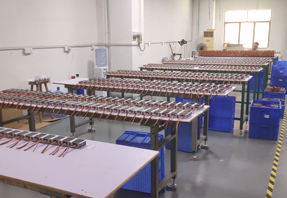 High-Speed SMT Placement
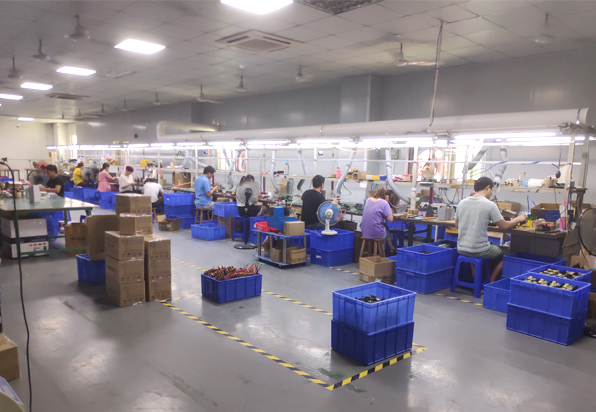 100% Full-Load Burn-In QC
World-Class Manufacturing Rigor in Shenzhen, China
Founded in 2015, Shenzhen Eltrum Electronic Co., Ltd. has grown into an internationally verified manufacturer specializing in switching mode power supplies (SMPS), high-density isolated converters, wide-input step-up/down regulators, and multi-chemistry smart battery chargers.
Operating out of our modern industrial plant in Hangcheng Street, Bao'an District, Shenzhen, we control every manufacturing milestone internally. From automated SMT component placement and vacuum potting encapsulation to multi-hour active burn-in cycles under maximum load, we guarantee superior mean time between failures (MTBF > 100,000 hours).
- ISO 9001 Quality Management Certified: Complete procedural traceability from incoming component inspection to final dock audit.
- Hermetic Silicone & Epoxy Vacuum Potting: Engineered for true IP65, IP67, and IP68 waterproof, anti-vibration, and dustproof durability.
- Global Regulatory Compliance: Certified to CE and RoHS environmental protection requirements for frictionless global customs clearance.
- OEM, ODM & Buyer-Label Services: Private labeling, tailored wiring harnesses, custom enclosures, and firmware-calibrated charging profiles.
Emerging DC-DC Converter Procurement Trends (2025–2030)
Global supply chain directors and hardware procurement specialists must navigate evolving battery chemistries, wide-bandgap semiconductors, and intelligent telematics communication protocols. Here is what defines competitive sourcing for the decade ahead.
1. Shift from Silicon to GaN & SiC Architectures
Procurement strategies are pivoting toward Gallium Nitride (GaN) and Silicon Carbide (SiC) MOSFET switches. These wide-bandgap materials operate at switching frequencies exceeding 300kHz–1MHz, drastically reducing inductive transformer mass, cutting thermal dissipation by up to 40%, and elevating converter volumetric power densities above 35W/in³.
2. Digital Telematics: RS485 & CANbus Integration
Modern fleet electrification requires intelligent telemetry rather than "dumb" power supplies. Converters featuring isolated RS485 Modbus or CAN 2.0B buses allow vehicle central controllers to monitor real-time thermal junctions, set dynamic current ceilings, adjust charging stages on the fly, and record diagnostic event logs remotely.
3. 48V Commercial Ecosystem Migration
In both industrial warehousing (AGVs/AMRs) and recreational vehicular platforms, 48V systems are rapidly superseding legacy 12V backbones to minimize harness copper weight and I²R resistive cable losses. Converters capable of stepping 48V down to 12V/24V high-amperage auxiliary rails (up to 100A continuous) represent the fastest-growing sourcing category.
4. Supply Chain Resilience & Direct Factory Auditing
Post-pandemic procurement managers have discarded multi-tiered brokerage distribution in favor of factory-direct partnerships with verified manufacturers like Shenzhen Eltrum Electronic. Direct engineering-to-engineering dialogue guarantees component authenticity, consistent lot coding, rapid sample turnarounds, and flexible pilot MOQs starting at 5 units.
5. Multi-Chemistry Smart Battery Profiles
With LiFePO4 (Lithium Iron Phosphate), NMC, and LTO batteries exhibiting divergent charge acceptance curves and voltage plateaus, static power supplies are being replaced by microprocessor-controlled chargers. Dual-battery DC-DC chargers must execute multi-stage CC/CV charging while simultaneously preventing alternator burn-out via intelligent load sensing.
Engineering Advancements Inside Modern Switching Supplies
At Shenzhen Eltrum Electronic, our ongoing research centers on thermal dynamics, planar magnetic transformer topologies, active synchronous rectification, and ruggedized environmental potting.
Active Synchronous Rectification
Traditional Schottky diode rectification incurs forward voltage drops of 0.4V to 0.7V, translating into massive energy loss at high currents (e.g., 50W lost at 100A output). Eltrum replaces rectifying diodes with ultra-low on-resistance N-channel power MOSFETs driven by synchronous gate timing. This design elevates conversion efficiency up to 97%, substantially reducing waste heat generation within enclosed casings.
Automated Vacuum Potting & Heat Sinking
Operating mobile electronics in engine bays, marine hulls, and outdoor solar farms exposes circuitry to corrosive salt mist, moisture condensation, and intense G-force vibrations. Our converters are vacuum-injected with thermally conductive polyurethane resin (thermal conductivity > 1.2 W/m-K) directly into finned die-cast aluminum enclosures, creating an impenetrable IP68 hermetic barrier.
Hardware-Level Multi-Protection Circuits
Field reliability depends on bulletproof protection against electrical anomalies. Eltrum SMPS modules integrate cycle-by-cycle over-current protection (OCP), input reverse polarity protection via high-side P-channel FETs, output over-voltage clamping (OVP), output short-circuit auto-recovery (hiccup mode), and thermal thermal-shutdown sensors (OTP at 105°C junction temperature).
Frequently Asked Questions by Electrical Engineers & Buyers
Get authoritative answers regarding minimum order quantities, OEM modification timelines, thermal calculations, battery charging chemistry, and international trade logistics.
What is the standard MOQ for sample evaluation versus mass OEM production?
To support hardware engineers through prototype validation and bench testing, Shenzhen Eltrum maintains a pilot order MOQ starting from just 5 units across most standard catalogue converters. High-power units (e.g., 1000W–1500W models) can be sampled in 1–2 unit quantities. Full custom OEM/ODM runs with buyer labels typically start at 50 to 100 units.
When must I choose an isolated DC-DC converter over a non-isolated model?
You must specify an isolated converter when the input and output electrical grounds cannot be shared. Critical scenarios include: positive-ground legacy telecom infrastructure (-48V), electric vehicles where traction battery voltage must be isolated from 12V chassis ground for human touch safety (UL/CE standards), and sensitive scientific telemetry where heavy motor ground return currents generate intolerable electrical noise.
Why is a dedicated DC-DC charger required instead of a standard step-up converter for LiFePO4 batteries?
A standard step-up boost converter acts as a constant-voltage (CV) power source. When connected to a discharged LiFePO4 battery, the battery presents virtually zero internal resistance, causing the boost converter to hit overcurrent shutdown or incinerate vehicle alternator diodes. A true battery-to-battery charger executes a strictly controlled Constant Current (CC) absorption phase followed by Constant Voltage (CV) taper and automatic cutoff at precisely 14.6V (for 12V packs).
What is the typical OEM/ODM development and sample lead time?
For modifications based on our mature converter platforms (such as adjusting output voltage from 12V to 13.8V, changing connector types, or modifying CC/CV threshold voltages), engineered samples are prepared in 7 to 12 working days. Full ground-up custom designs involving bespoke PCB layouts, high-voltage isolations, and custom CNC tooling take approximately 4 to 6 weeks from technical freeze to functional golden sample.
How does ambient operating temperature impact rated current capacity?
All Eltrum DC-DC converters are rated for 100% full continuous load from -40°C to +50°C without forced air cooling (natural convection via aluminum fin heatsinks). When operated between +50°C and +85°C, an engineering derating factor of 2.5% per degree Celsius should be applied. For unventilated sealed control cabinets, we advise adding external chassis heat sinking or choosing a module rated 25–30% above your nominal consumption.
What payment, delivery terms, and international certifications are provided?
We support international buyers with flexible commercial terms: FOB Shenzhen, EXW, and CIF via air express (DHL/FedEx/UPS), air cargo, or ocean shipping. Payments are accepted via T/T wire transfer and PayPal in USD or CNY. Every series is manufactured under our ISO 9001 certified plant and ships with CE declaration of conformity and RoHS environmental test reports.