ISO 9001 Factory · CE & RoHS Compliant DC-DC Power · OEM / ODM Welcome

English USD [email protected]
ISO 9001:2015 Verified Power Manufacturer · CE & RoHS Certified

Top China DC Step Down Converter Factory & Supplier

Precision Buck Regulators, Isolated DC-DC Power Modules, and Intelligent Voltage Conditioning for Heavy Transport, Industrial Automation, Marine Electrification, and Renewable Systems.

500+

Standard DC-DC Platforms

130+

Global Export Markets

96.5%

Peak Synchronous Efficiency

5 pcs

Flexible Sample Trial MOQ

Engineered for Harsh Electrical Environments

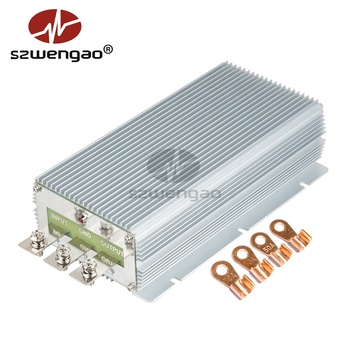
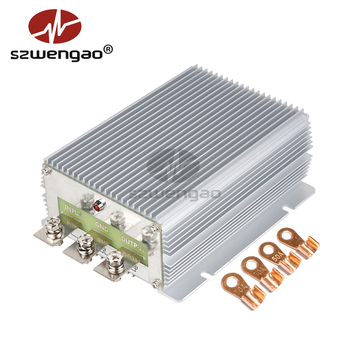
Precision DC-DC Step Down & Conditioning Solutions

Explore our high-demand buck regulators and dual-chemistry lithium solutions. Manufactured with automotive-grade potting, integrated thermal management, and comprehensive short-circuit protection.
Procurement Whitepaper & Technical Analysis

Overcoming Conversion Inefficiencies in Modern DC Microgrids

Industrial systems face hostile electrical realities: cold cranking drops, alternator load dump spikes, rapid temperature excursions, and aggressive ground potential shifts. Selecting an industrial-grade DC step down converter from a verified Chinese factory requires auditing beyond continuous rating claims.

In heavy transport and off-highway commercial machinery, step-down converters must sustain extreme transients. A typical 24V commercial vehicle alternator regularly exhibits ISO 7637-2/ISO 16750-2 transients, including 100V+ inductive surges during sudden battery disconnects (load dump). Standard commercial converters fail prematurely under these stress pulses due to sub-rated MOSFET avalanche breakdowns. Eltrum’s high-power step-down platforms integrate multi-stage input transient voltage suppressor (TVS) arrays, high-Q metal alloy inductors, and specialized active clamping circuits to safeguard the solid-state buck stages.

Synchronous Rectification

Traditional non-synchronous buck converters rely on Schottky freewheeling diodes, causing an inherent forward voltage drop of 0.4V to 0.7V. Under 50A or 100A output conditions, this translates into 25W–70W of wasted heat. Eltrum implements dynamic multi-phase synchronous gate driving using low RDS(on) MOSFETs, pushing continuous conversion efficiency up to 96.5% and mitigating thermal throttling.

Galvanic Ground Decoupling

Common-ground architectures in large material handling equipment, marine vessels, and telecommunications towers frequently suffer from persistent circulating ground loops. In isolated step-down modules, high-frequency planar transformers provide up to 1500V DC true galvanic isolation, preventing logic-level controller lockups and shielding sensitive telemetry devices from high-power return noise.

Potting & Heat Dissipation

Air-cooled buck units fail in engine bays and marine bilges due to humidity ingress and trace corrosion. We utilize direct vacuum potting with high thermal-conductivity polyurethane compounds. This vacuum-degassed encapsulation guarantees void-free IP68 environmental sealing, internal dampening against 5G vibration, and uninterrupted conductive heat flow to aluminum heatsinks.

Thermal Derating vs. Nameplate Power Realities

A prevalent trap for international sourcing managers is specifying power supplies based solely on 25°C ambient lab sheets. Real-world operating temperatures inside equipment enclosures easily breach 55°C to 70°C. Eltrum provides fully mapped thermal derating curves across every model family. By engineering headroom into inductor saturation limits and capacitor ripple ratings (utilizing 105°C-rated solid electrolytic capacitors), our step-down modules sustain rated ampere outputs without brownouts or premature thermal shutdown.

Market Intelligence & Technology Roadmap

Future DC-DC Procurement & Engineering Trends

The transition toward electrification across warehousing, recreational mobility, marine auxiliary systems, and utility microgrids is transforming the technical demands placed on DC-DC step down converters.

1. Wide-Bandgap GaN & SiC Architecture

Next-generation industrial DC step-down platforms are rapidly migrating toward Gallium Nitride (GaN) and Silicon Carbide (SiC) switches. These wide-bandgap semiconductors dramatically reduce switching losses at elevated frequencies (300kHz–1MHz). For original equipment manufacturers (OEMs), this unlocks up to 40% reduction in inductor physical footprint, lighter onboard assemblies, and cooler enclosure operating temperatures.

2. Ultra-Wide Voltage Windows (18V-100V+)

Equipment builders are abandoning narrow fixed-ratio converters. Sourcing trends prioritize consolidated SKUs capable of operating across legacy 24V, 36V, 48V, and modern 72V/80V industrial battery profiles. A single wide-input step-down SKU simplifies global spare parts management, streamlines production assembly lines, and guarantees compatibility with both lead-acid and variable LiFePO4 discharge knees.

3. Digital Telemetry via CANbus & RS485

Passive step-down regulators are giving way to digitally connected smart converters. Autonomous Mobile Robots (AMRs), smart RV energy hubs, and fleet telematics systems require real-time current logging, internal PCB temperature monitoring, remote voltage trim, and dynamic sleep states. Integrating MODBUS-RTU and CANopen communication enables proactive system health diagnostics before field power disruptions occur.

4. Stricter Global Regulatory & Supply Resilience Audits

Western Tier-1 procurement teams are shifting away from fragmented trading intermediaries toward directly audited, ISO 9001 certified manufacturing facilities. Full traceability on automotive-grade active components, comprehensive CE/RoHS test documentation, documented MTBF figures (>100,000 hours), and verified export supply chains represent mandatory criteria for long-term contract fulfillment.

Shenzhen Manufacturing Base

Engineering Rigor, Automated SMT & In-House QC

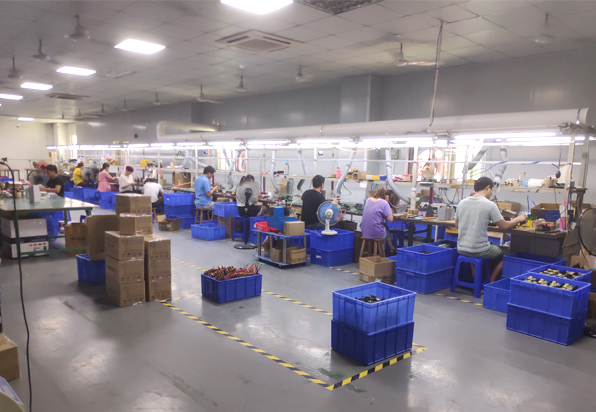
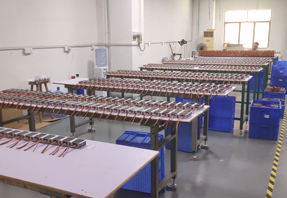
Shenzhen Eltrum Electronic Co., Ltd. has delivered precision power conversion technologies since 2015. Our modern manufacturing facility encompasses specialized automated surface-mount (SMT) lines, high-frequency transformer winding bays, computerized vacuum potting cells, and dedicated burn-in testing chambers.

We work directly with OEM procurement engineers and international distributors to design, modify, and produce rugged step-down converters, multi-chemistry lithium battery chargers, and galvanic isolated modules tailored to exact application envelopes.
  • ISO 9001 Quality System
  • CE & RoHS Full Compliance
  • 100% Full-Load Burn-In Tested
  • Custom Voltage & Pinout OEM/ODM
Shenzhen Eltrum Electronic Manufacturing Plant
Shenzhen Production Facility (Est. 2015)
Automated Surface-Mount SMT Assembly Line
Automated SMT Placement
Quality Control and Burn-In Environmental Testing
100% Thermal & Load QC
Direct Answers for Technical Sourcing

Frequently Asked Procurement Questions

Clear, unhedged engineering insights to help component engineers and purchasing directors specify the right step-down hardware.

What is the exact distinction between non-isolated buck converters and isolated DC-DC converters?
A non-isolated buck converter shares a common electrical ground plane between the input power source and the output load. It utilizes synchronous MOSFET switching and energy-storage inductors to step down voltage with peak efficiency (93%–96%) at a lower price point and compact dimensions. An isolated DC-DC converter passes electrical energy magnetically across a high-frequency planar transformer barrier, separating the input negative return from the output negative return. Isolation is mandatory in environments with potential ground voltage shifts, positive-ground legacy telecom installations, high-voltage vehicle traction batteries (60V–90V), or where high-power inductive switching generates ground bounce capable of resetting microcontrollers.
When should an engineer select a buck-boost converter instead of a standard step-down buck converter?
Select a buck-boost topology whenever the input source voltage window dynamic can drop below as well as rise above your target regulated output voltage. For example, in a "12V system", a lead-acid or LiFePO4 battery may sag to 9.5V during heavy diesel engine cranking, rest at 12.8V, and peak at 14.6V during active alternator charging. A standard buck converter ceases to regulate whenever the input drops near or below the target voltage (due to minimum dropout requirements). In contrast, a four-switch synchronous buck-boost automatically transitions between buck, buck-boost, and boost switching modes, maintaining a stable 12.0V rail across the entire discharge and charging cycle.
How should step-down converters be sized for highly inductive or motor-driven loads?
Inductive loads such as brushed DC motors, linear actuators, hydraulic valves, and refrigeration compressors exhibit startup inrush currents ranging from 300% to 600% of their steady-state run ratings. If a step-down converter has aggressive, non-latching overcurrent protection (OCP), this instantaneous inrush will trigger cyclic voltage collapsing or continuous hiccup restarts. When sizing power supplies for dynamic mechanical loads, either select a converter rated for 1.5× to 2× the steady-state ampere draw or work with our engineering team to program a custom constant-current limiting (fold-back) curve that safely rides through motor start transients without tripping.
What are Eltrum's minimum order quantities (MOQ), sample lead times, and OEM customization capabilities?
To assist international engineering teams with bench verification and vehicle testing, our standard converter and charger product families start with an accessible MOQ of just 5 units. High-power industrial modules are supported from 1 to 2 sample units. Standard engineering samples dispatch within 3 to 5 business days. Our Shenzhen facility provides turnkey OEM/ODM services: including custom input voltage brackets (e.g., up to 120V DC), application-specific output voltages (such as 13.8V, 19V, 28V, or 58.4V), custom wire harnesses and sealed automotive connectors (Deutsch, Anderson, Amphenol), buyer-label laser marking, custom PCB layouts, and integrated RS485/CAN communication protocols.
What internal protection circuits are implemented against harsh automotive and industrial electrical surges?
Eltrum DC-DC step down converters incorporate a multi-layered hardware defense matrix:
  • Input Reverse-Polarity Protection: Low-loss series MOSFET or shunt diode bypass to eliminate installation wiring errors.
  • Over-Voltage Protection (OVP): Hardware clamp circuitry shielding output loads if downstream regulation is lost.
  • Over-Current & Short-Circuit Protection (OCP): Automatic recovery hiccup-mode or constant-current limiting without manual fuse replacement.
  • Over-Temperature Protection (OTP): Integrated thermal sensors executing thermal rollback or soft shutdown when junction temperatures exceed safe ratings (typically 100°C internal).
What certifications and test reports accompany volume production shipments?
All volume production runs are governed under an ISO 9001 certified quality management framework. Units conform to CE (EMC Directive 2014/30/EU and LVD Directive 2014/35/EU) and RoHS environmental standards. Each dispatch batch is accompanied by comprehensive Outgoing Inspection Reports (OQC), including full-load burn-in performance records, high-voltage dielectric withstand (Hi-Pot) test results for isolated series, and ingress verification certifications.

Connect Directly with an Eltrum Power Engineer

Share your input voltage range, continuous/peak current targets, and environmental criteria for an exact quote within 24 hours.

Contact Us