ISO 9001 Factory · CE & RoHS Compliant DC-DC Power · OEM / ODM Welcome

English USD [email protected]
Industrial Power Whitepaper & Custom OEM Solutions

OEM/ODM DC Step Up Converter Manufacturer & Exporter

Precision Synchronous Boost Architectures, Galvanic Isolation Systems, and High-Yield Power Topologies Engineered for Extreme Environments and Sustainable Energy Logistics.

500+
Standard Power Models
130+
Countries Exported
ISO9001
CE / RoHS Certified
96%
Peak Conversion Efficiency
Enterprise Solutions

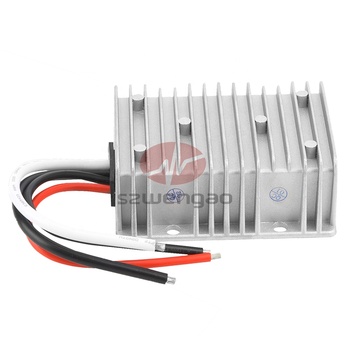
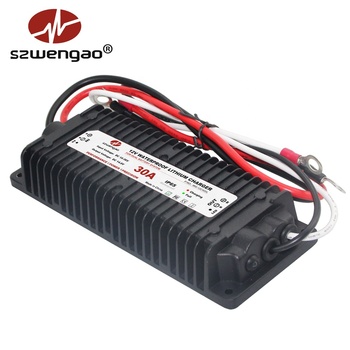
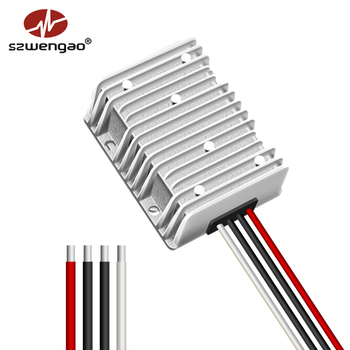
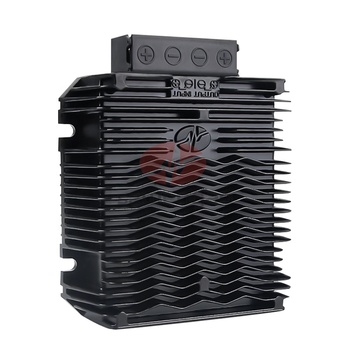
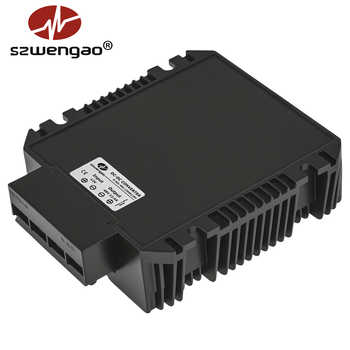
Engineered Step-Up Boost Converters & High-Current Chargers

Tested under continuous thermal loads, wide input swings, and mechanical vibration. Direct factory-engineered units tailored for vehicle chassis, maritime networks, and battery banking configurations.
Engineering Whitepaper

Deep Dive: Synchronous Step-Up Rectification & Thermal Physics

Overcoming saturation limits, parasitic capacitance, and transient ringing across extreme duty cycles.

In high-reliability industrial power electronics, achieving efficient step-up (boost) DC-DC conversion presents distinct electromagnetic and thermodynamic hurdles. When raising a low direct-current voltage (such as an automotive 12V bus or depleted renewable battery pack) to secondary stages like 24V, 43.8V, or 48V, conventional asynchronous non-isolated topologies encounter serious diode conduction losses. At forward voltage drops of 0.5V to 0.9V under a 30A sustained load, an asynchronous freewheeling diode dissipates up to 27 Watts of raw thermal waste inside the module. This uncontrolled thermal generation causes localized junction stress, accelerates potting compound degeneration, and reduces Mean Time Between Failures (MTBF).

Shenzhen Eltrum Electronic mitigates this bottleneck through Synchronous Rectification MOSFET architectures governed by custom high-speed pulse-width modulation (PWM) drivers. By swapping standard Schottkys with ultra-low \(R_{\text{DS(on)}}\) power metal-oxide field-effect transistors (typically under 2.8 milliohms), conduction loss drops drastically. This engineering advantage pushes conversion efficiencies past 96%, allowing system builders to deploy sealed enclosures without bulky external cooling fans.

Planar Magnetics & Low ESR

Our boost converters utilize custom sendust, iron-silicon-aluminum, or high-flux toroidal inductors wound with multi-strand Litz wire to counter high-frequency skin effects.

  • Significantly minimized hysteresis & eddy losses
  • Solid-state conductive polymer output decoupling
  • Ripple and transient spikes suppressed below 1% \(V_{\text{out}}\)

Severe Electrical Defense

Commercial mobile setups deal with harsh electrical transients like ISO 7637-2 alternator load dump spikes and cold-crank voltage sags down to 6.5V.

  • Multi-tiered transient voltage suppression (TVS) arrays
  • Instantaneous input reverse polarity safeguards
  • Automated foldback thermal cutoffs with auto-recovery

Hermetic Resin Encapsulation

For vessels, outdoor machinery, and EV chassis, our high-vacuum potting process prevents microscopic void formation within the thermally conductive polymer.

  • Certified IP67 and IP68 waterproof ratings
  • Resistance to saline mist, acidic oils, and damp corrosion
  • Dampens vibrational stress compliant with MIL-STD-810G
Strategic Sourcing Insights

Next-Gen Market Trends Reshaping DC Conversion

B2B procurement teams must look beyond unit price. The global transition toward electrified fleets, intelligent telematics, and compact packaging demands forward-looking hardware specifications.

Wide-Bandgap (GaN & SiC) Adoption

Gallium Nitride (GaN) and Silicon Carbide (SiC) semiconductors are shifting the power density benchmark across custom converters. By operating at switching frequencies over 300kHz–500kHz, physical magnetic footprint shrinks by up to 45% while handling higher peak surge currents without saturation breakdown.

Procurement Takeaway: Specify wide-bandgap topologies where structural volume and payload weight carry premium costs (e.g., aerospace, delivery robotics, and marine racing hulls).

Real-Time Bus Communications (RS485 / CAN)

Passive step-up modules that output unmonitored power are being phased out in modern machinery. Tier-1 integrators now require converters that support RS485 Modbus or CAN bus links, streaming operational metrics directly into the host PLC or central fleet cloud.

Procurement Takeaway: Eltrum manufactures boost modules equipped with bi-directional communications, delivering real-time telemetry on output voltage, load amperage, operating temperature, and fault alerts.

Chemistry-Specific CC/CV Charging Curves

Connecting a plain boost regulator directly to Lithium Iron Phosphate (LiFePO4) or Lithium Nickel Manganese Cobalt (NMC) batteries can degrade cells or trip BMS low-temperature protections. Sourcing demands dynamic constant-current/constant-voltage (CC/CV) step-up charging systems.

Procurement Takeaway: Our integrated chargers deliver precise absorption voltages (e.g. 14.6V for 12V LiFePO4; 43.8V for 36V arrays; 58.4V for 48V banks) with automatic float drops to avoid overcharging.
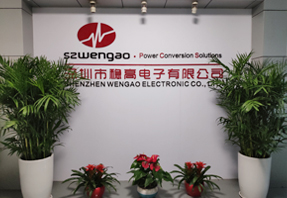
Shenzhen Eltrum Electronic Co., Ltd. Headquarter and Automated SMT Factory
Enterprise Trust & Capability

Precision Manufacturing Direct from Shenzhen

Since 2015, Shenzhen Eltrum Electronic Co., Ltd. has led the engineering and global export of rugged DC-DC converters, isolated modules, and specialized battery chargers. Located in Shenzhen's Hangcheng technology corridor, our 3,000m² production site operates under strict ISO 9001 certified quality control, with every facility detail independently inspected and verified on-site.

We work directly with industrial equipment OEMs, marine installers, and vehicle modifiers across North America, Europe, Australia, and Asia. Our on-site capabilities range from surface-mount placement and in-circuit automated optical inspection (AOI) to computer-controlled potting, environmental burn-in stress testing, and custom branding.

  • • Low Sample Barrier: Rapid evaluation units starting from just 5 pieces.
  • • Complete Customization: Tailored voltage steps, IP ratings, harness terminations, and firmware curves.
  • • 100% Quality Audited: Every unit passes automated full-load burn-in screening before leaving our facility.
Procurement Knowledge Base

Frequently Asked Questions: DC Boost Converters

Direct technical answers to common integration questions raised by system design engineers, buyers, and international distributors.

What is the core difference between a Non-Isolated Boost Converter and an Isolated Step-Up Converter?
Non-isolated boost converters share a direct electrical ground connection between the input negative and output negative terminals. This configuration achieves exceptional efficiency (often exceeding 96%), smaller physical profiles, and economical bill-of-materials costs. Isolated step-up converters incorporate an internal high-frequency planar transformer that completely breaks the galvanic loop, providing 1,500V DC or higher galvanic isolation. Isolated models are required when dealing with distinct vehicle ground potentials, negative-ground telecommunication arrays, high-voltage traction units (forklifts/mining carts), or systems sensitive to common-mode electrical noise.
How should procurement teams calculate input cable gauge and fusing for high-ratio boost units?
Because power must remain conserved (\(P_{\text{in}} = P_{\text{out}} / \text{Efficiency}\)), lower input voltages draw proportionally higher currents. For example, stepping up 12V to 48V at a 10A output requires 480 Watts. Factoring in a 95% efficiency, input draw reaches roughly 505W. At nominal 12V, that demands 42 Amperes of input current; if the input source sags to 10V during engine cranking or battery depletion, input draw spikes to nearly 51 Amperes. Cable harnesses, copper busbars, and fuse ratings must be calculated using the minimum input operating voltage rather than the nominal figure to prevent resistive heat accumulation and voltage drops.
Can a standard DC-DC step-up voltage converter be used to charge LiFePO4 batteries?
Using a standard constant-voltage (CV) power converter as a battery charger is not advised. A discharged lithium battery acts almost like a short circuit, drawing maximum instantaneous current from the source. Standard step-up converters can enter continuous over-current protection shutdown or experience thermal overload when subjected to this load. Purpose-built chargers—such as our Smart 36V Lithium Battery Charger (DC 12V to 43.8V 13A)—integrate dedicated constant-current/constant-voltage (CC/CV) control logic. These charge at a stable, regulated amperage until the cells reach their target absorption threshold before smoothly tapering off.
What environmental testing standards are applied to Eltrum's potted converters?
All Eltrum waterproof boost modules undergo rigorous environmental validation. Our production methodology utilizes vacuum-degassed, flame-retardant polyurethane or silicone epoxy filling compliant with UL94V-0 flammability criteria. Modules are subjected to 100% full-load thermal burn-in screening, thermal shock cycling from -40°C to +85°C, continuous salt spray atmosphere exposures for coastal deployment, and three-axis mechanical vibration profiles replicating off-road commercial transit environments.
What is the standard lead time, MOQ, and sampling policy for custom ODM development?
We maintain an engineer-friendly sampling threshold, with baseline testing orders beginning at just 5 units for catalog hardware. For full custom ODM engineering (such as customized input voltage ratios, proprietary aluminum chassis molds, bespoke wire terminations, or specific digital CAN/RS485 firmware protocols), sample prototypes are usually ready for bench testing within 10 to 18 working days. Standard volume batch production ranges from 2 to 4 weeks depending on order volume and component lead times. Shipments are handled globally under FOB or EXW terms, with payments supported via T/T, PayPal, or Escrow.
Direct Engineering Support

Require an Engineered Voltage Step-Up Solution?

Consult directly with our Shenzhen power engineering team. Whether you need custom enclosure dimensions, specialized potting for marine environments, or high-volume delivery, we build power systems configured to your precise requirements.

Contact Us