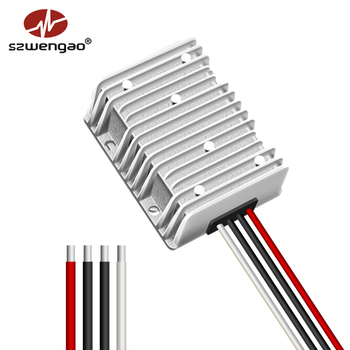
ISO 9001 Factory · CE & RoHS Compliant DC-DC Power · OEM / ODM Welcome

English USD [email protected]
Tier-1 OEM/ODM Manufacturing Guide

OEM/ODM DC DC Voltage Regulator Manufacturer & Factories

Precision Power Conversion, Galvanic Isolation & Intelligent LiFePO4 Charging Platforms Engineered for Global Mission-Critical Deployments

Industry Technical Whitepaper

Engineering High-Reliability DC-DC Voltage Regulation Architecture

Direct current power networks across modern commercial vehicles, off-grid storage installations, telecom infrastructure, and precision industrial automation are subjected to profound electrical stress. Real-world input voltages never mirror clean laboratory specifications. Vehicle engine cranking events induce harsh voltage sags down to 8V, alternator dump transients surge beyond 60V, and inductive mechanical switching triggers rapid EMI spikes. An industrial DC-DC voltage regulator must not merely conduct passive conversion—it must serve as a high-efficiency electrical buffer and stabilization barrier.


Strategic Sourcing Analysis

Emerging Procurement Dynamics in Industrial Power Electronics

Procurement directors and supply chain managers are recalibrating their vendor matrices. Commodity power supplies are increasingly discarded in favor of robust, factory-customized conversion topologies tailored to global electrification.

Supply Chain Consolidation via Universal Wide-Input Platforms

Global OEMs are actively migrating away from narrow-band SKUs. Procuring a single ultra-wide input regulator (e.g., 18V–90V) allows tier-1 integrators to service 24V commercial trucking, 48V material handling, and 72V light electric utility vehicles with one certified platform, slashing inventory overhead and speeding regional homologation.

Direct-to-Factory OEM/ODM Specification Engineering

Standard off-the-shelf catalog models often fall short regarding specialized enclosure dimensions, wire harness routing, and custom terminal terminations (Anderson, Deutsch, waterproof screw terminals). Sourcing strategies now prioritize manufacturers that deliver fully customized potting, PCB revisions, and private-label branding with low initial NRE costs.

Stringent Demands for Full-Lifecycle Traceability & Environmental Sealing

With massive adoption in harsh operational environments—such as marine auxiliary electronics, mining AGVs, and outdoor telecommunication nodes—procurement criteria prioritize verified IP67/IP68 hermetic vacuum potting using thermally conductive epoxy compounds over unsealed vented designs prone to salt-spray and condensation failures.

R&D Roadmaps

Next-Generation DC-DC Topology & Component Trends

The intersection of wide-bandgap semiconductors, digital control loops, and specialized battery chemistry integration is dictating the engineering evolution of DC-DC conversion hardware.

Wide-Bandgap GaN & SiC Power Stages

Silicon Carbide (SiC) and Gallium Nitride (GaN) MOSFETs allow dramatically higher switching frequencies (>300kHz) with minimal switching losses, permitting the miniaturization of internal planar magnetics while driving power density above 35W per cubic inch.

Digital Control Loops & RS485/CAN Telemetry

Analog PWM controllers are transitioning to integrated DSP/MCU platforms capable of executing adaptive synchronous rectification, continuous real-time health monitoring, dynamic current limit throttling, and remote fault reporting across industrial networks.

Dedicated LiFePO4 / NMC Multi-Stage Charging Profiles

DC-DC regulators are expanding past static output rails into intelligent battery-to-battery (B2B) charging platforms. Integrated logic manages precision constant-current/constant-voltage (CC/CV) profiles, low-temperature cutoff safety, and alternator back-feed isolation.

Advanced Thermal Conduction Potting Systems

Dissipating hundreds of watts without active cooling fans requires cutting-edge encapsulation. Formulations using aluminum oxide-filled polyurethane or silicone provide thermal conductivities >1.5 W/m·K, dampening severe vibration and preventing internal thermal hot spots.

Manufacturing Integrity

Shenzhen Eltrum Electronic Co., Ltd.

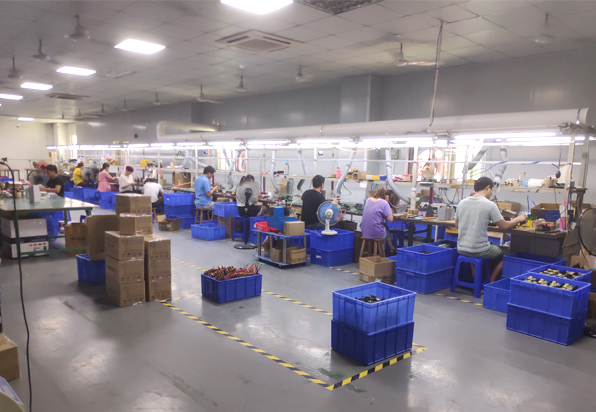
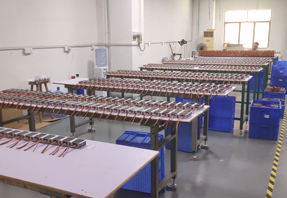
Founded in 2015, Shenzhen Eltrum Electronic Co., Ltd. has established itself as an authoritative engineering powerhouse specialized in high-efficiency DC-DC converters, isolated power modules, and intelligent LiFePO4 battery charging solutions. Operating out of our advanced Shenzhen manufacturing hub, our onsite-verified facilities span up to 3,000 m² of specialized production, SMT mounting, potting, and automated testing infrastructure.

With an engineering catalog exceeding 500+ active standardized production models, we support leading commercial vehicle upfitters, marine systems builders, telecommunications providers, and renewable energy innovators across more than 130 countries worldwide.

500+
Power Models
130+
Global Markets
5 Pcs
Validation MOQ

Our facility operates under rigorous ISO 9001:2015 Quality Management Systems. Products comply strictly with international CE (LVD/EMC) and RoHS environmental directives. From prototype validation to high-volume container shipments, our direct factory engineering workflow delivers rapid NRE turnaround and verified electrical integrity.
Engineering Consultation

Frequently Asked Questions: DC-DC Regulation & OEM Sourcing

Essential technical and logistical answers compiled by our chief applications engineering team for procurement professionals and system designers.

What core distinctions dictate choosing between Buck, Boost, and Buck-Boost topologies?
Topology selection is determined by the minimum and maximum input voltage limits relative to the required output:
  • Buck (Step-Down): Applied strictly when maximum input voltage and minimum sag voltage always remain higher than the target output (Vin,min > Vout + dropout). Example: Stepping down 24V or 48V battery banks to 12V auxiliary networks at up to 96% efficiency.
  • Boost (Step-Up): Selected when the input source is consistently below the target rail (Vin,max < Vout). Example: Raising a 12V chassis battery to run 24V marine steering or 48V auxiliary winches.
  • Buck-Boost (Voltage Stabilizer): Mandatory when the source voltage dynamically fluctuates across both sides of the output target. A prime example is an auxiliary 12V battery system: under engine starting or heavy discharge, voltage drops to 9V–10V, whereas during alternator bulk charging it reaches 14.6V. A buck-boost converter holds a continuous, fixed 12.0V or 13.8V rail throughout this swing.
When is Galvanic Isolation mandatory versus Non-Isolated conversion modules?
Non-isolated converters share a common electrical negative return (ground) between input and output, maximizing efficiency, lowering component count, and reducing physical size. However, galvanic isolation (incorporating internal transformer coupling rated for 1500V DC+) is strictly necessary when:
  1. Breaking destructive ground loops that introduce noise into sensitive telemetry, communications, or navigation sensors.
  2. Interfacing with telecommunications power systems operating on -48V positive-ground polarities.
  3. Protecting downstream control electronics from high-voltage traction battery packs (e.g., 72V–96V in forklifts, AGVs, or golf carts) where chassis grounding faults could expose human operators or low-voltage processors to lethal potentials.
What are Eltrum's minimum order quantities (MOQ) and sample validation lead times?
To empower tier-1 engineers and OEMs to thoroughly validate hardware on the bench and inside operational vehicles before committing to large inventory runs, our baseline MOQ for standard catalog models starts at just 5 units. High-power systems (e.g., 1000W–1500W buck-boost modules) can frequently be sampled at 1–2 units. Typical sample lead times are 3 to 7 working days, while bulk manufacturing contracts (500–5000+ units) maintain standard delivery timelines of 3 to 4 weeks.
How does an intelligent DC-DC battery charger protect vehicle alternators when charging LiFePO4 batteries?
Lithium Iron Phosphate (LiFePO4) chemistries exhibit exceptionally low internal impedance, meaning a depleted pack will draw the absolute maximum current an alternator can supply. At engine idle speeds, low fan airflow combined with sustained 100% current draw causes standard automotive alternators to rapidly overheat and burn out their internal diodes. Eltrum's DC-DC battery chargers enforce programmable input current limits, soft-start ramping, and alternator temperature-aware throttling, ensuring the vehicle's primary starting battery and alternator remain undamaged while delivering a tailored multi-stage CC/CV profile to the lithium bank.
What OEM/ODM customization capabilities are available for specialized applications?
Shenzhen Eltrum Electronic Co., Ltd. provides complete end-to-end design and buyer-label manufacturing services. Available modifications include:
  • Customized electrical parameters: non-standard input windows (e.g., up to 120V DC) and application-specific fixed output rails (5V, 7.5V, 9V, 13.8V, 19V, 28V, 58.4V).
  • Physical and environmental engineering: bespoke CNC-milled or die-cast aluminum heatsink shells, specific mounting flanges, and tailored silicone potting compounds.
  • Connectivity and communication: custom wire lengths, IP68 automotive connectors, and RS485 / Modbus RTU telemetry for digital remote status control.
Which international certifications and quality controls govern Eltrum factory production?
Our production workflows operate in compliance with ISO 9001:2015 quality standards. Every manufactured production unit passes through a multi-stage validation gateway: incoming component screening (AQL standards), automated SMT inspection, 100% full-load electrical burn-in testing under controlled thermal stress, and final potting dielectric hi-pot testing. Our entire standard catalog carries CE certification (covering EN 61000-6-3 emission and EN 61000-6-1 immunity requirements) and RoHS environmental compliance. Official test certificates are readily furnished upon request.

Accelerate Your Custom Power Electronics Project

Connect directly with our Shenzhen power engineering team to discuss input parameters, enclosure form factors, volume production schedules, or request custom-tailored samples.