Featured Step-Up Voltage Regulators & Boost Chargers
Engineered for automotive transients, marine ingress protection, and rugged industrial DC microgrids. Explore verified high-power step-up platforms available for OEM customization.

Smart 36V Lithium Battery Charger DC 12V to 43.8V 13A
- TopologyBoost CC/CV Charging
- Input RangeDC 10.5V – 16.0V
- Output Power570W Peak / IP67 Potted
- ApplicationEV, Marine & Electric Bike
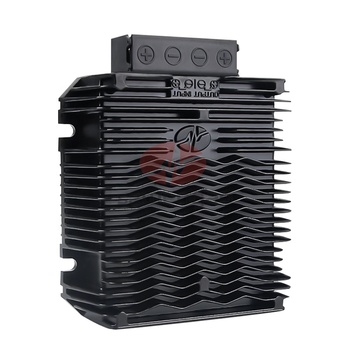
12V to 24V/48V High-Current Boost Regulator 50A/20A
- EfficiencyUp to 96.5% Synchronous
- Current Rating50A Continuous Output
- ThermalAluminum Extruded Base
- ProtectionOCP, OVP, OTP Self-Recovery
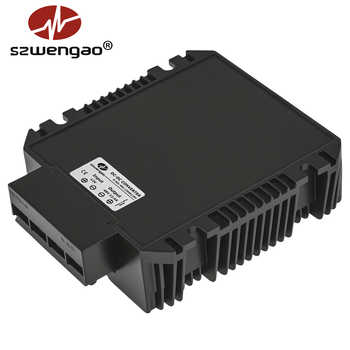
Heavy-Duty 12V to 48V Step-Up Boost Module 12.5A–20A
- Ingress RatingIP68 Epoxy Encapsulated
- Input SwingDC 9.0V – 32.0V
- Continuous Load600W – 960W Pure Output
- Target SectorsRobotics, Solar AGVs, Vessels
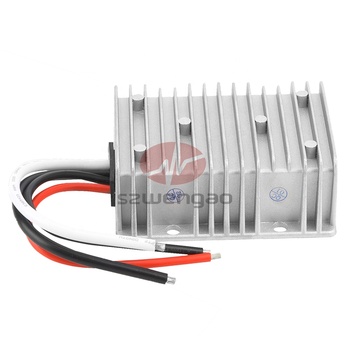
24V to 48V High-Torque Boost Converter 10A/15A
- Output Power480W – 720W Max
- Ripple & Noise< 50mVp-p Low EMI
- ComplianceCE / RoHS / ISO 9001
- Vehicle Grade24V Commercial Fleets

1500W Smart Buck-Boost Step-Up/Down with RS485 Bus
- Operating RangeDC 10V – 60V Wide Rail
- Output Config12V / 24V / 28V / 48V Programmable
- TelemetryRS485 Modbus Protocol
- CoolingSmart Active Fin Thermal Core
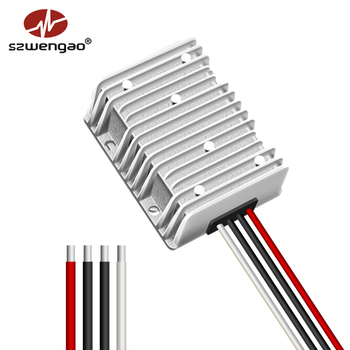
Wide 8–40V to 13.8V 30A Dynamic Voltage Stabilizer
- Cranking Ride-ThroughStarts reliably at 8.0V
- Regulated Output13.8V Lead/LiFePO4 Float
- Max Amperage30A (414W Sustained)
- ProtectionSurge / Load-Dump Suppressor
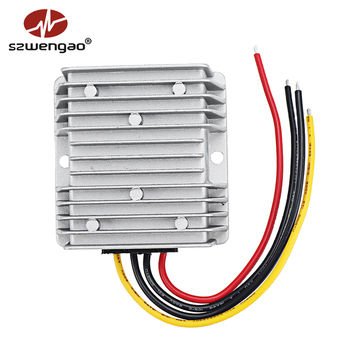
9–40V to 24V 10A Boost-Buck Industrial Converter
- Nominal Power240W Continuous
- Static Current< 15mA Low Standby Drain
- Operating Temp-40°C to +85°C Industrial
- Form FactorUltra-Low Profile Die-Cast
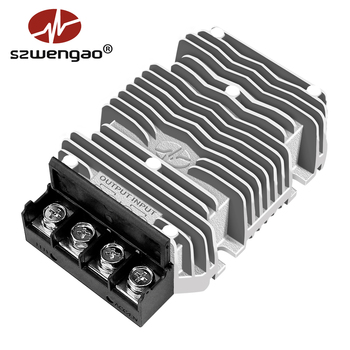
9–40V to 28V 20A High-Capacity Step-Up Regulator
- Max Output560W Regulated 28V Rail
- Conversion Rate> 95% High Reliability
- EncapsulationFlame-Retardant Silica Gel
- DeploymentsAviation, Marine LED, Telecom
State-of-the-Art Step-Up Power Conversion Architecture
Deep technical insights into high-current synchronous rectification, wide-bandgap semiconductors, dynamic loop compensation, and ingress-sealed packaging for enterprise hardware designers.
Synchronous MOSFET Switching
Traditional asynchronous boost converters utilize Schottky freewheeling diodes that generate severe conduction losses ($V_f \times I_{load}$) at high output currents. Eltrum's OEM step-up platforms replace the diode with ultra-low $R_{DS(on)}$ N-channel synchronous MOSFETs governed by zero-voltage-switching (ZVS) gate timing, curbing thermal dissipation and pushing power conversion efficiencies beyond 96.5%.
- Minimized $I^2R$ heat profile extending internal MTBF
- Active dead-time control preventing shoot-through
- Seamless Continuous Conduction Mode (CCM) transition
Magnetic Optimization & Flux Margining
Inductor saturation under heavy current swing is the primary culprit of boost converter switch catastrophic failures. We employ sendust (Kool Mµ) and high-permeability iron silicon aluminum toroids with low core loss at high frequencies (100kHz–350kHz). Our planar magnetic custom windings reduce skin effect and leakage inductance, maintaining high stability even under 150% inrush surge conditions.
- High saturation flux density ($B_{sat} > 1.0\text{ Tesla}$)
- Custom copper-foil interleaving for reduced AC resistance
- Shielded inductor housing for ultra-low radiated EMI
Full Vacuum Silicone Encapsulation
Designed for harsh mobile and marine environments, our modules are filled with UL94V-0 certified, flame-retardant thermally conductive organosilicon potting under automated vacuum deaeration. This completely eliminates internal air pockets, provides high dielectric withstand voltage (>1500V DC), guarantees IP68 ingress sealing, and conduits operational heat uniformly to the aluminum alloy chassis.
- Thermal conductivity $\ge 1.2\text{ W/m}\cdot\text{K}$ potting formulation
- Immunity against salt-spray, diesel vapor, and continuous vibration
- Operating temperature span verified from -40°C to +85°C
| Converter Topology | Input to Output Relation | Peak Efficiency | Dynamic Inrush Handling | Typical OEM System Deployment | Custom Design Support |
|---|---|---|---|---|---|
| Non-Isolated Boost | $V_{in} < V_{out}$ strictly | 94.0% – 97.2% | High peak capacity; requires pre-charge | 12V vehicle battery to 24V/48V motors, audio amps, LED arrays | Custom Voltage/PGA |
| 4-Switch Buck-Boost | $V_{in}$ dynamic overlap $V_{out}$ | 92.5% – 95.8% | Continuous regulation during engine cranking | Automotive stabilizers, 12V rail preservation, marine navigation | RS485 Telemetry |
| Isolated Flyback / Forward | Galvanic separation ($\ge 1.5\text{kV}$) | 88.0% – 92.5% | Isolated ground barrier prevents ground loops | Telecom racks, industrial PLCs, forklift battery-tap isolators | Custom Transformer |
| Synchronous Boost Charger | Microcontroller 3-Stage CC/CV | 93.5% – 96.0% | Controlled soft-start; reverse battery block | Vehicle-to-battery charging (12V input to 24V/36V/48V LiFePO4) | Firmware Chem Curves |
Future Procurement & Technological Trends (2025–2030)
Strategic supply chain directives for chief technology officers and sourcing executives navigating the transition toward wide-bandgap semiconductors, unified 48V power planes, and smart telemetry.
1. GaN & SiC Semiconductor Ingestion
As power density requirements surge toward 50W/in³, Gallium Nitride (GaN) and Silicon Carbide (SiC) high-electron-mobility transistors are replacing conventional silicon superjunction MOSFETs. Sourcing teams should anticipate 40% reduction in step-up footprint, switching frequencies exceeding 500kHz, and elevated operational efficiency at high thermal ambients.
2. Dual 12V/48V Hybrid Plane Migration
Automotive, RV, and commercial robotics manufacturers are rapidly deprecating single 12V legacy lines in favor of 48V zonal power distribution. Procurement orders for bi-directional 12V-to-48V boost regulators are experiencing a 38% CAGR to drive steer-by-wire, electric turbochargers, and high-capacity LiFePO4 house storage banks without copper cable weight penalties.
3. Dynamic Digital Control & Telemetry
Hardware buyers are increasingly refusing passive, unmonitored converters. Factory supply contracts now mandate real-time state-of-health data reporting. Regulators equipped with RS485 Modbus, CANbus 2.0B, or SMBus communication interfaces permit master controllers to adjust output voltages on the fly, balance multi-module arrays, and monitor thermal derating profiles.
4. Supply Chain Regionalization & Auditing
Recent global logistics disruptions have heightened scrutiny on tier-1 semiconductor bill-of-materials. Procurement directors prioritize factories possessing in-house high-speed SMT assembly, automated AOI inspection, and established secondary component sourcing matrices. Verified ISO 9001 quality infrastructure and direct direct-from-factory engineering support minimize lead-time shocks.
Precision Engineering by Shenzhen Eltrum Electronic Co., Ltd.
Founded in 2015, Shenzhen Eltrum Electronic Co., Ltd. is an industry-recognized leader in DC-DC power conversion technologies. Operating from our advanced 3,000m² manufacturing facility in the Anle Industrial Zone, Shenzhen, our vertically integrated plant houses high-precision automated SMT lines, automated magnetic winding workshops, and environmentally controlled burn-in test chambers.
With an engineering team dedicated to solving high-transient and thermal bottlenecks, our product catalog spans over 500 validated standard power converter models exported to over 130 countries across North America, Europe, Australia, and East Asia. Every single step-up regulator undergoes strict AOI optical inspection, vacuum encapsulation, and 100% full-load thermal burn-in aging prior to dispatch.
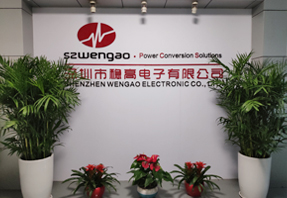 Shenzhen Headquarters & R&D Center
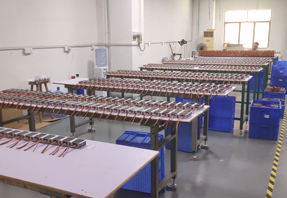 High-Speed SMT & Placement
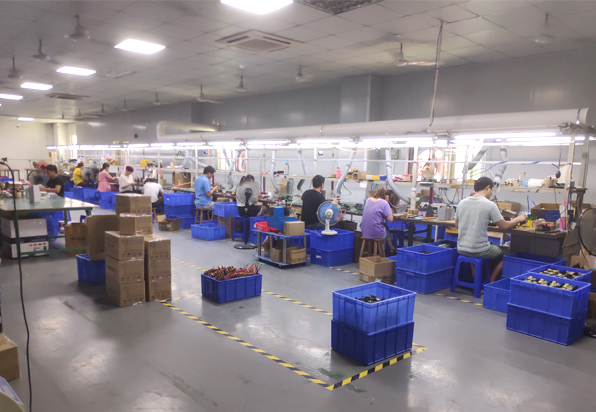 ATE Automated Burn-In & QC Station
Step-Up Regulator Customization & OEM Sizing Guide
Follow these 5 technical steps formulated by our application engineering department to guarantee error-free specification, thermal stability, and circuit reliability.
Determine Worst-Case Low Input Voltage ($V_{in,min}$)
In boost converters, input current is inversely proportional to input voltage: $I_{in} = (V_{out} \times I_{out}) / (\eta \times V_{in})$. When battery lines sag under load (e.g., a 12V battery sagging to 9.5V during heavy winching or engine start), the converter pulls massive current. Size your input fuses, wire cross-sections, and converter ratings based on $V_{in,min}$, not nominal voltage.
Assess Inrush & Inductive Reactance Loads
DC motors, compressor pumps, audio subwoofers, and capacitive bank inputs frequently draw momentary startup current 300% to 600% above steady-state nameplate values. For non-linear loads, select an Eltrum step-up regulator rated for 1.3× to 1.5× the continuous operating wattage to avoid latching into over-current hiccup mode.
Thermal Derating & Environmental Mounting
All power semiconductors experience thermal resistance ($R_{\theta JC}$). While our cast aluminum cases dissipate heat efficiently, operations in sealed engine bays or unventilated enclosures require derating. At ambients above 55°C, apply a 20% to 30% safety factor, or request an integrated cold-plate mounting profile during OEM contract specification.
Frequently Asked Questions by Industrial Sourcing Teams
Get authoritative answers regarding minimum order quantities, customization parameters, lead-time protocols, testing methodologies, and international compliance standards.
What parameters can be customized on Eltrum OEM step-up voltage regulators? +
What is the Minimum Order Quantity (MOQ) and production turnaround for custom orders? +
How does a step-up boost regulator handle input reverse polarity and load-dump surges? +
Why choose a potted IP68 step-up converter over an open-frame industrial power supply? +
Can two or more step-up converter modules be connected in parallel for higher amperage? +
Which international testing certifications and compliance standards do you adhere to? +
Accelerate Your Power Engineering Project with Custom OEM Solutions
Share your exact electrical parameters—input swing, target voltage, continuous load, ambient envelope, and mechanical constraints. Our Shenzhen engineering design division will deliver a tailored schematic assessment and competitive volume quotation within 24 business hours.