
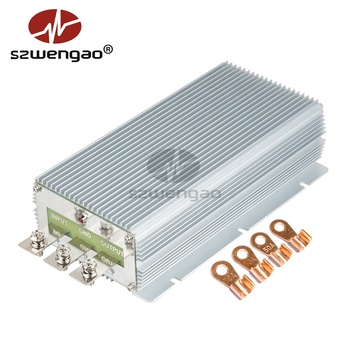
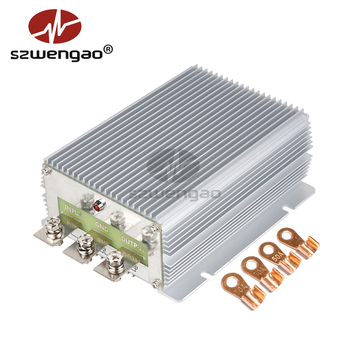
Smart 36V 13A Lithium Battery Charger
- TopologyCC/CV Step-Up/Down
- Input RangeDC 12V Nominal
- Output Power43.8V 13A (570W)
- EnclosureIP67 Sealed Alloy
Industrial-grade buck switches, high-amperage down-converters, and intelligent multi-chemistry controllers built under certified ISO 9001 precision assembly standards.
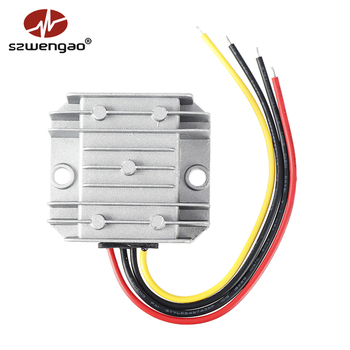
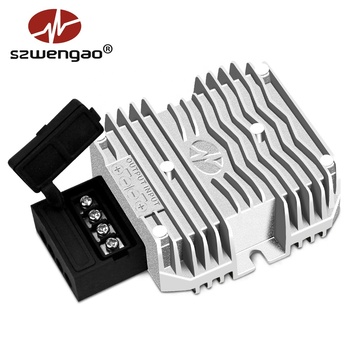

An authoritative breakdown of buck topology selection, power-train switching architectures, and thermal boundary conditions for mission-critical industrial implementations.
Traditional non-synchronous buck regulators utilize Schottky catch diodes, inducing severe conduction losses calculated as P = V_f × I_out. At a 100A continuous output, even an optimized 0.5V forward drop results in 50 Watts dissipated directly as thermal waste. Eltrum's synchronous designs replace passive catch diodes with ultra-low RDS(on) MOSFETs, reducing conduction losses by up to 82% and pushing conversion efficiency past 96% under real-world vehicle conditions.
Automotive and heavy equipment lines experience continuous electrical disturbances, including inductive load dumps (ISO 7637-2 / ISO 16750-2 pulses) exceeding 87V on nominal 24V networks. Standard 30V-rated step-down controllers suffer breakdown under these pulses. Our custom step-down modules utilize 100V-rated trench gate MOSFETs, transient voltage suppressing (TVS) arrays, and solid-state decoupling to guarantee uninterrupted DC rail regulation without system hang-ups.
In traction power distributions (such as 48V, 72V, or 80V electric utility vehicles, AGVs, and positive-ground telecom shelters), non-isolated shared-ground architectures risk severe ground-loop circulating currents. Eltrum isolated step-down regulators integrate high-frequency planar transformer coupling providing 1500V DC breakdown isolation, entirely breaking ground paths and eliminating parasitic interference across digital instrumentation lines.
Market dynamics influencing international B2B supply agreements, technical design considerations, and platform lifecycle planning over the coming decade.
High-voltage battery platforms are transitioning from traditional Silicon IGBTs to Gallium Nitride (GaN) and Silicon Carbide (SiC) semiconductors. These materials support 5x higher switching frequencies, substantially shrinking inductor dimensions and thermal mass while achieving up to 98% conversion efficiency in compact sealed chassis.
Analog step-down conversion is rapidly shifting toward digital power control. Modern procurement demands integrated RS485 / CAN bus Modbus connectivity for live telemetry feedback, enabling centralized vehicle management systems to track current consumption, board temperatures, and fault codes remotely.
Industrial OEMs increasingly eliminate open-frame regulator boards due to environmental failures caused by vibration, humidity, and chemical vapor ingress. Vacuum-infused, high-thermal-conductivity polyurethane encapsulation has become a baseline standard for heavy industrial installations.
Global automotive and material-handling directives are standardizing around 48V bus distribution architectures to reduce cabling cross-sections and copper weight. This shift drives elevated demand for high-current 48V to 12V and 48V to 24V step-down converters operating continuously between 50A and 100A.
Global supply disruptions have prompted procurement directors to bypass middle-tier trading entities, choosing instead to partner directly with source factories in Shenzhen that manage turnkey SMT assembly, automated testing, and custom housing CNC tooling in-house.
Import compliance mandates require rigorous testing for radiated and conducted EMI (EN 55032 Class B) alongside RoHS compliance. Enterprise buyers are consolidating supply chains toward verified manufacturers providing genuine third-party compliance dossiers.
Founded in 2015, Shenzhen Eltrum Electronic is a certified high-tech manufacturer specializing in industrial DC-DC power supplies, high-power buck regulators, and intelligent LiFePO4 battery charging equipment.
Operating dedicated high-speed Yamaha surface-mount technology (SMT) lines and automated optical inspection (AOI) units, our Shenzhen facility executes end-to-end component population, magnetic winding, and housing assembly with zero reliance on third-party board stuffing shops.
Every step-down regulator and power module undergoes a mandatory full-load, elevated-temperature burn-in procedure inside our climate-controlled testing bays. We verify voltage stability, current limit threshold tripping, and thermal dissipation performance before packing.
Whether you require customized input voltage envelopes (e.g., 20–100V DC input), pre-wired Anderson connectors, modified mechanical chassis, custom anodized finishes, or buyer-label packaging, our dedicated R&D engineering staff delivers rapid initial prototypes within 7 to 12 working days.
Clear, technical answers to the most common engineering and commercial inquiries directed to our technical sales team.
I_in(max) = (V_out × I_out) / (V_in(min) × Efficiency). For example, a 12V 100A (1200W) converter operating from a 24V nominal battery bank that sags to 18V under crank with 95% efficiency will draw: 1200 / (18 × 0.95) ≈ 70.1A. Input fusing and wire gauge cross-sections must be rated for at least 70A continuous duty, rather than the average 50A drawn at nominal 24V.
Collaborate directly with our power supply design team. Provide your input voltage limits, desired load output, environmental constraints, and target volume to receive a comprehensive engineering datasheet and commercial proposal within 24 hours.
Inquire Now