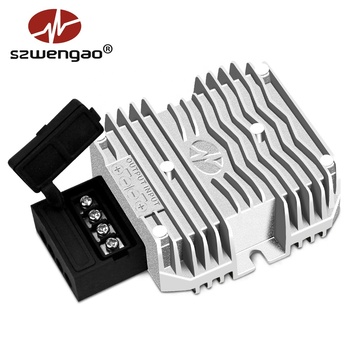
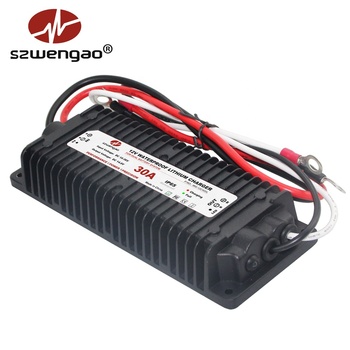
Smart 36V Lithium Battery Charger DC 12V to DC 43.8V 13A
- Input Voltage RangeDC 10V – 36V
- Output Charging43.8V CC/CV 13A
- Ingress ProtectionIP67 Fully Potted
- Primary FitEV, Marine & RV Aux
Engineered for high vibrational durability, wide thermal dissipation thresholds (-40°C to +85°C), and uncompromising step-down, step-up, and isolated regulation.


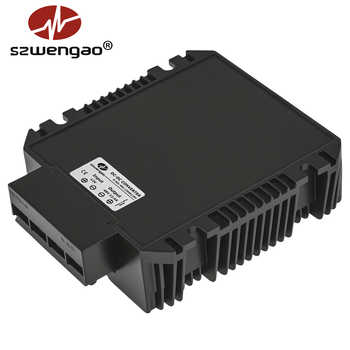
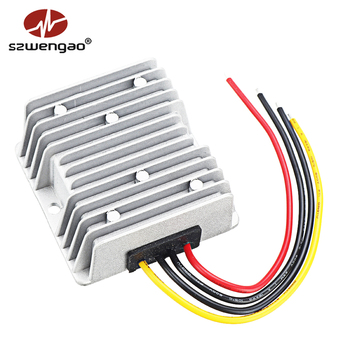
Navigating the balance between electromagnetic compatibility (EMC), thermal equilibrium, and dynamic transient load recovery in rugged DC topologies.
In modern power electronic architecture, selecting an OEM power conversion topology demands deep scrutiny of dynamic supply fluctuations. A standard Buck Converter (Step-Down) offers peak electrical efficiency (often exceeding 96%) when the source rail reliably maintains head-room voltage above output. However, in vehicular and battery-backup installations, nominal 12V or 24V lead-acid and lithium-iron-phosphate (LiFePO4) chemistries sag drastically under cranking currents—dropping down to 8.5V—and surge upwards to 29V+ during alternator absorption phases. In these environments, selecting an inappropriate topology causes intermittent load reset, thermal runaways, or catastrophic over-voltage feedthrough.
Engineering Rule of Thumb: When input rails swing across the regulated output profile (e.g., 9V to 16V battery swing powering a stabilized 12V or 13.8V rail), an OEM must implement a Non-Inverting Synchronous Buck-Boost Topology with four-switch MOSFET bridge orchestration to sustain uninterrupted voltage clamping.
Conversely, for high-potential traction systems (48V, 72V, 96V in electric automated guided vehicles and telecom central offices), ground differential elimination is mandatory. Galvanic Isolated Converters leverage planar magnetic transformers to completely detach the primary return path from the secondary chassis ground. This suppresses common-mode noise, mitigates hazardous high-voltage leakage, and neutralizes destructive ground loops across distributed sensor and CAN/RS485 transceiver networks.
| Conversion Architecture | Standard Input Range | Target Output Voltage | Isolation Class | Typical System Deployment |
|---|---|---|---|---|
| Synchronous Buck | 20V – 36V / 30V – 90V | 5V, 12V, 13.8V, 24V | Non-Isolated (Common GND) | Heavy Truck 24V Fleet Auxiliary, Fleet Telematics, In-Cab Display |
| Synchronous Boost | 9V – 20V / 18V – 32V | 24V, 28V, 36V, 48V | Non-Isolated (Common GND) | 12V Battery to 48V Solar Storage, Stepper Motors, High-Lumen LED |
| 4-Switch Buck-Boost | 8V – 40V / 10V – 60V | 12V, 19V, 24V, 28V | Non-Isolated Dynamic Bridge | Automotive Cold-Crank Stabilizers, Marine Navigation Electronics |
| Planar Isolated Forward | 18V – 36V / 36V – 75V / 18V – 90V | 5V, 12V, 24V | Galvanic 1500VDC Dielectric | Base Station Telecom, AGVs, Medical Carts, Forklift Instrumentation |

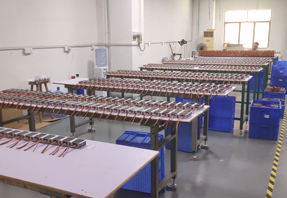
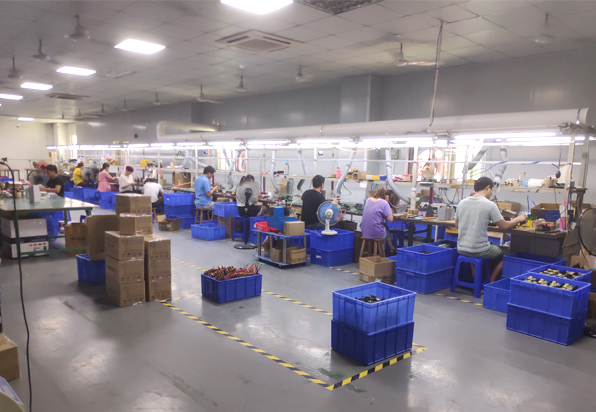
Operating from our dedicated 3,000m² manufacturing facility in Shenzhen, China, Shenzhen Eltrum Electronic Co., Ltd. (founded in 2015) bridges the critical gap between conceptual electrical engineering and volume industrial production. Our state-of-the-art SMT pick-and-place lines, automatic selective wave soldering, and computer-controlled potting systems yield over 500 validated DC-DC converter models trusted across 130 countries worldwide.
Strategic analysis of market demands shaping DC-DC module architectures through 2030.
System designers are rapidly phasing out silicon planar MOSFETs in favor of wide-bandgap (WBG) materials. Silicon Carbide (SiC) and Gallium Nitride (GaN) switching stages enable frequencies exceeding 500 kHz, drastically reducing inductive magnetic core sizing while elevating conversion efficiencies beyond 97%. This enables OEMs to pack 1500W modules into form factors previously limited to 600W.
Modern industrial procurement demands more than static power delivery. Fleet managers require bidirectional communication channels. Next-generation DC-DC converters integrate microprocessor-controlled CAN-bus, LIN-bus, and RS485 communication protocols, broadcasting real-time module temperatures, output ripple statistics, cumulative runtime data, and dynamically variable current-limit thresholds.
With the exponential growth of electrification in marine, off-grid expedition RVs, agriculture, and construction equipment, vulnerable fan-cooled vented power supplies are being obsolete. The procurement trajectory is uniformly pivoting to fanless, thermally optimized aluminum alloy enclosures encapsulated in flame-retardant epoxy or thermally conductive silicone gel (UL94-V0 rated).
Full lifecycle quality management executing ISO 9001 protocols, third-party onsite verifications, and 100% full-load thermal burn-in testing.
Every production batch undergoes strict incoming material qualification (IQC), automated optical inspection (AOI), in-circuit testing (ICT), and outgoing quality control (OQC). Raw materials are sourced exclusively from Tier-1 semiconductor and passive component vendors.
Unlike spot-sampling manufacturers, 100% of Eltrum power modules and chargers undergo continuous thermal burn-in screening under full rated electrical loads inside specialized elevated-temperature chambers before sealing and release.
We provide rapid engineering iteration. From tailor-made PCB dimensions and custom IP68 terminal pigtails to proprietary multi-stage LiFePO4 / NMC charging algorithms, our engineering team delivers functional B2B evaluation samples from 5 units within record turnaround times.
Direct technical answers to common integration, testing, logistics, and design-in inquiries.
Consult directly with our Shenzhen power electronics engineering team. Whether you need custom thermal dimensions, proprietary bus voltages, or standard evaluation units shipped within 48 hours, our technical sales department is ready to assist your B2B sourcing requirements.