Featured High-Current & Wide-Input DC Buck Converters
Direct from Shenzhen Eltrum Electronic Co., Ltd.—over 500 standard platforms deployed across automotive, heavy fleet, telecommunications, and maritime traction architectures.
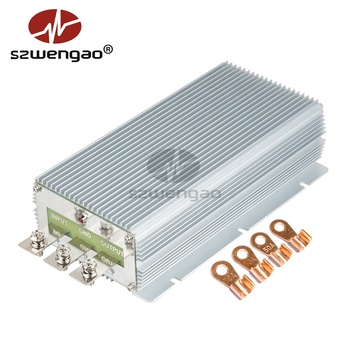
24V to 12V 85A/100A High-Current Truck Step-Down Converter
- Nominal Input: 24V DC (18–35V)
- Regulated Output: 12V DC ±1.5%
- Continuous Amps: 85A / 100A Peak
- Enclosure / Ingress: IP68 Die-Cast Alloy
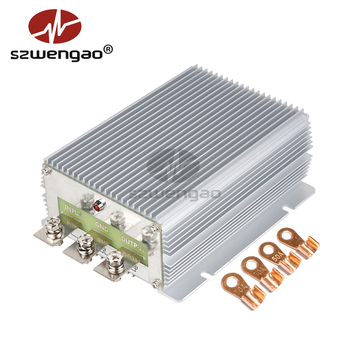
48V to 24V 40A 1000W Synchronous Industrial Buck Module
- Nominal Input: 48V DC (36–60V)
- Regulated Output: 24V DC @ 40A
- Peak Efficiency: 96.4% Synchronous
- Thermal Defense: Integrated Fin Sink
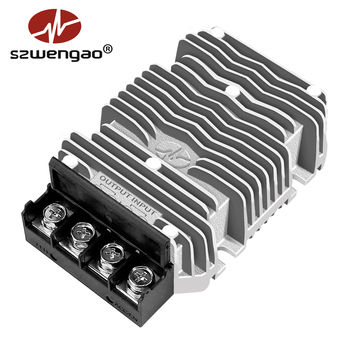
30–60V to 12V 50A/60A Step-Down Voltage Regulator
- Working Window: 30V–60V DC Wide
- Output Power: 600W / 720W Max
- Ripple & Noise: < 60mVp-p Low EMI
- Protection: OCP, OVP, OTP, SCP
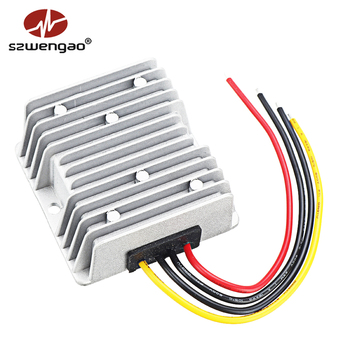
30–90V (72V Rail) to 24V 10A/20A DC Step-Down Module
- Input Compatibility: 36V, 48V, 60V, 72V
- Nominal Output: 24V DC (10A–20A)
- Target Applications: Forklifts, AGV, E-Bikes
- Encapsulation: Thermally Conductive Epoxy
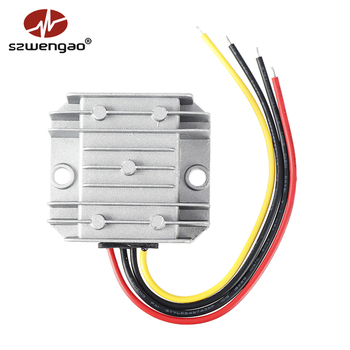
18–90V Ultra-Wide to 12V 5A/10A Auxiliary Step-Down Module
- Dynamic Span: 18V to 90V DC Sustained
- Output: 12V DC (60W–120W)
- Standby Current: < 15mA Quiescent
- Compliance: CE / RoHS Certified
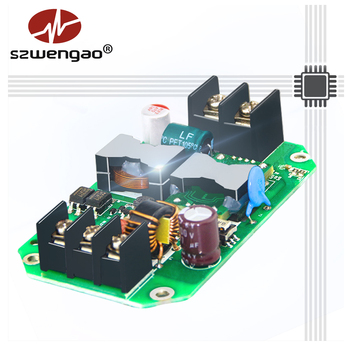
Isolated 36–75V to 12V 10A Telecom-Grade Buck Converter
- Dielectric Isolation: 1500V DC Galvanic
- Input Range: 36V–75V Standard Bus
- Grounding: Separated GND Isolation
- Application: Telecom Racks & Robotics
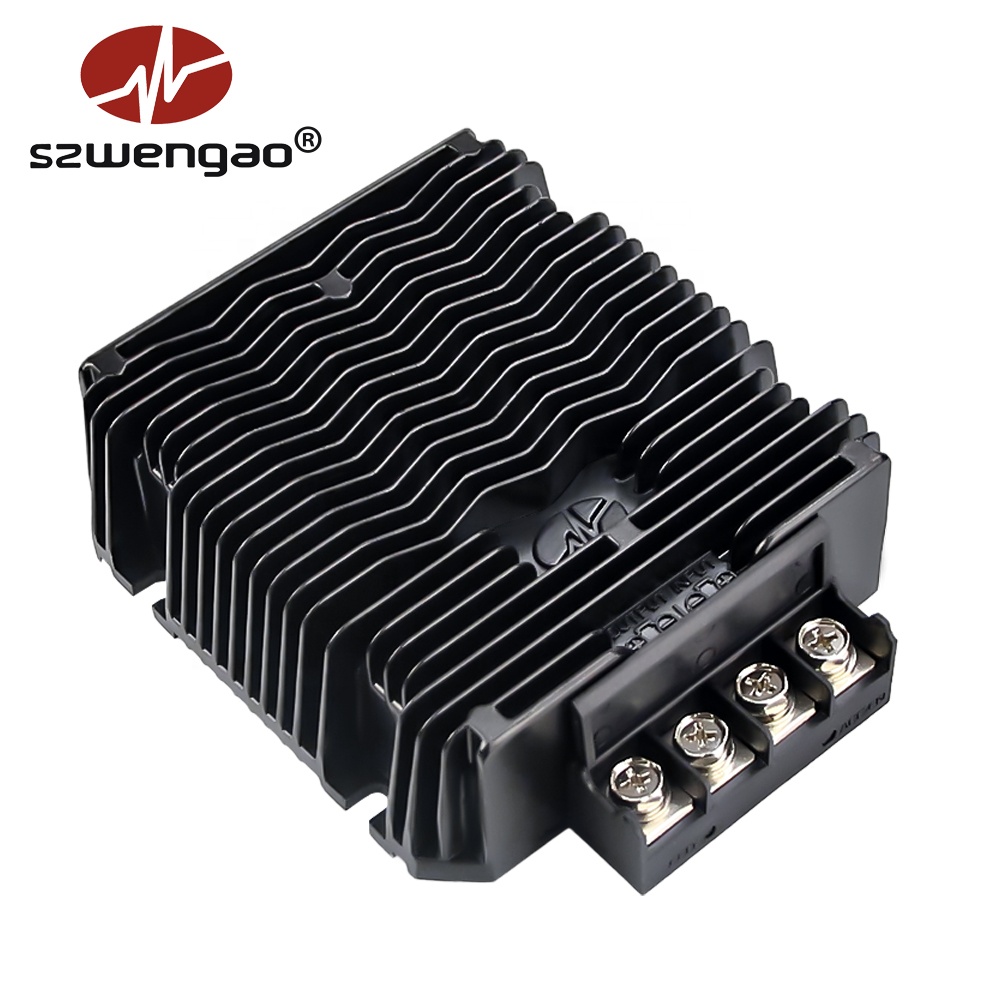
Smart 36V Lithium Charger 12V to 43.8V 13A for EV & Marine
- Algorithm: Microprocessor CC/CV
- Input / Output: 12V DC → 43.8V DC (13A)
- Protection: Smart Spark-Free & Reverse
- Waterproof Tier: IP67 Fully Potted
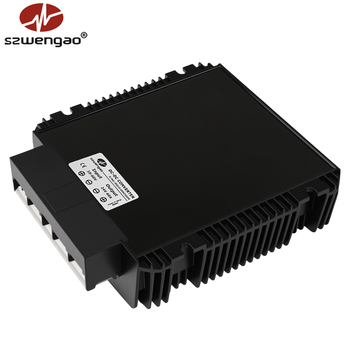
1500W High-Power Intelligent DC Converter with RS485 Modbus
- Input Span: 10V–60V Universal
- Output Rails: 12V / 24V / 28V / 48V Stable
- Communication: RS485 Full Telemetry
- Max Output: 1500W Continuous
Need Custom Conversion Ratios, Terminals, or Tailored Enclosures?
Our direct engineering workshop evaluates custom voltage envelopes (e.g., 96V to 13.8V, high vibration IP69K housings, custom CAN bus/RS485 firmware) within 24 business hours.
Engineering Architecture of Modern DC Buck Regulators
An authoritative inspection of synchronous vs. non-synchronous switching, thermal dissipation physics, transient line regulation, and automotive load dump suppression.
1. Synchronous Rectification vs. Traditional Diode Freewheeling
In classical non-synchronous step-down topologies, the low-side switch relies on a Schottky freewheeling diode. Under high current demands—such as stepping down 24V to 12V at 50A—the intrinsic forward voltage drop ($V_f \approx 0.55\text{V}$) across the Schottky results in static losses exceeding $P_{loss} = 50\text{A} \times 0.55\text{V} = 27.5\text{W}$. This concentrated thermal energy degrades efficiency below 88% and accelerates component fatigue.
Shenzhen Eltrum Electronic Co., Ltd. incorporates ultra-low $R_{DS(on)}$ synchronous MOSFETs driven by precision dead-time controllers. By substituting the diode with active silicon exhibiting on-state resistance down to $1.8\text{m}\Omega$, conduction losses plummet to under $4.5\text{W}$. This architectural upgrade elevates overall system efficiency beyond 96%, dramatically reducing thermal heatsink footprint requirements and enabling hermetically sealed IP68 form factors.
2. Wide $V_{IN}$ Transients & ISO 7637-2 Automotive Hardening
Real-world industrial vehicles and battery systems do not present a pristine DC bus. During alternator field decay or sudden load disconnections, heavy equipment power rails encounter violent transient spikes. ISO 7637-2 Pulse 5a/5b "Load Dump" simulations expose components to surges reaching upwards of 87V over a 400ms duration.
Standard buck converters fail under these transient conditions due to gate-oxide rupture or inductor core saturation. Eltrum custom OEM buck converters integrate active transient voltage suppressor (TVS) networks, solid-state clamping circuits, and shielded powdered iron toroidal cores. This ensures that fluctuating inputs—ranging from battery cold-crank conditions (sagging to 9V) up to load dump spikes—are attenuated seamlessly without output rail dropouts or voltage spikes threatening downstream computing units, navigation suites, or LED arrays.
| Architecture Class | Typical Input / Output | Conversion Efficiency | Ingress / Cooling System | Ideal Application Vectors |
|---|---|---|---|---|
| Synchronous Buck (Potted) | 24V (18–35V) → 12V (85A–100A) | 95.5% – 97.2% | IP68 Aluminum / Passive Conduction | Heavy commercial trucks, municipal transit, mining machinery |
| Wide-Rail Industrial Buck | 48V (36–72V) → 24V (20A–40A) | 94.8% – 96.5% | IP67 Enclosure / Extruded Fin Sinks | Warehouse automation, AGVs, industrial robotics, solar battery packs |
| Traction Step-Down Module | 72V (30–90V) → 12V / 24V (10A–20A) | 92.0% – 94.5% | IP68 Waterproof / Solid Silicon Resin | Electric golf carts, utility e-mobility, agricultural sprayers |
| Galvanic Isolated Buck | 48V (36–75V) → 12V (10A) | 89.0% – 92.5% | Open-Frame or Metal Can / Convection | Telecom switching centers, railway instrumentation, marine sensors |
| Smart Regulated Charger | 12V (10–18V) → 43.8V LiFePO4 (13A) | 93.5% – 95.0% | IP67 Sealed / Dynamic Multi-Stage Profile | RV dual-battery balance, off-grid lithium storage, marine charging |
Strategic Sourcing Trends in DC Power Conversion (2025–2030)
Global supply chain directors and system integrators face escalating voltage standards, stricter compliance directives, and demanding thermal constraints. Here is how modern procurement is shifting.
The Universal 48V Ecosystem Shift
Automotive tiers, telecommunications infrastructure, and data handling facilities are systematically deprecating purely centralized 12V architectures in favor of 48V zonal distribution. High-efficiency 48V-to-12V buck converters reduce copper harness mass by up to 60%, drastically cutting wire gauge costs and vehicle weight while meeting stringent energy efficiency mandates.
Tiered Solid-State Encapsulation (IP68)
Vibration-induced solder fatigue and chemical aerosol ingress represent the primary failure vectors in mobile power supplies. Modern buyers mandate factory-grade vacuum potting with thermally conductive polyurethane or silicone polymers (UL94-V0 flammability rated), eliminating air pockets and allowing continuous operation across extreme -40°C to +85°C thermal windows.
Digital Telemetry & Micro-BMS Synergy
Analogue "black-box" converters are making way for smart modules featuring embedded microcontrollers communicating via isolated RS485 (Modbus RTU) or CAN bus. Fleet telemetry systems now demand real-time diagnostics on thermal throttling, output current draw, cumulative amp-hours, and preventative alarm triggers before brown-out conditions occur.
Technological Evolution: GaN, Planar Magnetics, & Smart Power
Shenzhen Eltrum Electronic Co., Ltd.'s engineering roadmap integrates cutting-edge semiconductor physics directly into production OEM platforms.
Wide-Bandgap GaN Implementation
Gallium Nitride (GaN) switching stages enable frequencies up to 500kHz–1MHz without proportional switching loss, slashing output inductor volumes by up to 50% while operating cooler.
Planar Core Transformers
Replacing hand-wound copper chokes with multi-layer printed circuit board (PCB) planar magnetic transformers eliminates leakage inductance, optimizes thermal coupling, and delivers automated SMT repeatability.
Interleaved Multi-Phase Bucking
By phasing two or four buck channels 180° out of alignment, input and output ripple currents mathematically cancel. This minimizes stress on input capacitors and allows compact filter circuitry to pass EN 55032 Class B effortlessly.
Predictive Fault Diagnostics
Future iterations embed real-time capacitor ESR monitoring algorithms to detect dielectric wear and ambient stress over decades of usage, notifying master controllers prior to functional degradation.
Why Global Tier-1 OEMs Trust Shenzhen Eltrum Electronic
Founded in 2015 in Shenzhen, Guangdong, China. Onsite verified factory facilities dedicated to custom DC-DC conversion, battery management, and extreme-environment power engineering.
Complete OEM & ODM Customization
From tailor-made input envelopes (e.g., custom 16–95V DC) and specific non-standard output voltages (13.8V, 19V, 28V, 43.8V) to custom wire harness termination (Anderson, Deutsch, Molex) and buyer-label branding.
Full-Spectrum Burn-In & 100% QC
Every module undergoes automated full-load cycling, elevated temperature burn-in testing, insulation resistance validation, and rigorous ripple-noise profiling before packaging and worldwide dispatch.
Engineer-Friendly Low Sample MOQs
We respect engineering development cycles. Standard and modified evaluation samples begin from just 5 units, facilitating low-risk lab prototyping and vehicle field trials before commitments to container volumes.
CE & RoHS Compliance Rigor
Built to strictly comply with European Union electromagnetic compatibility (EMC) standards and hazardous substances limitations. Certificate copies and full technical construction files provided upon request.
Deep Galvanic & Buck Heritage
With isolated DC-DC converters as our foundational engineering origin, our non-isolated buck and buck-boost modules inherit identical high-reliability safety isolation, high creepage distances, and premium EMI filtering.
Global Export & Flexible Terms
Decade-long partnerships spanning North America, Europe, Australia, Japan, and Southeast Asia. We facilitate secure trade via T/T, PayPal, Escrow in USD or CNY, with FOB or EXW terms and rapid expedited air/sea dispatch.
B2B Procurement & Technical Engineering Inquiries
Direct answers to common questions posed by electrical architects, sourcing managers, and quality assurance inspectors.
What distinguishes a synchronous buck converter from a standard buck converter?
The distinction lies in the rectification method. A conventional buck converter utilizes a passive Schottky diode to handle the freewheeling current when the main high-side transistor turns off. Because diodes exhibit an intrinsic forward voltage drop ($0.4\text{V}–0.7\text{V}$), thermal losses escalate drastically under heavy loads (e.g., $50\text{A} \times 0.5\text{V} = 25\text{W}$ dissipated as pure heat).
In contrast, a synchronous buck converter replaces the freewheeling diode with a low-resistance MOSFET (often less than $2\text{m}\Omega$). The MOSFET is actively switched in synchronization with the main switch. This cuts conduction losses down to a fraction of a watt, drives efficiency upwards of 96%, reduces enclosure temperatures, and allows for compact, fanless IP68 designs.
When should an engineer select a Buck-Boost converter instead of a dedicated Buck converter?
A step-down (Buck) converter requires the input voltage to remain permanently above the target output voltage by a required headroom margin (typically at least $1.5\text{V}–2.0\text{V}$). For example, powering a regulated 12V payload from a dedicated 24V or 48V battery bank is an ideal buck converter scenario.
However, if your power source is a nominal 12V battery system, the actual terminal voltage fluctuates from 9.0V (engine cold-cranking or heavy discharge) up to 14.6V (active alternator or solar bulk charging). If your payload requires a constant, stable 12.0V or 13.8V rail without dropping out or overvolting, a buck-boost converter is compulsory because it can seamlessly step-up when input is low and step-down when input is high.
How does Shenzhen Eltrum handle thermal derating in sealed IP68 housings?
Our sealed waterproof converters utilize vacuum-degassed, high thermal conductivity polyurethane or silicone potting compound ($\kappa > 1.2\text{ W/m}\cdot\text{K}$). This encapsulation physically binds all internal hot components (MOSFETs, inductors, electrolytic banks) directly to the heavy-gauge die-cast aluminum alloy shell.
As a result, the entire metal casing acts as a continuous heat spreader. For high ambient environments (> 50°C), we advise customers to bolt the module flat against a chassis ground or auxiliary metal plane to facilitate conductive heat transfer, typically recommending a derating of 20% to 30% if natural air convection is entirely stagnant.
What is the Minimum Order Quantity (MOQ) and production turnaround for custom OEM orders?
For standard catalog configurations (over 500 cataloged varieties), sample evaluation quantities are supported from 5 units. High-power units (> 1000W) or select charging systems may be sampled from 1–2 units.
For complete OEM/ODM modifications (custom voltage setpoints, tailored wire lengths, specialized connectors, or unique laser-etched buyer logos), the typical minimum batch run begins at 50–100 units. Standard engineering sample lead time is 5–7 working days, while volume production runs of 500–5,000 units are fulfilled in 18–25 business days from drawing freeze.
Can your DC-DC buck units be connected in parallel for higher current loads?
Standard non-isolated buck converters should not be paralleled directly without active droop sharing or dedicated current-share circuitry, as minor tolerances in the internal reference voltage (e.g., 12.02V vs. 11.98V) will cause one module to hog the entire load, trip over-current protection, and enter thermal shutdown.
Upon request during OEM ordering, Eltrum equips our high-power converters with active current-sharing pins or custom resistive droop slopes that allow up to 4 modules to run in parallel safely, doubling or quadrupling continuous amperage capability for heavy industrial machinery.
What compliance documentation and test reports accompany volume exports?
All converters manufactured under our ISO 9001:2015 certified quality system adhere to CE (EN 55032 / EN 55035 / EN 61000 standards) and RoHS Directive (EU) 2015/863 limits. Customers can request complete third-party electromagnetic compatibility (EMC) test reports, certificates of conformity, full component traceability records, and outgoing factory burn-in inspection summaries with every dispatched freight batch.
Initiate Your Custom DC-DC Buck Project Today
Speak directly with our power electronics application engineers in Shenzhen. From input voltage swings to demanding thermal environments, we engineer precision step-down solutions built to your strict specifications.