Wholesale Waterproof Voltage Converters & LiFePO4 Chargers
Direct-from-factory power solutions featuring vacuum silicone encapsulation, IP67/IP68 ingress ratings, and wide dynamic input tolerances. Fully customizable for OEM & ODM requirements.

Smart 36V Lithium Battery Charger DC 12V to 43.8V 13A
- Input Voltage: DC 12V (9V-16V Wide)
- Output Charging: DC 43.8V @ 13A CC/CV
- Ingress Rating: IP67 Fully Potted
- Application: EV, Golf Carts, E-Bikes

1500W High-Power Buck-Boost Converter DC 10V–60V
- Topology: Non-Isolated Buck-Boost
- Output Range: 12V / 24V / 28V / 48V
- Interface: RS485 Telemetry Bus
- Enclosure: Die-Cast Aluminum Heat Sink
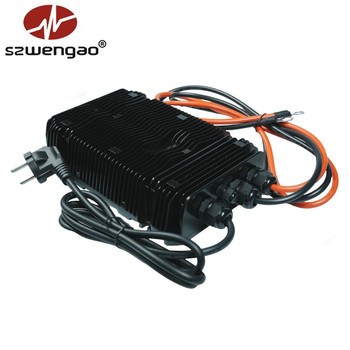
600W Waterproof LiFePO4 AC-DC Fast Charger
- AC Input: 90V–265V AC Universal
- Output Target: 14.6V / 29.2V / 58.4V
- Efficiency: ≥ 93.5% Synchronous
- Protections: OVP, OCP, SCP, Reverse Polarity

24V to 12V 85A/100A Heavy-Duty Fleet Step-Down Buck
- Input Voltage: DC 18V–35V
- Output Power: DC 12V Continuous (1200W)
- Housing: Anodized Heavy Fin Case
- Deployment: Trucks, Buses, Mining Fleets
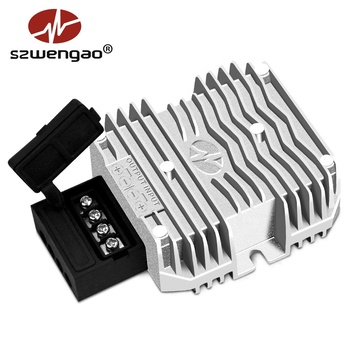
Isolated 18V–90V to 12V 10A Waterproof DC Converter
- Isolation: 1500V DC Dielectric Barrier
- Ultra-Wide Input: 18V–90V (5:1 Operational Ratio)
- No Ground Loop: Zero Noise Coupling
- Industry: Telecom Racks, Forklifts, AGVs
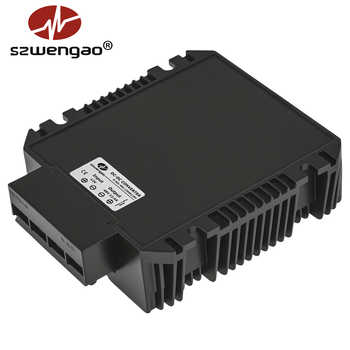
12V to 48V High-Current Step-Up Boost Module (20A)
- Input Voltage: DC 10V–16V
- Output Voltage: DC 48V Regulated (960W)
- Thermal Transfer: Thermally Conductive Epoxy
- Standard Use: Marine Winches, Solar Arrays, Motors
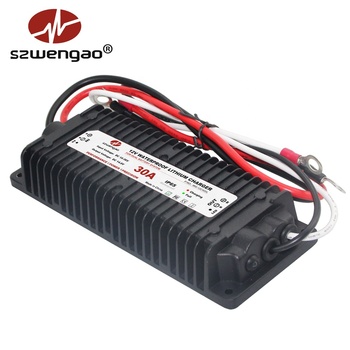
400W DC-DC Battery-to-Battery Charger for RV & Marine
- Engine Alternator: Smart Euro 6 Compatible
- Charging Profile: Custom LiFePO4 3-Stage CC/CV
- Ignition Sensing: Automatic Start/Stop Logic
- IP Rating: IP68 Under-Chassis Resilience
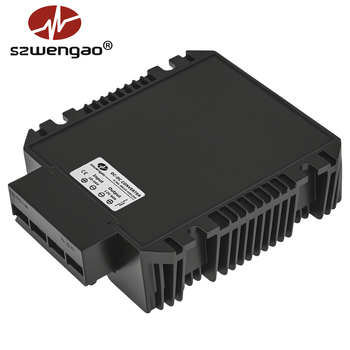
10V–44V to 12V 50A/60A High-Current Voltage Stabilizer
- Dynamic Window: 10V to 44V Seamless Float
- Regulated Output: 12V DC Constant (±1% Accuracy)
- Peak Current: 60A Surge Handling (720W)
- Protection: Load Dump & Cranking Sag Proof
Shenzhen Eltrum Electronic Co., Ltd: Your Direct OEM/ODM Partner
Founded in 2015 in Shenzhen's high-tech manufacturing corridor, Shenzhen Eltrum Electronic Co., Ltd. has grown to become an authoritative benchmark manufacturer of industrial-grade DC-DC converters, smart battery chargers, and specialized voltage regulators. Operating across a modernized 3,000 m² facility with on-site verification confirmed by international inspection agencies, we combine precision electrical engineering with rugged mechanical potting techniques.
Unlike trading houses that markup third-party assembly lines, Eltrum controls the entire engineering lifecycle: from surface-mount technology (SMT) pick-and-place lines and planar magnetic coil winding to two-component polyurethane and silicone vacuum potting. This ensures that every waterproof power converter leaving our dock complies strictly with ISO 9001:2015 quality management benchmarks, carrying verified CE (EMC/LVD), and RoHS international compliance.

Full Thermal Potting (IP68 Standard)
Our vacuum-assisted encapsulation process eliminates internal air voids using thermally conductive silicone resin (≥1.8 W/m·K). This protects delicate surface-mount components from catastrophic saltwater intrusion, constant moisture, vibration fatigue, and thermal expansion failure.
100% 4-Hour Burn-In Stress Testing
Quality control is anchored by our zero-defect policy. Every production unit undergoes 100% full-load dynamic burn-in testing inside computer-monitored thermal chambers for 4 to 8 hours, guaranteeing an exceptional Mean Time Between Failures (MTBF) exceeding 100,000 operating hours.
Agile OEM/ODM Custom Engineering
We tailor electrical input/output topologies, algorithmic lithium charging profiles, custom waterproof connectors (Deutsch, Anderson, Amphenol), and bespoke CNC aluminum heat sink designs. Engineers can validate proof-of-concept prototypes with standard sample MOQs starting from just 5 units.
The Mechanics of High-Reliability Waterproof Power Conversion
Understanding topology tradeoffs, thermal dissipation mechanics, and galvanic isolation thresholds is critical for system architects designing for off-grid, marine, and industrial vehicle systems.
In harsh mobile and outdoor environments, voltage converters face continuous operational stresses: violent engine bay vibration (MIL-STD-810G), alternator dump surges up to 100V, ground potential differentials, and salt fog corrosion. Standard plastic-housed or open-frame converters inevitably degrade due to moisture capillary action and thermal cycling fatigue. Engineering true industrial reliability demands a systemic approach combining advanced magnetic component design, high-frequency synchronous rectification, and total chemical encapsulation.
| Converter Topology | Input Voltage Window | Typical Conversion Efficiency | Ground Plane Isolation | Ideal Industrial Application |
|---|---|---|---|---|
| Synchronous Buck (Step-Down) | Vin must remain > Vout + 3V headroom | 94.0% – 97.2% | Non-Isolated (Common Ground) | 24V/48V commercial vehicle buses feeding 12V auxiliary electronics, lighting, and GPS. |
| High-Current Boost (Step-Up) | Vin must remain < Vout across all states | 92.5% – 95.8% | Non-Isolated (Common Ground) | Stepping up 12V vehicle starter banks to 24V or 48V for bow thrusters, heavy winches, and solar arrays. |
| Four-Switch Buck-Boost | Wide Dynamic (e.g. 9V–40V, 10V–60V) | 91.0% – 94.5% | Non-Isolated (Common Ground) | Precision voltage stabilization where input swings wildly above and below output (e.g. cold cranking down to 9V, alternator charging up to 14.8V). |
| Galvanic Isolated (Flyback/Forward) | Wide Industrial (18V–36V, 36V–75V, 18V–90V) | 88.0% – 92.5% | 1500V – 3000V Dielectric Isolation | Telecom -48V power distribution, heavy industrial AGVs, electric forklifts, eliminating catastrophic ground loops and EMI crosstalk. |
Synchronous Rectification MOSFETs
Replacing conventional Schottky diodes with ultra-low on-resistance (RDS(on)) power MOSFETs drastically slashes forward conduction losses (P = I²RDS(on)). In a 100A 12V step-down module, synchronous switching recovers over 45W of heat that would otherwise accelerate capacitor electrolyte evaporation.
Automotive Load Dump Suppression
Automotive SAE J1113 and ISO 7637-2 standards dictate resilience against severe inductive energy discharges when an alternator cable disconnects while charging. Eltrum modules incorporate high-capacity bidirectional TVS diodes and LC input filtering stages that clamp 100V spikes safely below semiconductor breakdown thresholds.
Hermetic Vacuum Potting Science
Unlike superficial conformal coatings, our automated dual-chamber vacuum potting pulls air out of inductor windings before injecting modified flame-retardant (UL94 V-0) silicone compound. This ensures unified thermal conductivity straight into the die-cast aluminum housing while providing true IP68 immersion defense.
Global Procurement Trends: Waterproof Voltage Converters (2025–2030)
How supply chain directors, fleet managers, and industrial OEMs are transforming their power procurement specifications to mitigate supply risks and improve operational efficiency.
Adoption of Wide Bandgap (GaN & SiC)
Procurement teams are actively phasing out silicon-based legacy converters in favor of Gallium Nitride (GaN) and Silicon Carbide (SiC) architectures. WBG devices operate at triple the switching frequencies, permitting 40% reduction in magnetic core size and yielding continuous volumetric power densities previously unattainable in sealed enclosures.
Telematics & Digital Bus Integration
Static analog conversion is rapidly being superseded by smart converters embedded with CAN bus (J1939), RS-485 Modbus RTU, or LIN communications. Industrial fleet operators require dynamic current throttling, real-time board temperature telemetry, and remote fault diagnostics direct to vehicle telematics gateways.
Multi-Chemistry Algorithmic Flexibility
With global fleets transitioning across traditional Lead-Acid, AGM, Lithium Iron Phosphate (LiFePO4), and Lithium Titanate (LTO), buyers prioritize universal DC-DC chargers capable of reprogramming absorption, float, and low-temperature cutoff thresholds without necessitating hardware redesign.
Direct-to-Manufacturer Sourcing
Disruptions in global logistics have driven North American and European tier-1 integrators away from regional brokers toward audited tier-1 Chinese manufacturers. Direct factory relationships provide full Bill of Materials (BOM) transparency, customized connector tooling, and direct engineering access.
Need a Tailored Voltage Ratio or RS485 Comm Protocol?
Our engineering division will review your custom input profile, charging curve, and thermal constraints within 24 hours.
Technological Innovations Driving Next-Gen Voltage Regulation
From planar magnetics to bidirectional energy recovery, discover the cutting-edge power topologies being engineered inside Eltrum's Shenzhen R&D laboratories.
Multilayer Planar Transformer Architectures
Traditional round-wire wire-wound transformers suffer from extreme skin-effect and proximity-effect eddy current losses at frequencies exceeding 200 kHz. Eltrum's advanced isolated converters implement multilayer PCB planar magnetics. This architecture guarantees 100% repeatable electrical inductance, virtually eliminates human winding variances, enhances dielectric isolation margins up to 3000V AC, and drops profile height by up to 50%.
Bidirectional Power Flow Capabilities
With the expansion of commercial electric vehicles and grid-tied mobile energy storage, auxiliary converters can no longer remain one-way streets. Our latest dual-active bridge (DAB) topologies facilitate seamless bidirectional energy transfer: operating as a step-down regulator from high-voltage traction batteries (48V/72V/96V) to low-voltage 12V loads, while instantaneously reversing power flow to recharge starter batteries during braking or external solar input.
Ultra-Wide 5:1 & 8:1 Input Voltage Regulators
Managing discrete converter inventories for 24V, 36V, 48V, and 72V equipment imposes massive inventory holding costs on international OEMs. Eltrum's wide-ratio R&D focus has developed proprietary wide-window regulators (e.g. 18V–90V and 10V–60V continuous). A single converter SKU reliably serves a complete catalog of warehouse material-handling equipment, forklifts, golf cars, and heavy machinery without redesign.
Frequently Asked Questions by Sourcing & Power Engineers
In-depth technical answers addressing testing benchmarks, customization workflows, environmental protections, and electrical safety standards.
What is the difference between non-isolated and isolated waterproof voltage converters?
Non-isolated converters share a common negative ground between the input and output circuits. They offer superior power efficiency (typically 94%–97%), smaller physical footprints, and lower manufacturing costs. They are the ideal choice for automotive, commercial truck, and standard marine 12V/24V accessory installations where the ground potential is unified.
Isolated converters utilize internal high-frequency transformers to physically and electrically decouple the input and output ground planes, providing dielectric isolation from 1500V DC to 3000V AC. You must specify isolated converters in -48V telecommunication systems, high-voltage battery packs (forklifts, AGVs, electric mining locomotives), or whenever ground loop noise interferes with sensitive audio, navigational sensors, or medical equipment.
How does IP68 encapsulation perform under continuous submersion and salt spray?
Eltrum's IP68 waterproof converters are protected by a two-component, flame-retardant silicone elastomer that undergoes vacuum degassing during injection. This liquid polymer penetrates the smallest gaps between PCB traces, semiconductor packages, and the anodized aluminum shell before curing into a permanent, flexible barrier.
This design satisfies both IP67 (immersion up to 1 meter for 30 minutes) and IP68 continuous underwater pressure specifications. Furthermore, units pass rigorous ASTM B117 salt spray chamber exposure for 96 hours with zero trace corrosion on terminals or ingress into the magnetic core chamber, making them completely ocean-going and marine-ready.
Why must a buck-boost converter be specified instead of a standard buck regulator for vehicle installations?
A standard buck (step-down) converter requires that the input voltage always exceed the desired output voltage by a fixed dropout margin (usually +2V to +3V). If you are powering a critical 12V GPS, communication radio, or mobile refrigeration unit from a nominal 12V battery, the actual battery rail is constantly dynamic: it can sag to 9V–10V during cold engine cranking, drop to 11.5V under deep discharge, and climb to 14.6V during alternator charging.
Under a voltage dip below 12V, a buck converter suffers complete output brownout or shutdown. A buck-boost converter automatically and seamlessly transitions between step-up and step-down switching modes, maintaining a strictly regulated 12.0V or 13.8V output across the entire 9V to 36V dynamic input envelope.
Can Eltrum DC-DC chargers properly charge a LiFePO4 auxiliary battery from a smart alternator?
Yes. Connecting a secondary LiFePO4 battery bank directly to an engine alternator via a split-charge relay is hazardous: lithium iron phosphate's extremely low internal resistance causes it to draw excessive current from the alternator, leading to alternator stator burn-out, while modern Euro 5/6 smart alternators frequently shut down or lower voltages below lithium absorption levels.
Our battery-to-battery (B2B) DC-DC chargers actively regulate charging current, step up or down the alternator voltage into an exact 3-stage Constant Current / Constant Voltage (CC/CV) LiFePO4 algorithm (e.g., 14.6V absorption, 13.6V float), and incorporate ignition control wiring to ensure starter battery drain never occurs.
What is your minimum order quantity (MOQ) and standard delivery lead time for wholesale orders?
For standard catalog models, our sample evaluation MOQ is just 5 units, enabling R&D engineering divisions to complete bench testing, thermal validation, and chassis integration before committing to mass production. High-power custom models can occasionally be sampled from 1–2 units.
Standard sample batches ship via express courier (DHL, FedEx, UPS) within 3 to 5 business days. Commercial production volume orders (500 to 5,000 units) maintain a manufacturing cycle of approximately 15 to 20 working days, with FOB Shenzhen or EXW delivery terms accepted in both USD and CNY.
What OEM and ODM custom parameters can your engineering team support?
As a true manufacturing facility, Shenzhen Eltrum Electronic offers comprehensive white-label and ODM customization capabilities, including:
- Custom input and output voltage/current calibrations (e.g., fixed 13.8V, 19V, 28V, 43.8V, 58.4V).
- Digital telemetry integrations: RS485 Modbus RTU, CAN 2.0B, or custom TTL serial buses.
- Specific lithium charging profiles programmed directly into onboard microcontrollers.
- Harness customization: wire length, wire gauge (UL 1015/1007), and connectors (Anderson Powerpole, Deutsch DT series, Ring Terminals, M12 waterproof plugs).
- Custom extrusion molds, mounting flanges, laser-engraved buyer branding, and barcoded retail/industrial packaging.