Wholesale Industrial DC-DC Converters & Chargers
Explore our battle-tested switch-mode power conversion units built in our Shenzhen manufacturing plant. Every topology is optimized for thermal dissipation, electromagnetic compatibility (EMC), and superior operating efficiency up to 96.5%.

Smart 36V 13A Waterproof DC-DC LiFePO4 Battery Charger
- Input Nominal: 12V DC (9–16V DC)
- Regulated Output: 43.8V DC • 13A Max
- Efficiency / Rating: ≥94% • IP68 Ingress
- Application: EV Car, Marine, E-Bikes

1500W High-Power Buck-Boost Converter with RS485
- Input Voltage Range: 10–60V Wide Range
- Output Regulation: 12V / 24V / 28V / 48V
- Control Bus: RS485 / Modbus RTU
- Form Factor: Sealed Anodized Enclosure

24V to 12V 85A/100A High-Current Heavy Fleet Buck Converter
- Input Bus Voltage: 24V DC (18–35V Swing)
- Continuous Output: 12V / 13.8V DC • 100A
- Thermal Architecture: Heavy Aluminum Fins
- Compliance: CE, RoHS, CISPR 25
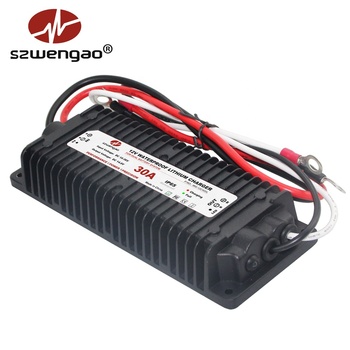
400W Multi-Stage DC-DC LiFePO4 Dual Battery Charger
- Alternator Input: 10–36V Smart Alternator
- Charge Curve: CC/CV 14.6V / 29.2V
- Potted Enclosure: Silicone IP67 Thermal Gel
- Core System: RV & Yacht Dual Battery
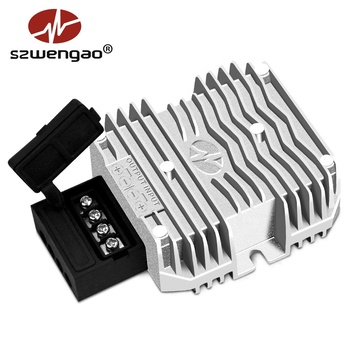
Isolated 18–90V Wide-Input to 12V 10A Telecom Converter
- Ultra-Wide Input: 18–90V DC Continuous
- Galvanic Isolation: 1500V DC Input-to-Output
- Output Power: 12V DC • 120W Continuous
- Ground Protection: Zero Ground-Loop Ripple
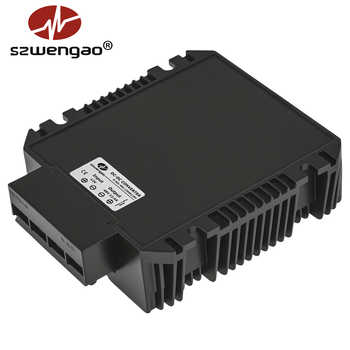
12V to 48V 20A Step-Up DC-DC Boost Converter (960W)
- Low-Side Input: 9–20V DC Battery Rail
- High-Side Output: 48V DC Regulated • 20A
- MOSFET Array: Synchronous Rectified
- Environment: IP68 Potted Submersible
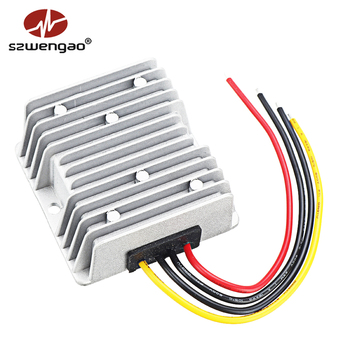
30–90V Traction Pack to 24V 20A AGV & Forklift Buck Regulator
- Traction Pack In: 36V / 48V / 60V / 72V Nom
- Auxiliary Bus Out: 24V DC • 20A (480W)
- Transient Defense: TVS Clamping + Soft-Start
- End Equipment: Robotics, Pallet Jacks, AGV
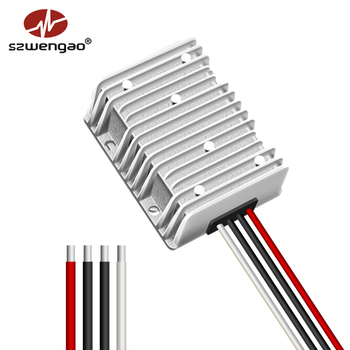
8–40V to 13.8V 30A Buck-Boost Synchronous Stabilizer
- Cranking Voltage In: 8–40V Sag-Immune
- Clean Bus Out: 13.8V DC Stable • 30A (414W)
- Filtering: Low Ripple <50mVp-p
- Field Deployment: VHF Radios, Marine Sonar
Future Global Procurement Trends in DC-DC Conversion Systems (2025–2030)
A strategic technical analysis for system integrators, OEM hardware architects, and supply chain directors sourcing switch-mode power conversion modules from Chinese manufacturing hubs.
Strategic Shift: The worldwide switch-mode power supply (SMPS) ecosystem is experiencing a structural migration away from traditional legacy silicon switching matrices toward high-frequency wide-bandgap (WBG) semiconductors, multi-rail bidirectional converters, and software-defined charging curves. OEMs that fail to integrate these topological evolutions face higher thermal overheads, increased packaging volume, and severe parasitic losses.
1. Transition to Gallium Nitride (GaN) & Silicon Carbide (SiC)
Global purchasers are increasingly mandating GaN and SiC MOSFET architectures in place of standard Silicon (Si) superjunction transistors. Operating at switching frequencies exceeding 300kHz–500kHz dramatically reduces inductive and capacitive core sizes, shrinking overall converter footprint by up to 42% while curbing switching dissipation. In our Shenzhen laboratories, synchronous rectification driven by WBG semiconductors delivers stable full-load conversion efficiencies of 95.5% to 97.2%, easing thermal constraints inside hermetically sealed IP68 enclosures.
2. The 48V-Centric Vehicle & Industrial Infrastructure
Driven by e-mobility, telecom base stations, and autonomous warehouse robotics (AGVs/AMRs), the industry is aggressively adopting 48V nominal distribution architectures to mitigate I²R resistive cable transmission losses. Procurement pipelines are prioritizing wide-input buck converters capable of stepping down variable 36V–72V traction banks directly to regulated 12V or 24V auxiliary circuits without requiring secondary intermediate bus converters. Modules must withstand transient spikes of up to 100V without triggering overvoltage latch-off.
3. Intelligent Digital Communication: RS485 & CAN 2.0B
Analog "blind" voltage step-down converters are being rapidly replaced by digitally controlled power converters equipped with microprocessor backbones. B2B purchasers now require telemetry feedback over RS485, Modbus, or CAN bus networks, allowing centralized system controllers to monitor real-time input voltage, load amperage, PCB thermistor readings, and fault logs. Dynamic software-defined CC/CV algorithm adjustments allow a single hardware module to switch between LiFePO4, Ternary Lithium, and AGM lead-acid profiles dynamically.
4. Hermetic Potting for Extreme Environmental Resilience
Commercial vehicle OEMs, off-grid marine operators, and outdoor wireless telecom installers demand IP67 to IP68 environmental protection classes. Sourcing teams are replacing ventilated perforated-metal enclosures with vacuum-degassed thermal silicone potting in extruded or die-cast aluminum alloys. This packaging eliminates condensation corrosion, resists 10G mechanical vibration (MIL-STD-810G compliance), and optimizes heat conduction from magnetic chokes directly to the outer chassis heat sink.
5. Dual-Battery Euro 6/Euro 7 Smart Alternator Compatibility
Modern commercial trucks and recreation vehicles integrate ECU-controlled regenerative braking and smart alternators whose operating voltage fluctuates violently between 11.8V and 15.2V. Conventional split-charge relays cause auxiliary LiFePO4 batteries to suffer from severe undercharging or overcurrent destruction. Procurement tenders now prioritize synchronous 4-switch buck-boost DC-DC chargers capable of maintaining a stable CC/CV 14.6V charging envelope regardless of alternator voltage dropouts.
6. Supply Chain Nearshoring vs. Direct Shenzhen OEM Alliances
While regional distribution hubs in North America and Western Europe maintain buffer stocks, tier-1 system assemblers are cementing direct OEM/ODM strategic relationships with verified Shenzhen manufacturing facilities. Direct collaboration facilitates custom wire harness pinning (e.g., Anderson Powerpole, Deutsch DT connectors, M12 industrial plugs), tailored overcurrent tripping points, bespoke heatsink footprints, and buyer-label silk-screening without excessive middleman margins.
DC-DC Power Topologies Compared: Sizing & Selection Rules
Selecting the optimal power conversion topology directly impacts mean-time-between-failures (MTBF), electromagnetic interference (EMI) compliance, and BOM manufacturing costs.
| Topology | Input vs. Output Voltage Window | Full Load Efficiency | Galvanic Isolation | EMI Signature & Filtering | Primary Industrial Use Case |
|---|---|---|---|---|---|
| Buck (Step-Down) | Vin > Vout + 2.0V (Continuous drop) | 94% – 97% | Non-Isolated (Common Ground) | Low input ripple; discontinuous output inductor filtering required. | Truck 24V to 12V cab accessories, 48V/72V EV pack down to 12V/24V telemetry. |
| Boost (Step-Up) | Vin < Vout − 1.5V (Continuous boost) | 92% – 96% | Non-Isolated (Common Ground) | Continuous input current; high pulsed output ripple requiring low-ESR caps. | 12V vehicle battery boosting to 24V/48V high-torque winches, LED light towers. |
| Buck-Boost (4-Switch) | Vin dynamically crosses Vout (8–40V, 10–60V) | 91% – 95% | Non-Isolated (Common Ground) | Moderate; complex PWM switching requires integrated snubber circuits. | Engine-cranking voltage stabilizers (9–16V in → 12.0V out), marine navigation racks. |
| Galvanic Isolated | Wide 2:1 & 4:1 Inputs (18–36V, 36–75V, 18–90V) | 88% – 92% | Opto/Magnetic (1500V–3000V DC) | Transformer primary/secondary isolation prevents common-mode noise propagation. | -48V Telecom central offices, high-voltage forklift ground-loop elimination, medical. |
Senior Engineer Sizing Rule: Always calculate maximum input current at minimum operating input voltage using the formula:
Iin_max = (Vout × Iout) / (Vin_min × Efficiency).
For an 8–40V to 13.8V 30A converter operating under cold-cranking conditions (Vin = 8V, η = 0.90), input current spikes to 57.5 Amperes. Upstream automotive circuit breakers, fuses, and cable gauges must be dimensioned to handle this peak current without thermal nuisance tripping.
Why Tier-1 Global OEMs Source with Shenzhen Eltrum
Operating from our modern 3,000m² production center in Bao'an District, Shenzhen, we integrate automated electronics manufacturing with rigorous reliability validation protocols.
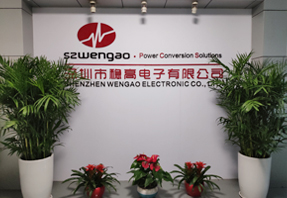 Shenzhen Headquarter Plant
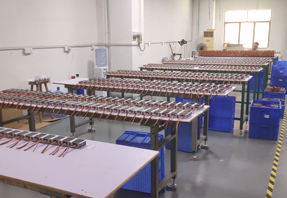 SMT Assembly Line
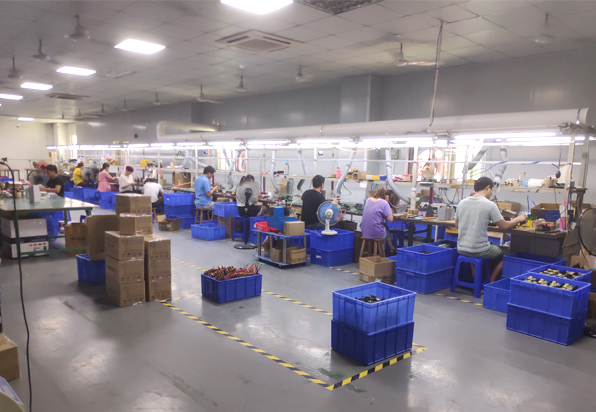 100% Full-Load Burn-in
End-to-End Quality Control: From Raw Ferrite to Potted Modules
Since our founding in 2015, Shenzhen Eltrum Electronic Co., Ltd. has established deep manufacturing know-how in high-reliability switch-mode conversion. We maintain an agile production floor designed specifically to support both rapid prototyping and multi-thousand containerized OEM volumes.
- ISO 9001:2015 Certified System: Strict incoming component inspection (AQL 0.4 standard) for high-grade solid capacitors and genuine power MOSFETs.
- Full Thermal Burn-In Screening: Every commercial unit undergoes a minimum of 4 hours at full electrical load inside 50°C accelerated environmental chambers.
- Turnkey OEM/ODM Engineering: Complete flexibility to customize input thresholds, output charging curves, connector assemblies, and buyer-label branding.
Frequently Asked Questions: B2B DC-DC Converter Sourcing
Detailed technical, compliance, and commercial guidance addressing the operational criteria evaluated by hardware engineering directors and international procurement officers.