
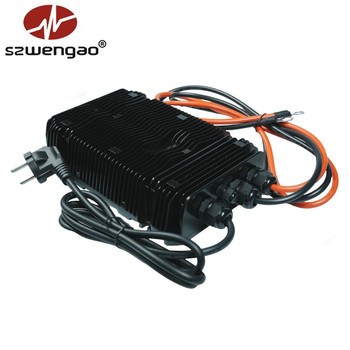
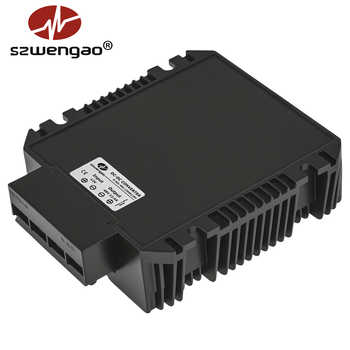
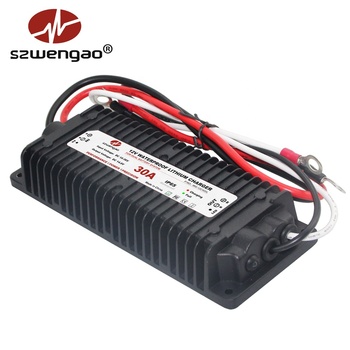
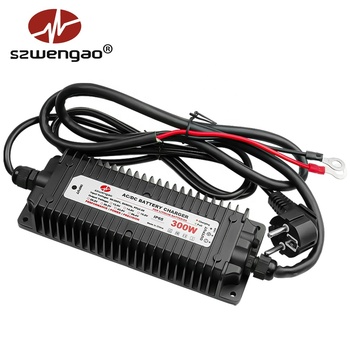
Smart 36V Lithium Battery Charger DC 12V to 43.8V 13A Waterproof Charger
- Topology: DC-DC Boost CC/CV
- Input Voltage: 10V – 36V DC
- Target Output: 43.8V @ 13A (570W)
- Ingress Rating: IP68 Sealed Potting
Strictly engineered with vacuum silicone potting, die-cast aluminum thermal heat dissipation fins, and comprehensive short-circuit, over-current, and over-voltage safeguards.



As global electrification penetrates commercial mobility, maritime logistics, and outdoor battery energy storage systems (BESS), procurement managers must adapt to structural changes in solid-state topologies, ingress standards, and lifecycle testing.
| Converter Topology | Input Range (DC) | Regulated Outputs | Peak Efficiency | Isolation Barrier | Optimal Deployment Scenarios |
|---|---|---|---|---|---|
| Buck (Step-Down) | 18V – 90V DC | 5V, 12V, 13.8V, 24V | 95.5% – 97.2% | Common Ground | Fleet trucks (24V→12V), mining dumpers, golf carts, e-scooter auxiliaries |
| Boost (Step-Up) | 9V – 32V DC | 24V, 36V, 48V, 58.4V | 93.8% – 96.0% | Common Ground | 12V battery stepping up to drive 48V marine trolling motors and LED lightbars |
| Buck-Boost Auto | 8V – 60V Continuous | 12.0V, 13.8V, 28.0V | 92.5% – 95.0% | Non-Isolated | Alternator cranking sag stabilization, off-grid unstable solar DC buses |
| Galvanic Isolated | 18V – 36V / 36V – 75V | 5V, 12V, 24V Regulated | 89.0% – 93.0% | 1500V DC Min | Telecommunications, positive-ground forklifts, medical electronics, noise filtering |
Founded in 2015, Shenzhen Eltrum Electronic Co., Ltd. has grown into an international powerhouse in high-reliability power conversion electronics. Operating from our specialized industrial facility in Sanwei Community, Hangcheng Street, Shenzhen, we control every critical phase of manufacturing: high-speed SMT placement, automated winding of toroidal magnetics, vacuum potting, and 100% full-load dynamic burn-in testing.
Unlike trading entities, our onsite-verified factory is certified under ISO 9001 quality management guidelines. Our engineers specialize in high-density DC-DC topologies, wide-input battery charging algorithms, and military-grade waterproofing that adheres to strict CE and RoHS environmental safety mandates.
Every module undergoes elevated temperature load cycling before packaging.
Custom input ranges, custom voltage/current curves, and tailored buyer labeling.
Complete traceability on raw active components and passive magnetic cores.
Real-time bilingual support from senior power electronics development engineers.
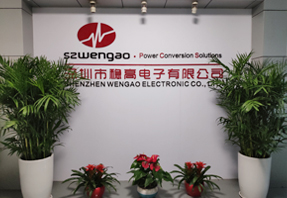 Shenzhen Manufacturing Facility
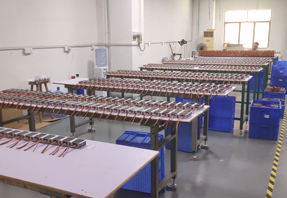 Surface Mount Assembly
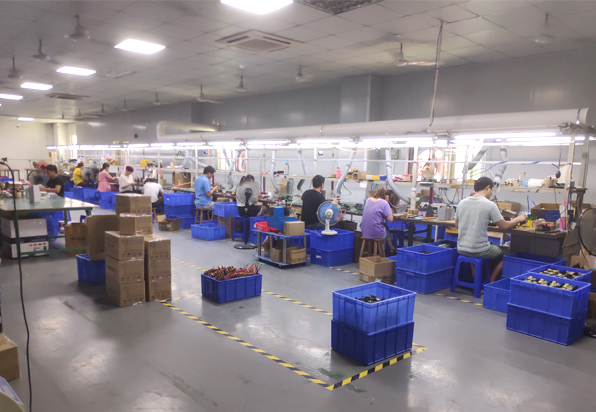 100% QC Bench Testing
Direct technical and commercial answers addressing topology selection, custom potting parameters, order logistics, and certification validity.
To support design engineers in bench validation and pilot prototyping, our standard catalog models require an MOQ of just 5 units. High-power units (1000W–1500W) can be sampled starting from 1–2 pieces. Standard samples ship within 3–5 working days from our Shenzhen warehouse, while custom modified-voltage units require approximately 12–15 days for PCB reconfiguration and potting cure.
Choose a standard Buck converter only if your lowest battery discharge voltage remains consistently higher than your desired output voltage by at least 2V–3V of headroom (e.g., a 24V nominal fleet battery running between 20.4V and 29.2V driving a 12V output). If your input voltage crosses over the target output—such as a 12V lead-acid battery dropping to 9.5V during starter motor crank and surging to 14.6V under alternator charging—a Buck-Boost stabilizer is mandatory to prevent brownouts.
Non-isolated converters share a common negative ground bus between input and output. In high-power telecommunications (typically -48V rails), positive-ground forklifts, or large industrial robotics, shared ground loops generate electromagnetic ground currents, high-frequency digital noise spikes, and catastrophic short-circuit hazards if external wiring touches chassis ground. Galvanic isolation inserts a high-frequency magnetic transformer barrier, eliminating ground loops and isolating electrical faults.
Yes. Modern Euro 6 and Euro 7 commercial vehicles feature smart variable-voltage alternators that intentionally drop voltage below 12.4V during vehicle coasting to reduce emissions. Connecting a secondary LiFePO4 battery directly to this line results in insufficient charging or severe alternator overload. Our smart DC-DC chargers feature integrated ignition detection sensing wiring and programmable low-voltage cutoffs, ensuring steady CC/CV charging without damaging the primary starter battery.
All our production models comply with European Union CE EMC directives (EN 55032, EN 55035) and RoHS 2.0 restrictions regarding hazardous substances. For our global OEM clientele, complete declaration documents, test reports, and factory inspection certificates under our ISO 9001 quality audit framework are readily available upon project quotation.
We offer comprehensive private labeling and full ODM hardware adaptation. Capabilities include custom multi-voltage taps, Anderson Powerpole or Deutsch DT04 connector integration, specialized anodized enclosure coloring, buyer laser engraving, custom RS485 communication protocols, and tailored multi-stage CC/CV charging curves aligned to specific proprietary LiFePO4, NMC, or LTO cell specifications.
Download our complete industrial product catalog containing detailed electrical datasheets, mechanical CAD dimensional drawings, derating curves, and volume tier pricing. Connect directly with our Shenzhen power engineering team for prompt OEM support.