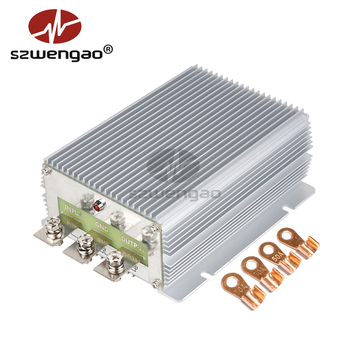
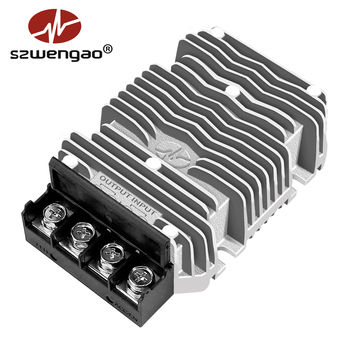
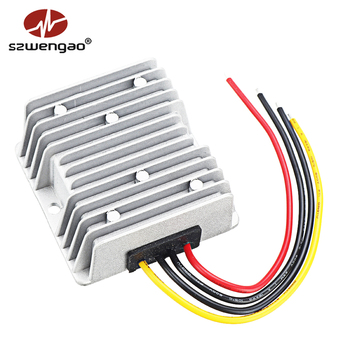
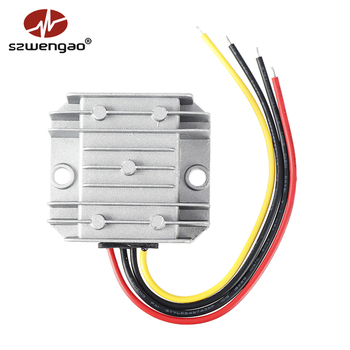
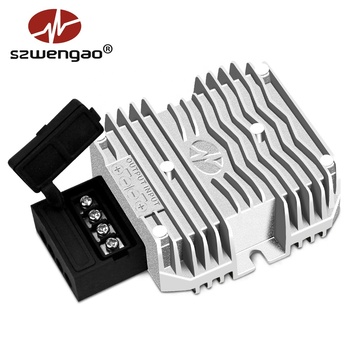
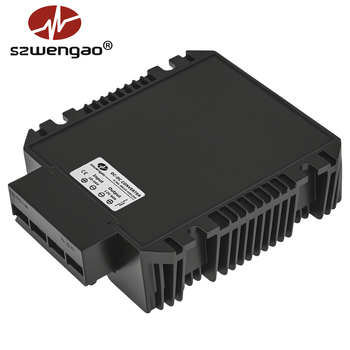
Smart 36V Lithium Battery Charger DC 12V to DC 43.8V 13A
- Topology: Synchronous Step-Up/Down
- Output: 43.8V CC/CV (13A)
- Sealing: IP67 Resin Encapsulated

Direct factory sourcing from Shenzhen Eltrum Electronic Co., Ltd. Explore our high-current buck converters, wide-input voltage step-down regulators, and automotive-grade DC conversion systems engineered for high thermal tolerance, vibration resistance, and clean rail outputs.
In modern electrical vehicle, marine, and telecommunication deployments, step-down voltage regulators (buck converters) serve as the foundation of downstream power integrity. Understanding non-isolated synchronous buck topologies versus isolated transformer topologies determines system reliability and lifespan.
By substituting traditional catch diodes with ultra-low RDS(on) MOSFET switches, our synchronous step-down stages curtail forward-conduction voltage losses by over 78%. This drives system conversion efficiency upward of 96%, critical in sealed IP68 modules where internal thermal build-up cannot be dissipated via active forced-air convection.
In harsh high-voltage DC environments such as 72V–96V e-forklifts or 48V negative-rail telecommunications, an unexpected ground fault on a shared DC rail can destroy downstream ECUs. Shenzhen Eltrum designs optocoupler-isolated and planar transformer step-down modules that deliver 1500V DC dielectric isolation to preserve control node integrity.
High-speed switching at 150kHz–300kHz induces conducted and radiated harmonics across vehicle chassis harnesses. Our high-power buck converters feature integrated Pi-filters, multi-layer planar magnetic damping, and aluminum shielding to surpass stringent CISPR 25 Class 3 emissions standards for radio and radar compatibility.
| Topological Class | Typical Input (Vin) | Nominal Output (Vout) | Efficiency Span | Primary Industrial Use-Case |
|---|---|---|---|---|
| Non-Isolated Synchronous Buck | 24V (18–35V) / 48V (36–60V) | 12V, 13.8V, 24V | 95% – 97% | Truck cabins, auxiliary lighting, bus electronics, RV house batteries |
| Traction Pack Step-Down | 72V / 80V / 96V (30–120V) | 12V, 24V | 92% – 95% | Electric forklifts, golf carts, AGVs, mine haulage instrumentation |
| Galvanically Isolated Buck Module | 36–75V Telecom / 18–90V Wide | 5V, 12V, 24V | 88% – 93% | Cellular base stations, medical carts, positive-ground rail machinery |
| Buck-Boost Regulator Stage | 10–44V Dynamic Range | 12.0V Rigid Regulated | 91% – 94% | Automotive cold-crank protection, solar battery banks, marine nav consoles |
As power electronics move toward wide-bandgap semiconductors and decentralized power management, industrial buyers and tier-1 system integrators must position their supply chains ahead of impending shifts in efficiency, digital control, and thermal architectures.
Procurement requirements are rapidly shifting from conventional Silicon MOSFETs to Gallium Nitride (GaN) and Silicon Carbide (SiC) topologies. These wide-bandgap devices accommodate three-fold increases in switching frequency, which directly reduces magnetic core volume and bulk filtering capacitance. For industrial supply chains, this translates to converters delivering 40% higher power densities at equal or lighter footprints.
Fixed, analog step-down converters are increasingly augmented by digitally supervised platforms. Enterprise buyers now mandate bi-directional communication over CAN 2.0B or Modbus-RTU RS485. This allows central Vehicle Control Units (VCUs) to dynamically calibrate voltage rails, monitor real-time thermal throttling, evaluate load amperages, and predict field failure before an end-user breakdown occurs.
The proliferation of mobile robots (AMRs), maritime vessels, and outdoor telecommunication nodes has made potted, sealed converter housings an industry prerequisite. Procurement managers demand complete void-free resin potting capable of withstanding immersion, salt-spray corrosion, and thermal shock cycles ranging from -40°C to +85°C without dielectric degradation or casing fractures.
Headquartered in Shenzhen's Hangcheng industrial corridor, Shenzhen Eltrum Electronic Co., Ltd. has specialized in precision power electronics manufacturing since 2015. With an onsite-verified production footprint, certified quality systems, and deep engineering competencies, we turn complex conversion requirements into reliable, market-ready volume products.
Whether your project requires custom input step-down ratios (such as 18–120V input for specialty railway auxiliaries), modified wiring harnesses with Deutsch/Amphenol connectors, or private-label CNC enclosures, our Shenzhen engineering division delivers rapid CAD prototypes and functional validation units starting from low minimum order thresholds (MOQ from 5 units).
Zero-defect compliance is maintained through strict process gates. Every step-down converter and LiFePO4 battery charger undergoes automated optical inspection (AOI) post-SMT, high-voltage dielectric isolation testing, and a mandatory 4-hour dynamic full-load burn-in inside elevated temperature chambers prior to final potting and dispatch.
All standard step-down product families comply with CE and RoHS standards under an ISO 9001 quality management framework. With direct export trade channels to over 130 countries across North America, Europe, Australia, and East Asia, we offer stable supply continuity, FOB/EXW delivery agility, and dedicated bilingual engineering support.
Technical, commercial, and engineering questions answered directly by Eltrum application engineers.
A non-isolated buck step-down converter shares a common ground (negative rail) between the high-voltage input and low-voltage output. It offers higher electrical efficiency (up to 96-97%), smaller physical size, and lower component costs, making it ideal for vehicle fleets, LED arrays, and general machinery. An isolated DC-DC converter uses a high-frequency transformer to separate the input and output grounds completely, preventing ground loops, eliminating parasitic noise in sensitive telecommunications, and protecting downstream loads if a short circuit occurs in high-voltage traction batteries.
Because sealed, potted step-down converters rely primarily on thermal conduction through their outer aluminum housing, ambient temperature significantly impacts heat rejection. For installations inside unventilated enclosures or engine bays where temperatures exceed 50°C, we recommend designing with a 20% to 30% current margin below the module's nameplate rating. Furthermore, inductive loads (such as DC refrigeration compressors, hydraulic solenoids, and DC motors) generate high start-up inrush currents that can reach 3 to 5 times running current; these loads require careful evaluation of peak pulse capacity.
Yes. Shenzhen Eltrum Electronic Co., Ltd. provides full OEM/ODM power design services. Our Shenzhen R&D facility can fine-tune output voltages (e.g., custom 13.8V floating rails, 19.5V computing supply rails, or 28V avionic rails), integrate custom waterproof pigtails and terminal connectors, incorporate RS485/CAN bus telemetry circuits, and design tailored aluminum extruded heatsinks to match specific dimensional enclosures.
Standard catalog converter models support pilot and validation runs starting at an MOQ of just 5 units, allowing engineering teams to perform bench validation and EMC verification before placing volume orders. For custom OEM voltage modifications or tailored housing production, the typical initial MOQ is 50 to 100 units. Prototype and pilot runs are typically dispatched within 7–12 business days, while volume production runs are delivered within 3–4 weeks via standard FOB or EXW terms.
Linear regulators step down voltages by dissipating excess energy as heat (Efficiency = Vout / Vin). Dropping 48V to 12V with a linear regulator yields a catastrophic 25% efficiency, dumping 75% of your power as waste heat. A switching synchronous buck step-down converter transfers energy through controlled pulse-width modulation (PWM) switching, inductor energy storage, and synchronous rectification, maintaining 94% to 97% efficiency regardless of high voltage differentials, eliminating massive heatsink requirements.
Every industrial-tier converter manufactured by Eltrum integrates comprehensive multi-stage autonomous protection: Over-Current Protection (OCP) with auto-recovery hiccup mode, Over-Voltage Protection (OVP), Over-Temperature Protection (OTP) with thermal shutdown, and Reverse-Polarity Protection on the input stage to prevent catastrophic reverse installation damage in field environments.
Connect directly with Shenzhen Eltrum’s power engineering group. Send us your operational input window, required voltage/amperage rails, ambient conditions, and enclosure constraints for a rapid technical appraisal and competitive quotation.