
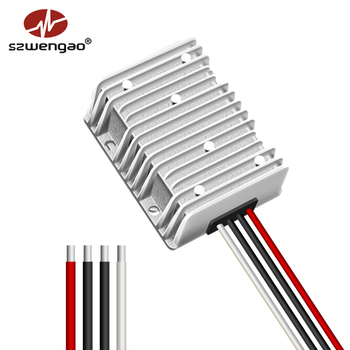
Smart 36V Lithium Battery Charger DC 12V to 43.8V 13A
- Topology: Boost Charging CC/CV
- Input Window: 10V – 36V DC
- Protection: IP67 Aluminum Alloy
Engineered for harsh operating environments, featuring ultra-wide input voltage windows, intelligent transient suppression, and IP65–IP68 potted mechanical protection.

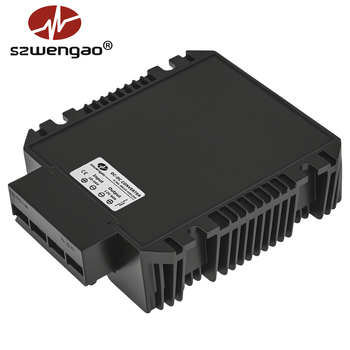
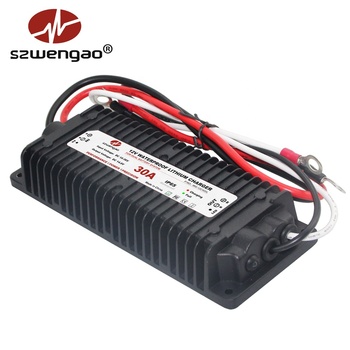
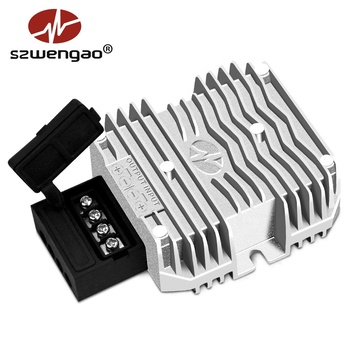

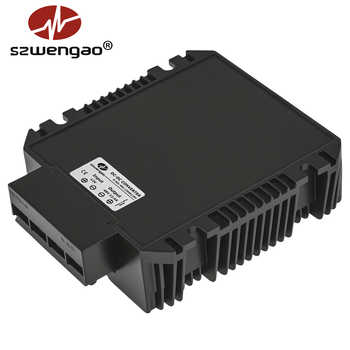
Understanding non-inverting 4-switch synchronous transitions, thermal balancing, and isolation mechanisms across commercial and industrial deployments.
Traditional single-inductor buck-boost circuits suffered from polarity inversion and high ripple current. Modern high-power industrial converters utilize a four-switch H-bridge architecture configured with synchronous MOSFET rectifiers. Depending on the input-to-output differential, the DSP smoothly modulates the transition between pure Buck mode, Boost mode, and a tightly controlled 4-switch interleaved Buck-Boost window.
This design mitigates switching dead-time losses and maintains high operational efficiency across deep battery discharge curves—especially crucial when dealing with 12V/24V nominal vehicle systems that drop to 8V during engine cranking or spike past 36V during load dumps.
Selecting between non-isolated and isolated topologies involves weighing thermal efficiency against ground loop protection. Non-isolated converters share a common negative rail, maximizing power density and efficiency. However, industrial environments with fluctuating zero-volt potentials, telecommunication negative racks (-48V), or traction battery packs (72V–96V) demand galvanic isolation exceeding 1500V DC.
Planar high-frequency transformers integrated with optocoupler or digital magnetic feedback break destructive circulating ground currents, eliminate hazardous noise in sensitive CAN/RS485 sensor buses, and protect microcontrollers from high-voltage flashovers.
Power converters operating at high current densities generate localized heat flux that must be dissipated without rely on fragile forced-air fans. Shenzhen Eltrum deploys custom tooling with 6063-T5 aluminum alloy fins paired with automated vacuum injection of thermal silica resin (thermal conductivity > 1.5 W/m-K).
This full-potting design achieves two objectives: it forms a completely sealed ingress barrier rated to IP67/IP68 against saline humidity and dust, and mechanically bonds electrolytic capacitors and magnetic inductors to eliminate vibration failures in off-road vehicles and heavy construction machinery.
How OEMs and fleet integrators are evolving their procurement matrices over the next 3–5 years.
The transition toward wide-bandgap (WBG) power semiconductors is moving into commercial off-grid conversion. Buyers are prioritizing converters utilizing Gallium Nitride (GaN) and Silicon Carbide (SiC) switches to elevate switching frequencies past 250kHz–500kHz. This dramatically shrinks inductive copper weight while reducing thermal dissipation loads by upwards of 40% under continuous high-amperage output.
Passive "dumb" conversion modules are being phased out in fleet and smart energy management platforms. Procurement teams increasingly demand built-in RS485 (Modbus RTU) or CAN bus interfaces to report real-time operating metrics: real-time junction temperature, dynamic input voltage sag, cumulative ampere-hours, and active fault codes. This data feeds into vehicle telematics for predictive maintenance routines.
Global distributors are moving away from middle-tier trading agencies in favor of direct-from-factory suppliers capable of rapid customization on standardized base architectures. By sourcing directly from Shenzhen production hubs, enterprise buyers maintain consistent quality, bypass unvetted broker markups, and secure certified CE/RoHS engineering documentation.
Comprehensive matching parameters for systems engineering and electrical procurement teams.
| Conversion Topology | Nominal Input Range | Standard Regulated Outputs | Typical Efficiency | Recommended Applications | Sourcing Action |
|---|---|---|---|---|---|
| Buck (Step-Down) | 24V, 36V, 48V, 72V, 90V | 5V, 12V, 13.8V, 24V | 94% – 96% | Commercial trucks, electric buses, warehouse AGVs | Get a Quote |
| Boost (Step-Up) | 10V – 16V (12V Nom), 24V | 24V, 36V, 48V, 58.4V | 93% – 95% | Solar PV boosting, marine winches, 48V auxiliary racks | Get a Quote |
| 4-Switch Buck-Boost | 8V – 40V, 10V – 60V Wide | 12.0V, 13.8V, 19V, 24V, 28V | 91% – 94% | Automotive engine cranking, boat navigation, battery stabilization | Get a Quote |
| Galvanic Isolated | 18V – 36V, 36V – 75V, 18V – 90V | 5V, 12V, 24V (Floating) | 88% – 92% | Telecom -48V base stations, industrial PLCs, forklift electronics | Get a Quote |
| Smart Battery Chargers | 10V – 36V, 18V – 90V DC / AC Mains | 14.6V, 29.2V, 43.8V, 58.4V CC/CV | 92% – 95% | Dual-battery RV overland rigs, LiFePO4 packs, e-bikes | Get a Quote |
How our Shenzhen manufacturing plant delivers end-to-end reliability from CAD layout to final burn-in validation.
Parametric intake: input voltage excursion range, max burst currents, target ripple mVp-p, and physical mounting footprints.
Precision multi-axis pick-and-place surface mount lines handling solid polymer caps, power inductors, and planar transformers.
High-precision degassed epoxy dispensing ensures complete coverage without air voids, maximizing thermal dissipation and IP rating.
Every individual unit undergoes elevated temperature soak testing under high current cycling to expose and weed out early-life failures.
Hi-pot dielectric resistance verification, output noise oscilloscopy, custom silk-screen branding, and global freight dispatch.
Combining localized supply chain agility with rigorous ISO 9001 manufacturing discipline since 2015.
Operating over 3,000 m² of modern industrial space with 51–100 skilled production and technical personnel in the Anle Industrial Zone, Shenzhen. Our factory has been verified on-site by international third-party inspection firms, confirming our manufacturing capabilities, export qualifications, and full equipment transparency.
With an extensive design library built over a decade, we provide standard and custom solutions covering step-down, step-up, buck-boost, and galvanic isolation topologies. We support buyer-label printing, modified casing profiles, specialized industrial connectors, custom multi-stage LiFePO4 curves, and firmware adjustments.
We eliminate sourcing bottlenecks for project engineers. Most standard converter and smart charger models start from an accessible MOQ of just 5 units, allowing thorough validation on physical test benches prior to mass rollouts. Prototype revisions for custom input/output voltages typically ship in 7 to 10 days.
Direct answers to common electrical integration, logistics, and compliance inquiries.
Connect with our Shenzhen application engineering team to review system requirements, calculate input/output current parameters, or request samples from our 500+ model portfolio.