Industrial Buck Converter Modules & Integrated Solutions
From vehicle fleets and commercial robotics to maritime electronics and telecommunication infrastructure, our synchronous step-down regulators convert erratic raw DC voltages into stable, low-noise power rails.
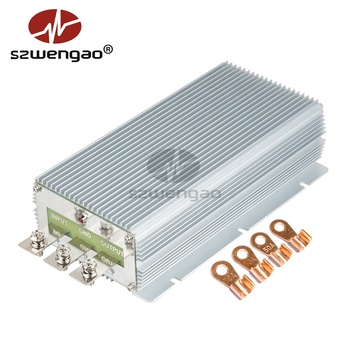
24V to 12V 85A/100A High-Current Step Down Buck Converter
- Nominal Input: 24V DC (18–35V range)
- Regulated Output: 12V DC @ 85A – 100A
- Continuous Power: 1020W – 1200W
- Efficiency / Housing: 95% · IP68 Die-cast Alu
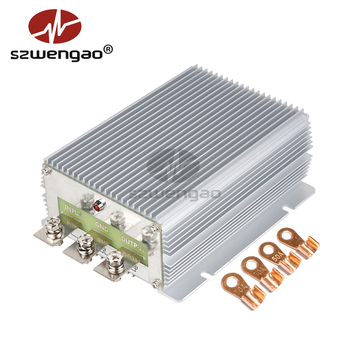
48V to 24V 40A 1000W High Conversion Buck Converter
- Nominal Input: 48V DC (36–60V range)
- Regulated Output: 24V DC @ 40A Continuous
- Peak Efficiency: 96.2% at Half Load
- Protection: OCP, OVP, OTP, Reverse Polarity
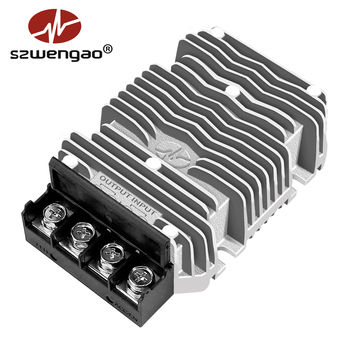
30–60V to 12V 50A/60A Step-Down Voltage Regulator
- Input Voltage: 30V – 60V DC Wide Range
- Output Power: 600W – 720W Max
- Cooling Method: Integrated Extruded Heat Sink
- Compliance: CE, RoHS, ISO 9001 Factory
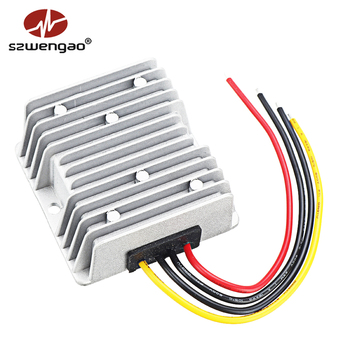
30–90V (72V nominal) to 24V 10A/20A Buck Module
- Input Compatibility: 36V, 48V, 60V, 72V Battery
- Output Rail: 24V DC (240W – 480W)
- Enclosure: Silicone Potted Waterproof
- Application: AGVs, Forklifts, Golf Carts
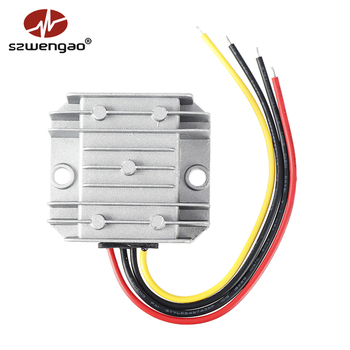
18–90V Ultra-Wide Input to 12V 5A/10A Buck Module
- Input Dynamic: 18V – 90V DC Continuous
- Output Precision: 12V ±1.5% Line/Load Reg
- No-Load Current: < 25mA Low Standby
- Testing Standard: 100% Full-load Burn-in
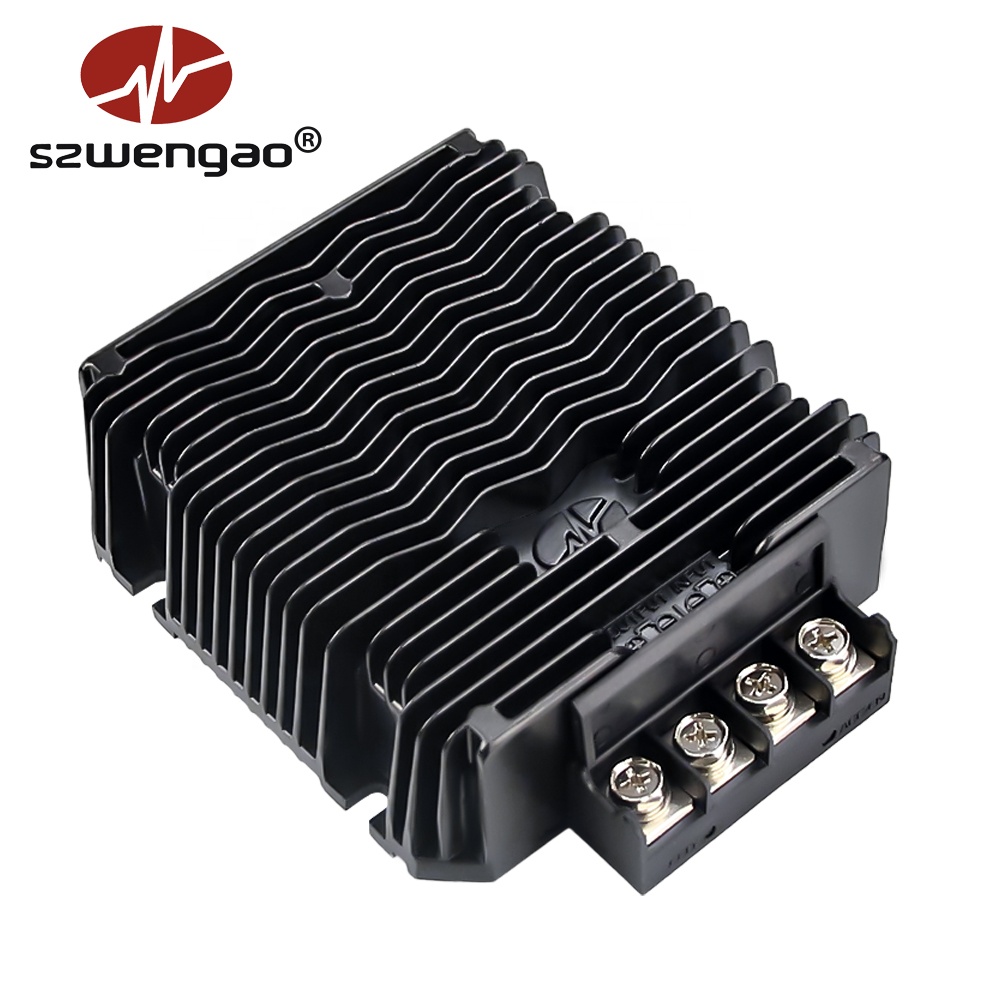
Smart 36V Lithium Battery Charger DC 12V to DC 43.8V 13A
- Input Bus: DC 12V Vehicle Alternator
- Charge Voltage: 43.8V CC/CV LiFePO4 / Li-ion
- Rated Current: 13A Controlled Charging
- Protection: Dual Battery Isolation, IP65
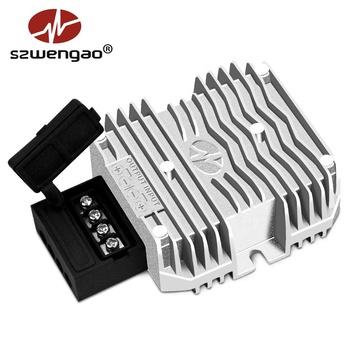
18–75V to 5V 20A 100W Industrial Isolated Step-Down
- Isolation Voltage: 1500V DC Galvanic Barrier
- Input Rails: 24V, 36V, 48V Telecom Standards
- Output Rating: 5V DC @ 20A Low-Ripple
- Thermal Rating: -40°C to +85°C Operating
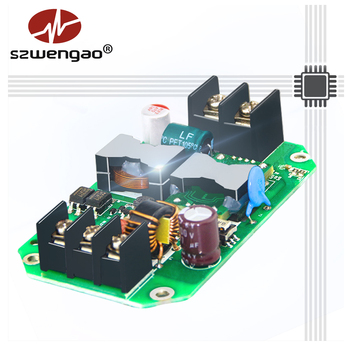
36–75V to 12V 10A 120W Rugged Telecom DC-DC Converter
- Ground Topology: Fully Isolated Input-to-Output
- Input Voltage: 36V – 75V (48V / 60V Central)
- Output: 12V DC @ 10A Continuous
- Target Fields: Base Stations, Material Handling
Synchronous Buck Topology vs. Traditional Regulators
Understanding thermal dissipation, switching transients, and conduction losses in high-voltage industrial step-down conversions.
| Topological Parameter | Legacy Asynchronous Buck | Eltrum High-Power Synchronous Buck | Galvanically Isolated Step-Down |
|---|---|---|---|
| Freewheeling Component | Schottky Diode (0.5V - 0.8V forward drop) | Ultra-Low Rds(on) MOSFET (< 4mΩ) | Optocoupled / Transformer Secondary Stage |
| Typical Conversion Efficiency | 82% – 88% (Severe thermal penalties >20A) | 94% – 97.2% Peak Efficiency | 88% – 93% (Transformer core loss trade-off) |
| Thermal Load Generation | High (Requires large active cooling fans) | Minimal (Conduction cooled via aluminum potting) | Moderate (Dissipated via module baseplate) |
| Ground Path Structure | Common Ground (Negative Shared) | Common Ground (Optimized Low-Z Plane) | 1500VDC Break (Total Ground Separation) |
| Transient Spike Damping | Basic RC Snubber Circuit | Active Gate Drive + Multi-stage LC Filtering | Shielded Dual-Choke Differential Filter |
| Optimal Application Arena | Low-budget consumer gadgets < 5A | Industrial fleets, EVs, solar arrays, RVs | Telecom -48V rails, medical instrumentation |
Synchronous Rectification
By replacing legacy freewheeling diodes with microprocessor-driven power MOSFETs having ultra-low drain-source resistance (Rds(on)), internal voltage drop collapses from 0.7V to millivolt levels, curbing heat generation by more than 60%.
- Saves up to 45W of thermal waste per 100A module
- Maintains 94%+ efficiency across 20% to 100% load curve
- Eliminates noisy and failure-prone cooling fans
Structural Environmental Ruggedness
All high-current buck modules are vacuum encapsulated with aerospace-grade thermally conductive epoxy resin inside an anodized ADC12 die-cast aluminum housing, achieving true industrial hermeticity.
- IP68 certified: impervious to submersion, brine, and engine grease
- Withstands 10G mechanical vibration along X, Y, and Z axes
- 100% moisture condensation proof for sub-zero operation
Multi-Tier Autonomous Protection
Industrial electrical systems suffer from inductive load dump transients, voltage ringing, and inadvertent terminal short circuits. Our custom controller architecture incorporates comprehensive self-healing protection.
- Hiccup-mode short-circuit defense with auto-recovery
- TVS suppression absorbing inductive vehicle alternator surges
- Dynamic over-temperature foldback avoiding thermal runaway
Future Sourcing Trends for DC-DC Buck Converter Modules
How engineering directors, tier-1 system integrators, and OEM procurement managers are evolving their vendor qualification matrices for next-generation DC architecture.
1. Transition from 12V/24V to 48V/72V/96V Battery Ecosystems
As material handling equipment, automated guided vehicles (AGVs), marine leisure craft, and commercial trucking electrify, primary battery voltages are shifting dramatically toward 48V, 72V, and higher. Sourcing managers are consolidating their BOMs by selecting buck converters with ultra-wide input margins (such as 18V–90V continuous) that cover multiple nominal battery states on a single hardware footprint.
This trend drastically lowers inventory carrying costs, mitigates supply chain volatility, and simplifies field servicing across diversified regional product variants.
2. Stringent Demand for Synchronous Rectification & Thermal ROI
With energy efficiency benchmarks tightening across the EU and North America, thermal calculation is no longer an afterthought. Sourcing non-synchronous buck converters with 82% efficiency in an unventilated sealed equipment enclosure leads to early component failure and elevated warranty claims.
Modern OEMs analyze Total Cost of Ownership (TCO): selecting a 96% synchronous module from a certified China manufacturer saves upwards of 80kWh per commercial fleet vehicle annually, directly extending battery range and lowering MTBF failure rates below 0.05%.
3. Integration of Telemetry: RS485, CANbus, and Digital PMBus
The days of dumb analog voltage droop regulators are rapidly sunsetting. Forward-looking procurement programs increasingly stipulate digital communication hooks—principally isolated RS485 (Modbus RTU) and CAN 2.0B interfaces. Fleet telemetry requires real-time monitoring of bus voltage, rail current, heatsink temperature, and fault logging.
Our R&D team directly provisions microprocessor-monitored buck systems that feed health metrics directly to the vehicle central processing unit or remote IoT gateways.
4. Supply Chain De-risking via Verified Shenzhen Direct OEM/ODM
Geopolitical uncertainties and trading house markups have driven international buyers away from third-party broker networks. Technical sourcing directors require direct factory validation: onsite SMT inspection, component traceability (original brand MOSFETs and Japanese capacitors), and certified ISO 9001 quality management systems.
Partnering directly with Eltrum in Shenzhen eliminates intermediary markups of 30–45%, ensures rapid custom design cycles (2–3 weeks from spec to sample), and guarantees guaranteed production allocation.
Technological Trajectories Shaping DC-DC Buck Converters
How wide bandgap semiconductors, high-frequency planar magnetics, and advanced substrate thermal design are redefining power density.
Gallium Nitride (GaN) & SiC Transistors
The silicon limit is real. Eltrum's advanced engineering team is piloting Wide Bandgap (WBG) GaN-on-Si and Silicon Carbide power switches across high-density converters. GaN slashes gate capacitance and reverse-recovery charges to near zero, enabling switching frequencies to ascend from 100kHz into the 500kHz–1MHz regime.
- Reduces passive magnetic inductor volume by over 50%
- Enables higher continuous output current in smaller form factors
- Zero reverse recovery loss drastically dampens EMI ringing
Planar Transformers & Flat-Wire Inductors
Traditional hand-wound toroidal inductors suffer from winding inconsistencies, parasitic capacitance, and high AC resistance due to skin effect at higher frequencies. We utilize flat-copper helical coils and multilayer PCB planar magnetics to maximize copper fill factor and provide unmatched batch-to-batch inductance consistency.
- Exceptionally uniform thermal path directly to aluminum baseplate
- Immunity to mechanical shock and vibration stress fractures
- Significantly curtailed differential-mode EMI radiation
Insulated Metal Substrates (IMS / DBC)
Standard FR-4 glass-epoxy PCBs act as thermal insulators with conductivities under 0.3 W/m·K. In high-amperage applications (such as our 24V to 12V 100A modules), we integrate Direct Bonded Copper (DBC) or aluminum-core Insulated Metal Substrates boasting thermal conductivities up to 3.0 W/m·K.
- Lowers MOSFET junction-to-case thermal resistance (Rth_jc)
- Preempts localized hotspot formation on power traces
- Enhances continuous amperage throughput by 35% without fan assist
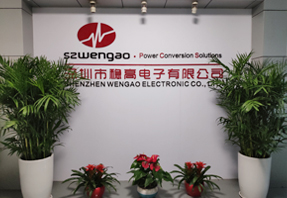
Shenzhen Eltrum Electronic Co., Ltd.
Founded in 2015 in the global electronics manufacturing epicenter of Shenzhen, China, Shenzhen Eltrum Electronic Co., Ltd. has grown to become a benchmark manufacturer of DC-DC buck, boost, buck-boost, and galvanically isolated power conversion systems.
Unlike commercial trading companies, Eltrum operates complete in-house design, automated SMT surface mount assembly, vacuum silicone potting, high-precision magnetic coil winding, and automated computerized burn-in testing chambers. Our legal entity, facility, and export operations are verified onsite by independent third-party international inspection agencies.
Our core philosophy of "Customer First, Best Service" translates into pragmatic engineering support: whether you require customized input drop-out thresholds for low-voltage battery protection, custom IP68 terminal pigtails, or RS485 communication baud rate configuration, our R&D department interacts directly with your design engineers.
Frequently Asked Questions: DC-DC Buck Converters
Direct answers to the most critical technical, commercial, and quality assurance questions raised by international sourcing teams.
What is the difference between non-isolated buck converters and isolated DC-DC converters?
When should an engineer specify a buck-boost converter rather than a buck converter?
How should continuous load vs. surge current be sized when procuring buck modules?
Can Eltrum customize input ranges, output voltages, and mechanical connectors?
What certifications, testing, and quality control procedures govern production?
What is the Minimum Order Quantity (MOQ) and sample lead time?
What commercial terms, logistics, and payment methods are supported?
Request a Custom Buck Converter Proposal or Volume Quotation
Send your input voltage range, target output amperage, environmental constraints, and estimated annual usage. Our senior electrical engineering team in Shenzhen will reply with matching catalog datasheets or an OEM design proposal within 24 hours.