Factory-Engineered Step Up & Boost Converters
From compact marine IP68 modules to 1500W microprocessor-managed DC stabilizers, evaluate our verified platforms engineered for demanding continuous-duty applications.

Smart 36V LiFePO4 Booster Charger DC 12V to 43.8V 13A
- Nominal In:12V DC (9-16V Window)
- Regulated Out:43.8V CC/CV 13A
- Enclosure:IP68 Potted Aluminum
- Target Load:EV, RV, E-Bike 36V Packs
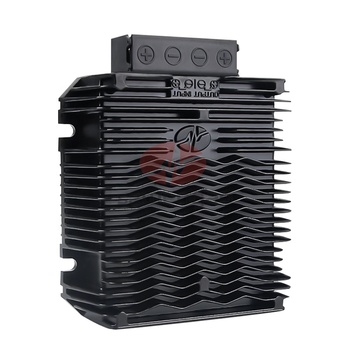
High-Current DC Step Up Converter 12V to 24V 50A
- Topology:Synchronous Step-Up
- Continuous Power:1200W Output
- Peak Efficiency:Up to 96.5%
- Application:Truck Bow Thrusters & Motors
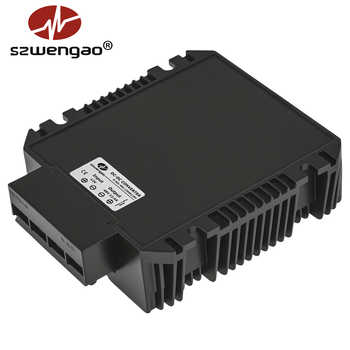
Waterproof 12V to 48V Step Up Boost Converter 20A
- Input Swing:9V - 20V DC
- Output Voltage:48V DC Regulated (±1%)
- Power Rating:960W Max
- Protection:OCP, OVP, OTP, Reverse Polarity
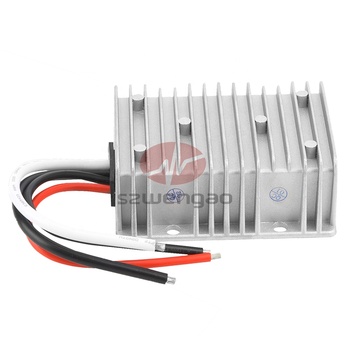
Industrial 24V to 48V 15A Boost Voltage Regulator
- Input Nominal:24V DC (18-35V)
- Output Current:15A (720W Output)
- Thermal Derating:Full Load @ 50°C Ambient
- Housing:Extruded Heat-sink Fin

1500W High-Power Programmable Boost Stabilizer
- Dynamic In:10V - 60V Wide Range
- Target Out:12V / 24V / 28V / 48V
- Telemetry:RS485 Modbus RTU
- Certification:CE, RoHS, ISO 9001
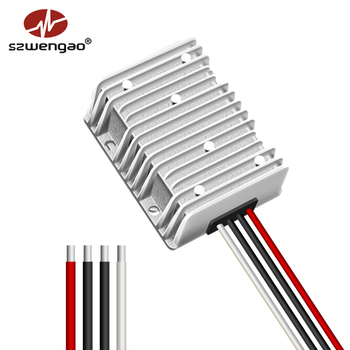
Wide 8-40V to 13.8V 30A Marine Voltage Stabilizer
- Input Span:8V to 40V DC
- Calibrated Out:13.8V Radio Rail (±0.2V)
- Max Amps:30A Continuous (414W)
- Sealing:Thermally Conductive Epoxy
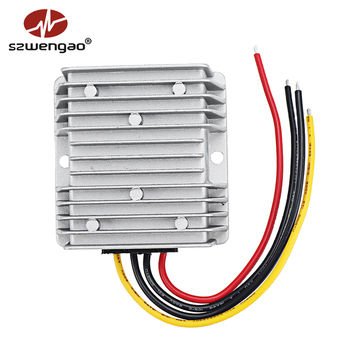
Multi-Voltage 9-40V to 24V 10A Step Up Power Module
- Inversion Mode:Non-Isolated Auto Boost
- Output Wattage:240W Rated
- Ripple / Noise:< 80mVp-p
- Target Fleet:Mining Carts, CCTV, Robotics
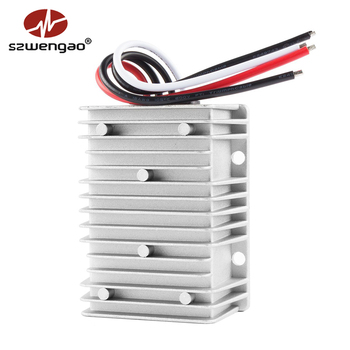
Vehicle 9-40V to 19V 15A Rugged PC Step Up Booster
- Input Compatibility:12V / 24V Fleet Sources
- Target Output:19.0V DC Stable 15A
- Efficiency:95.2% Typical
- Use Profile:Industrial PCs, Telematics
Shenzhen Eltrum Electronic: Direct Manufacturing Authority
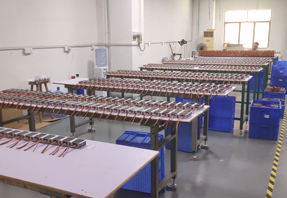
Founded in 2015 in the manufacturing epicentre of Shenzhen, Guangdong, Shenzhen Eltrum Electronic Co., Ltd. has established an international reputation as one of China's premier original design manufacturers (ODM) and high-volume exporters of industrial-grade DC-DC converters and smart lithium battery charging systems. Operating from our modern 3,000 m² specialized manufacturing facility in the Hangcheng industrial cluster, our operation integrates in-house surface-mount technology (SMT), automated robotic potting, magnetic component winding, and 100% full-load thermal burn-in chambers.
Unlike trading intermediaries, Eltrum controls the entire product lifecycle from electromagnetic simulation (FEA) and thermal modeling to hardware prototyping, firmware calibration, and final packaging. Our isolated and non-isolated step-up boost converter product lines are manufactured under rigorous ISO 9001 quality management standards, maintaining strict conformity to CE, RoHS, and FCC directives.
Our global footprint spans Tier-1 automotive upfitters, off-grid renewable energy integrators, marine vessel electronics fabricators, and commercial robotics manufacturers across North America, Europe, Australia, Japan, and Southeast Asia. We maintain flexible OEM/ODM service arrangements, allowing customization of input operating thresholds, multi-stage CC/CV charging curves, custom wire harness terminations, and ruggedized aluminum enclosure footprints starting from minimal prototype volumes.


Step-Up (Boost) Converter Fundamentals & Design Criteria
An authoritative technical breakdown for hardware engineers, systems architects, and procurement managers evaluating Chinese export-grade power electronics.
Synchronous vs. Non-Synchronous Boost
Traditional non-synchronous boost converters utilize a passive Schottky freewheeling diode. Under high current output (e.g., 20A to 50A), forward diode drops ($V_f \approx 0.5V$) dissipate immense waste heat ($P = I \times V_f$).
- Eltrum employs active synchronous rectification MOSFETs ($R_{DS(on)} < 3.2m\Omega$).
- Reduces forward conduction losses by up to 78%.
- Delivers continuous industrial conversion efficiencies exceeding 96.5%.
Peak Input Current Sizing
A frequent engineering trap in boost procurement is failing to compute peak low-input current. According to the conservation of energy principle: $P_{in} = \frac{P_{out}}{\eta}$.
- For a 48V 20A (960W) output operating at 92% efficiency, input requirement is 1043W.
- When the primary battery drops to 10.0V cranking sag, input current reaches 104.3A.
- Eltrum uses heavy-gauge copper terminal rails and massive inductor core cross-sections to prevent magnetic saturation.
Automotive & Marine Environmental Sealing
Harsh mobile equipment environments subject electronics to extreme mechanical shock, high salt-fog oxidation, and condensative humidity cycles.
- Vacuum potting with high-grade organosilicon thermal elastomer.
- True IP68 ingress protection against submerged conditions.
- Thermal conductivity rating $\lambda \ge 1.5 \text{ W/m}\cdot\text{K}$, eliminating localized hotspots across MOSFET junction points.
Critical Information Gain: Why Direct Alternator-to-Auxiliary Lithium Charging Destroys Alternators
In vehicular and marine conversions, connecting an auxiliary 24V, 36V, or 48V LiFePO4 battery directly across a 12V starter alternator via mechanical relays causes severe system degradation. LiFePO4 chemistry presents virtually near-zero internal resistance ($R_i \le 2m\Omega$), drawing destructive continuous charging current that drives commercial alternators into thermal runaway at low idle engine speeds. Furthermore, the voltage drop across long wiring runs inhibits the secondary battery from ever hitting its mandatory CC/CV saturation threshold. Eltrum's DC-DC step-up battery chargers actively regulate input current draw, protect the starter battery from deep discharge, and elevate the output rail to precisely 14.6V, 29.2V, 43.8V, or 58.4V with calibrated three-stage charging profiles.
Standard Conversion Ratios & Production Configurations
Cross-reference your platform input operating window, target load specifications, and deployment environment against our standard verified factory baselines.
| Topology | Nominal Input Range | Calibrated Output | Max Current / Wattage | Conversion Eff. | Primary Industrial Sector | Direct Inquiries |
|---|---|---|---|---|---|---|
| Non-Isolated Boost | 12V DC (9.0V - 20.0V) | 24.0V DC ±1% | 50A / 1200W | 96.5% | Heavy Commercial Truck, Marine Winches | Get a Quote |
| Non-Isolated Boost | 12V DC (9.5V - 18.0V) | 48.0V DC ±1% | 20A / 960W | 95.8% | 48V Micro-Hybrid Bus, Telecom Inverters | Get a Quote |
| Smart CC/CV Charger | 12V DC (10.0V - 16.0V) | 43.8V (36V LiFePO4) | 13A / 570W | 94.5% | Light EV, Golf Carts, Electric Bike Fleets | Get a Quote |
| Non-Isolated Boost | 24V DC (18.0V - 35.0V) | 48.0V DC ±1% | 15A / 720W | 96.2% | Off-Grid Solar Storage, Heavy Equipment | Get a Quote |
| Automatic Buck-Boost | 10V - 60V Continuous | 12V / 24V / 28V / 48V | Up to 1500W | 95.0% | Multi-Voltage Defense Systems, AGVs, Robotics | Get a Quote |
| Isolated Step-Up DC | 18V - 36V Wide Input | 48.0V Galvanic Isolation | 10A / 480W | 92.0% | Railway Rolling Stock, Noise-Sensitive RF | Get a Quote |
| Rugged Regulated Boost | 9V - 40V Ultra-Wide | 19.0V DC Constant | 15A / 285W | 95.2% | In-Vehicle Industrial Computing, Telematics | Get a Quote |
Future Procurement Trends: Where the Industry is Moving
Key macroeconomic and technical forces redefining sourcing strategies for global equipment manufacturers over the 2025–2030 period.
Wide-Bandgap Semiconductor Adoption (GaN & SiC)
Procurement teams are aggressively shifting away from legacy Silicon MOSFET architectures toward Gallium Nitride (GaN) and Silicon Carbide (SiC) power switching elements.
- Enables switching frequencies exceeding 250kHz to 500kHz without thermal runaway.
- Reduces passive inductor and capacitor volume by over 40%, shrinking module footprint.
- Drastically lowers switching losses, empowering closed unventilated IP67 packaging in tight chassis.
Digital Power Telemetry & CAN/RS485 Networks
Dumb analog power bricks are increasingly obsolete in commercial fleets. Tier-1 buyers require real-time visibility into edge voltage, thermals, and ampacity draw.
- Integration of onboard 32-bit ARM microcontrollers supporting Modbus RTU & CANbus 2.0B protocols.
- Dynamic closed-loop output voltage adjustments based on battery State-of-Charge (SoC).
- Predictive maintenance telemetry preventing catastrophic field downtimes in autonomous fleets.
Stringent EMC Harmonization (CISPR 25 & EN 55032 Class B)
High-voltage step-up modules generate acute high-frequency parasitic ringing and common-mode noise that disrupt sensitive GPS, radar, and wireless communication links.
- Western markets demand full compliance with automotive CISPR 25 radiated emissions standards.
- Adoption of multi-stage Pi-filters, internal Faraday shield copper planes, and ferrite beads.
- Eltrum integrates hardware-level jitter reduction and spread-spectrum clock modulation directly on PCB layers.
System Engineering & Sizing Decision Framework
Avoid critical over-heating, inductive tripping, and low-voltage lockouts with these battle-tested sizing rules from our applications team.
Thermal De-rating Criteria
Never size continuous operating loads at 100% of maximum factory nameplate rating when mounted inside unventilated enclosures or vehicle engine compartments.
- Maintain a standard 20% to 30% power headroom buffer for ambient temperatures between 25°C and 50°C.
- At ambients exceeding 60°C, derate output current capability by 2.5% per °C.
- Ensure solid mechanical thermal coupling using aluminum backing plates and thermal paste.
Inductive Motor & Inrush Management
Inductive loads such as bow thrusters, DC refrigeration compressors, and electric linear actuators draw startup inrush currents that can reach 300% to 600% of nominal running amperage.
- Standard step-up converters can trigger instant over-current protection (OCP) shutdowns during inrush.
- Specify converter models equipped with "Constant-Current Limiting" rather than "Hiccup-Mode" shutoff.
- Incorporate high-surge aluminum electrolytic capacitor banks on the converter output rail.
Input Cable Sizing & Fusing Rules
Voltage drop across long input cables reduces the actual voltage arriving at the converter terminals, forcing input current to spike dramatically under heavy boost conditions.
- Calculate copper cable gauge based on the minimum continuous input voltage threshold (e.g., 9.5V on a 12V bus).
- Keep input voltage drop strictly below 3% of total nominal bus voltage.
- Always locate input high-amperage ANL or MIDI fuses within 30cm of the primary power source.
Frequently Asked Questions for Sourcing & Procurement
Clear, technically rigorous answers regarding lead times, customization, compliance, and warranty policies for OEM importers.
To support rapid engineering validation, Eltrum maintains a flexible sample policy with MOQs starting from just 5 units across most standard step-up boost models. For customized OEM specifications (such as custom output voltages, specific wire lengths, or buyer-labeled laser engraving), volume production MOQs typically begin at 50 to 100 units depending on chassis retooling requirements.
Yes. While our standard smart DC chargers are pre-programmed for 12V, 24V, 36V, and 48V LiFePO4 (LFP) and Lithium Nickel Manganese Cobalt (NMC) cells, our Shenzhen engineering division regularly customizes absorption voltages (e.g., 43.8V, 54.6V, 58.4V), float voltages, and termination current cutoffs ($\le 0.05C$) via factory firmware flashing to harmonize precisely with your internal BMS specifications.
All high-power Eltrum boost converters feature integrated dual-stage LC Pi-filters on both input and output stages, alongside an enclosed 6-sided die-cast aluminum chassis acting as a solid EMI Faraday cage. Our internal multi-layer PCB design maintains isolated ground planes and keeps high-frequency switching loops extremely tight, ensuring compliance with CE EMC Directive 2014/30/EU and EN 55032 / CISPR standards without interfering with marine radios or vehicle VHF/GPS receivers.
Non-isolated boost converters share a common negative ground ($GND$) between input and output, offering maximum power density, superior conversion efficiency (>96%), and lower unit cost. Isolated step-up converters utilize high-frequency planar transformers to physically break galvanic continuity between circuits, eliminating ground loops, preventing parasitic noise propagation, and protecting sensitive avionics or positive-ground telecom equipment from high-voltage faults.
Standard commercial delivery terms are FOB Shenzhen or EXW, with payment accepted via T/T wire transfer or PayPal in USD or CNY. Sample orders typically ship within 3 to 7 business days directly from factory stock. Volume production orders (500 to 5,000 units) require a standard manufacturing lead time of 15 to 22 business days, which incorporates our mandatory 100% full-load 4-hour thermal burn-in screening process.
Every batch follows an exhaustive multi-stage inspection procedure under ISO 9001: incoming component AQL verification, automated SMT optical inspection (AOI), in-circuit testing (ICT), potting cure monitoring, and automated active electronic load testing. Every finished unit undergoes a 100% full-power burn-in cycle. Eltrum backs its industrial converter products with a comprehensive 24-month limited factory replacement warranty.
Partner with China's Premier Step-Up Converter Manufacturer
Accelerate your product development cycle with direct factory access. Submit your target input range, required output current, environmental sealing needs, and estimated annual batch volume for rapid technical review and transparent tier-1 pricing.
Get a Quote