ISO 9001 Factory · CE & RoHS Compliant DC-DC Power · OEM / ODM Welcome

English USD [email protected]
Direct From Shenzhen Factory · ISO 9001 Certified

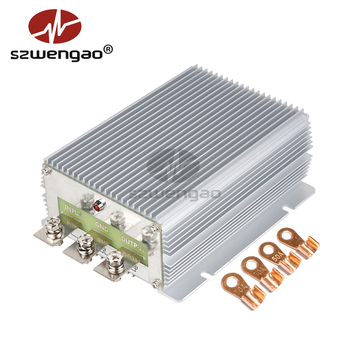
CE Certified Non Isolated DC DC Module Manufacturers & Factory

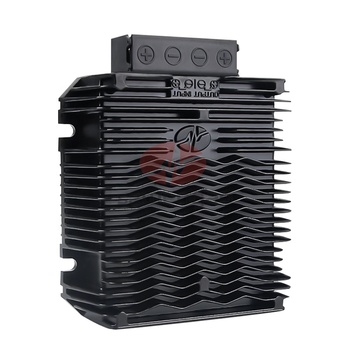
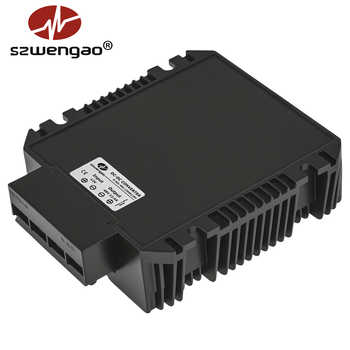
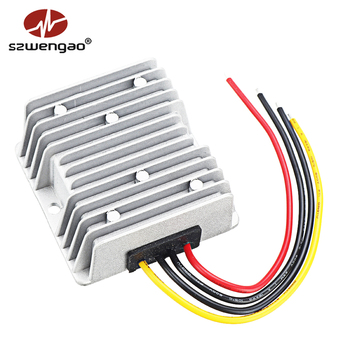
Industrial-grade synchronous buck, boost, and buck-boost power modules engineered for harsh electrical environments, automotive dual-battery systems, marine equipment, and utility-scale robotics.

Precision Conversion Lineup

Featured Industrial DC-DC Power Modules & Systems

Engineered with planar magnetics, multi-phase synchronous rectification, and IP68 potted structural aluminum enclosures for maximum operational reliability.

OEM / ODM Manufacturing Strength

Shenzhen Eltrum Electronic Co., Ltd.

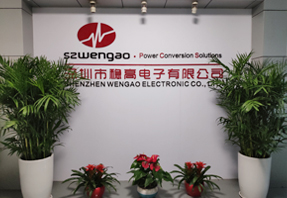
Founded in 2015 and operating out of a 3,000m² state-of-the-art facility in Anle Industrial Zone, Shenzhen, Shenzhen Eltrum Electronic is an onsite-verified manufacturer specializing in non-isolated and isolated power conversion modules, lithium battery chargers, and dynamic stabilization units.

Unlike trading entities, we execute full-cycle manufacturing: in-house SMT placement lines, high-frequency transformer and planar inductor precision winding, multi-stage automated optical inspection (AOI), complete epoxy/polyurethane potting under vacuum to eliminate micro-cavities, and 100% full-load elevated-temperature (50°C) burn-in cycles for every production lot.

ISO 9001:2015 Management
CE Certified Directives
RoHS Environmental Compliance
Shenzhen Eltrum Electronic manufacturing facility and industrial equipment
500+
Standard Power Architectures
130+
Global Export Markets
5 Pcs
Low Verification Sample MOQ
98.2%
Peak Rectification Efficiency
White Paper: Engineering Architecture

Engineering Non-Isolated DC-DC Converters: Design, Topology & Efficiency

A deep analysis into thermodynamic optimization, synchronous MOSFET gating, transient protection, and common-ground architecture in high-density DC power electronics.

1. The Synchronous Rectification Advantage

In conventional non-isolated buck or boost circuits, freewheeling Schottky diodes generate forward-voltage drops ranging from 0.4V to 0.7V. When handling 50A to 100A output currents, diode dissipation alone consumes 20W to 70W of wasted thermal power, requiring oversized finned heatsinks and compromising packaging density.

Eltrum's CE-certified non-isolated DC-DC converter series leverages low RDS(on) N-channel power MOSFETs (often under 2.5mΩ) driven by dedicated synchronous rectification controller ICs with sub-microsecond dead-time control. This reduces conduction losses by more than 82%, allowing our modules to operate at continuous conversion efficiencies between 95% and 98.2% across wide voltage brackets.

Key Reliability Metric: Low heat dissipation directly preserves the longevity of solid polymer aluminum electrolytic capacitors, prolonging Mean Time Between Failures (MTBF) past 120,000 operating hours at 45°C ambient conditions.

2. Solving Electrical Transients, Cold-Cranking & Load Dump

Commercial vehicle systems (24V systems conforming to ISO 7637-2 and ISO 16750-2) and off-grid renewable battery installations expose DC-DC conversion hardware to severe electrical disturbances. When large inductive loads disconnect suddenly, alternator load dumps generate spikes exceeding 100V for several hundred milliseconds. Conversely, automotive starter activation triggers "cold crank" conditions, collapsing a 12V bus to as low as 6V.

Our non-isolated buck-boost modules resolve this dual threat through a four-switch buck-boost bridge topology. The module smoothly shifts between bucking mode, boost mode, and mixed transfer modes depending on the live input-to-output delta, maintaining output rail stability to within ±1% across all dynamic input events.

Module Architecture Input Delta to Output Typical Efficiency Ground Configuration Ideal Application
Non-Isolated Buck Vin > Vout + 2V 95% – 98% Common Negative (GND) Truck 24V step-down to 12V accessories; Golf cart 48V to 12V lighting
Non-Isolated Boost Vin < Vout - 1V 94% – 97.5% Common Negative (GND) 12V vehicle battery raising to 24V/48V motors; Marine winches; LED strings
4-Switch Buck-Boost Vin swings above & below Vout 92% – 96% Common Negative (GND) Battery stabilizers for radio/nav gear; LiFePO4 multi-voltage charging banks
Galvanic Isolated Wide brackets (e.g. 18–75V) 88% – 92% Isolated Input / Output Telecom floating rails, medical electronics, high-EMI industrial grounding

3. Environmental Ruggedization: Silicon Potting & EMI Compliance

Shock, mechanical resonance, saltwater intrusion, and chemical fumes are the primary killers of switch-mode power supplies in marine and heavy-equipment deployments. Eltrum addresses structural survivability by housing every industrial module within precision-machined, hard-anodized or die-cast aluminum alloys.

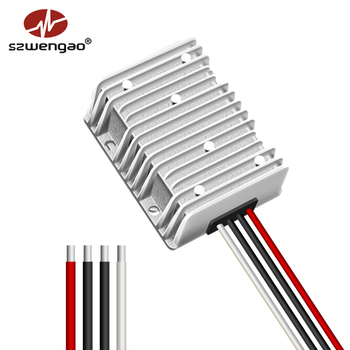
Modules are completely encapsulated using high-purity thermal conductive organosilicon potting compounds (rated UL94V-0 for flame resistance). The silicone matrix achieves dual functions: it creates an airtight IP67/IP68 ingress barrier and conducts heat directly from power inductors and MOSFET tabs directly out into the external finned enclosure, mitigating internal thermal hot spots without prone mechanical cooling fans.


Market Foresight & Roadmap

Future Sourcing Trends & Next-Gen Power Conversions

How global supply chain dynamics, Wide Bandgap (WBG) semiconductors, and software-defined bus topologies are reshaping DC-DC procurement for 2025–2030.

GaN and SiC Semiconductor Integration

Procurement teams are prioritizing Wide Bandgap (Gallium Nitride and Silicon Carbide) switches. By cutting switching losses by more than 60%, GaN facilitates operating switching frequencies up to 500kHz–1MHz, shrinking magnetic inductor footprints by half and multiplying power densities up to 40W/in³.

Digital Telemetry & Software Regulation

Fixed-output modules are giving way to intelligent devices carrying integrated RS485 (MODBUS) and CAN bus telemetry. Procurement managers for autonomous AGVs and smart RV electrical systems require real-time reporting of thermal dissipation, load current, voltage drop, and active fault states.

Supply Chain Resiliency & Modular Customization

Global original equipment manufacturers are rejecting long 26-week lead times from legacy western brands. Sourcing strategies focus on agile ISO-certified Asian manufacturing partners that maintain raw component safety buffers and deliver OEM/ODM variants (custom connectors, wire harnesses, altered voltage thresholds) within 2–4 weeks.

Procurement Intelligence

How to Select the Right Non-Isolated Converter for Your System

A step-by-step methodology to avoid oversizing costs, common-mode ground loop pitfalls, and unexpected field warranty claims.

Step 1: Calculate Minimum Continuous Voltage Headroom

Always verify the absolute minimum input voltage under heavy load rather than nominal voltage. If a 12V battery drops to 9.5V during heavy load, a standard buck module feeding a 12V output will enter drop-out oscillation. In this situation, choose a buck-boost topology.

Step 2: Rule Out Ground Loop Hazards

Because non-isolated modules connect the input return directly to the output return across a solid ground plane, ensure that no differential potentials exist between source and load chassis grounds. If safety standards demand independent floating grounds (e.g. 48V telecom rectifiers), isolated models must be specified.

Step 3: Factor Inductive Inrush & Thermal Derating

Motors, halogen projectors, refrigeration compressors, and capacitive inputs pull startup currents 300% to 600% higher than running ratings. Specify a converter rated at 1.3× to 1.5× your target continuous draw to ensure the over-current protection circuit is not triggered during startup.

Procurement FAQ

Frequently Asked Questions by Power Systems Engineers

Detailed technical answers addressing design requirements, certifications, sample ordering, and custom manufacturing options.

What is the functional difference between non-isolated and isolated DC-DC modules?
Non-isolated converters share a common electrical ground plane between the input negative and output negative terminals. This eliminates the need for bulky internal isolation transformers and optocouplers, resulting in significantly higher efficiency (up to 98% vs 88-92%), reduced component count, smaller physical dimensions, and a lower total bill of materials. Isolated converters, by contrast, utilize galvanic isolation to break ground loops and withstand multi-kilovolt isolation breakdown tests, which is essential for medical safety and telecommunication positive-ground architectures.
What CE safety and electromagnetic compatibility (EMC) standards do Eltrum modules satisfy?
Our non-isolated DC-DC converters comply with the Low Voltage Directive (LVD) 2014/35/EU and the Electromagnetic Compatibility Directive (EMC) 2014/30/EU. Harmonized test standards include EN 61000-6-3:2007+A1:2011 (generic emission standard for residential, commercial and light-industrial environments) and EN 61000-6-1:2007 (immunity standards), as well as compliance with EU RoHS Directive 2011/65/EU and its amendment directives. Complete test reports issued by accredited laboratory partners are available to enterprise customers.
Can Eltrum adjust charging algorithms for LiFePO4, NMC, and LTO chemistries?
Yes. Our smart battery charger and adjustable buck-boost platforms can be programmed at our Shenzhen factory to match specific constant-current / constant-voltage (CC/CV) curves, absorption stages, float voltages, and low-temperature cutoff thresholds. Custom voltage parameters from 12.6V to 58.4V can be set in firmware, and communication protocols such as RS485 or CAN-bus can be added to integrate with your battery management system (BMS).
What is the Minimum Order Quantity (MOQ) and production turnaround for custom designs?
For standard catalog power converters, our evaluation MOQ starts at just 5 units, allowing your engineering team to validate thermal, EMI, and physical requirements on the test bench. For OEM/ODM customizations—such as bespoke output voltages, specialized IP68 quick-connect plugs, or modified wire gauges—the typical pilot MOQ begins at 50 to 100 units. Standard production lead times are 2 to 3 weeks, significantly shorter than the industry average.
How do your converters prevent thermal runaway in unventilated or high-temperature enclosures?
Every converter utilizes our three-stage protection protocol. First, low internal dissipation keeps baseline temperatures down. Second, thermally conductive silicone potting transfers heat away from semiconductors directly to the aluminum fins. Third, an internal thermal sensor shuts down the PWM controller if the internal junction temperature exceeds 85°C. Once the internal temperature cools down by 15°C, the module automatically recovers without requiring a manual power cycle.
What payment methods, currencies, and international shipping terms are available?
We work with international B2B clients under EXW, FOB Shenzhen/Hong Kong, CIF, and DDP terms. Payments are supported via wire transfer (T/T), PayPal, and Escrow platforms in USD, EUR, and CNY currencies. We maintain partnerships with DHL, FedEx, and UPS for fast air-freight sampling, as well as established sea and rail freight options for regular production orders.

Request Engineering Evaluation Samples & Full Catalog

Accelerate your project timeline. Contact our Shenzhen technical team directly to receive complete dimensional CAD drawings, comprehensive EMC compliance reports, and direct OEM pricing.