Featured Industrial DC-DC Converters & LiFePO4 Chargers
Engineered for extreme operating environments from -40°C to +85°C. Every unit undergoes automated SMT assembly, thermal stress screening, 100% full-load burn-in testing, and meets stringent CE (LVD/EMC) and RoHS compliance directives.

Smart 36V Lithium Battery Charger DC 12V to 43.8V 13A
- Topology: Synchronous Step-Up
- Input Voltage: DC 10V–16V
- Output: 43.8V Constant CC/CV
- Ingress Rating: IP68 Full Epoxy Potted

1500W Dynamic Buck-Boost Voltage Stabilizer (RS485)
- Topology: Non-Isolated 4-Switch Buck-Boost
- Input Window: DC 10V–60V Ultra-Wide
- Output Rails: 12V / 24V / 28V / 48V Regulated
- Control Bus: RS485 Modbus Telemetry

24V to 12V 85A/100A High Current Commercial Vehicle Buck
- Output Power: 1000W–1200W Continuous
- Efficiency: Up to 96.2%
- Enclosure: Extruded Aluminum Heat Sink
- Protection: OCP, OVP, OTP, Reverse Polarity

Telecom Grade Isolated 18–90V to 12V 10A Module
- Dielectric Proof: 1500VDC Input-to-Output
- Input Surge: Tolerates 100V Peak Transients
- Noise/Ripple: < 50mVp-p Low EMI Output
- Target Fields: Telecom Racks, Forklifts, AGVs
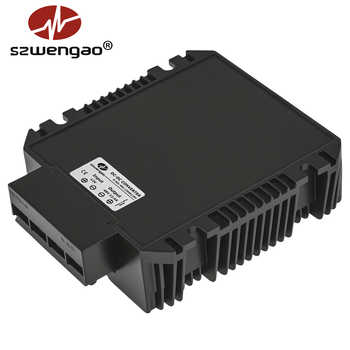
Rugged 12V to 48V 20A Waterproof Step-Up Boost Converter
- Continuous Rating: 960W at 48VDC
- Input Range: 9V–20V High Amp Inrush Ready
- Thermal Relief: Integrated Fin Cooling Baseplate
- Application: Solar Pumping, 48V Winches & Marine
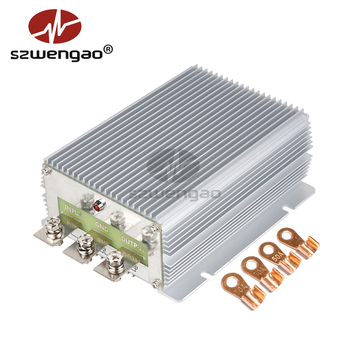
48V to 24V 40A 1000W Heavy Duty Step-Down Regulator
- Input Voltage: 35V–60V DC Nominal (48V Pack)
- Regulation: ±1% Load & Line Stability
- Standby Current: < 15mA Low Quiescent Drain
- Durability: Shock & Vibration Proof (MIL-STD)
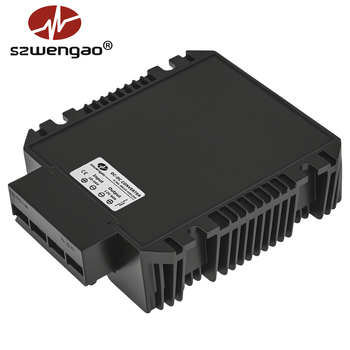
10–44V to 12V 60A Dynamic Cranking Voltage Stabilizer
- Output Amperage: 60A Peak (720W Max)
- Cold Cranking: Zero Dropout During Engine Start
- Waterproof: IP67 Solid Sealed Chassis
- Usage: Automotive Telematics & Sensitive ECUs
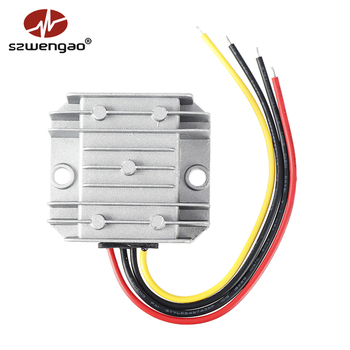
Ultra-Wide 18–90V Input to 12V 10A Traction Auxiliary
- Pack Compatibility: 24V, 36V, 48V, 60V, 72V Traction
- No Load Drain: < 8mA Ultra-Low Idle Power
- Operating Temp: -40°C to +80°C Rated
- Safety Standard: CE EN 61204-3 / EN 55032
Comparative Matrix: Selecting the Optimal DC-DC Topology
Selecting power topologies without rigorous system modeling accounts for over 65% of field power rail instabilities. Understanding converter electrical boundaries ensures long-term MTBF exceeding 100,000 hours under harsh electrical stresses.
Synchronous Buck Topology
Operates where input potential continuously exceeds target regulated output rail (Vin > Vout + Vdrop). Replaces freewheeling diodes with ultra-low RDS(on) MOSFETs, slashing conduction dissipation by up to 60%. Recommended for stepping down 48V/72V bus voltages to 12V/24V control buses in industrial and vehicle systems.
Active Boost Architecture
Employed strictly when source voltage remains consistently beneath load requirements (Vin < Vout). Critical engineering challenge: current stress concentrates on the primary inductive switch at low input voltages. Our boost series utilizes interleaved multi-phase stages to reduce input current ripple, preventing premature battery internal degradation.
Dynamic 4-Switch Buck-Boost
The ultimate solution when source voltage fluctuates dynamically above and below the regulated setpoint. In automotive systems, a nominal 12V LiFePO4 battery drops to 8.5V during starter motor surge and spikes to 14.6V under alternator charging. Our four-switch H-bridge architecture transitions seamlessly without deadband oscillation.
| Circuit Topology | Input Voltage Window | Nominal Outputs | Average Efficiency | Galvanic Isolation | Typical Industrial Target |
|---|---|---|---|---|---|
| Buck (Step-Down) | 24V, 36V, 48V, 72V, 96V DC | 5V, 12V, 13.8V, 24V DC | 94.5% – 96.8% | Non-Isolated (Common Ground) | Trucks, Commercial Buses, AGV Accessory Rails |
| Boost (Step-Up) | 9V–16V, 18V–32V DC | 24V, 36V, 48V, 56V DC | 92.0% – 95.5% | Non-Isolated (Direct Path) | Off-Grid Inverters, High-Voltage LED Arrays, Actuators |
| Buck-Boost Stabilizer | 9V–40V, 10V–60V DC | 12V, 13.8V, 19V, 24V DC | 91.5% – 94.8% | Non-Isolated (Seamless H-Bridge) | Automotive Cranking Stabilizers, Marine Telematics |
| High-Freq Isolated | 18V–36V, 36V–75V, 18V–90V DC | 5V, 12V, 24V, 48V DC | 88.5% – 92.5% | 1500VDC to 3000VDC Isolation | Telecom Central Offices, Mining, Forklifts, Rail Systems |
Future Procurement Trends for Industrial DC-DC Converters (2025–2030)
Global supply chain disruptions, the rapid shift toward 48V/800V electrification architectures, and stricter eco-design regulations are fundamentally reshaping how Tier-1 OEMs and procurement executives source power electronics.
1. Transition to Wide Bandgap GaN & SiC Semiconductors
Silicon carbide (SiC) and gallium nitride (GaN) switching components have matured from experimental prototypes to cost-effective volume production. Procurement teams are specifying SiC-based DC-DC converters to achieve switching speeds beyond 250kHz, enabling a 40% reduction in planar magnetic volume, lower copper consumption, and sustained operating efficiencies above 97% even under 80°C ambient temperatures.
2. Bidirectional Power Flow for V2X & Second-Life Batteries
Modern mobile equipment and microgrid installations no longer accept unidirectional power transfer. Sourcing criteria are shifting rapidly toward dual-direction buck-boost stages that dynamically manage charging from regenerative braking or photovoltaic inputs, while functioning as backup auxiliary power supplies when prime battery banks experience grid disconnects or load shedding.
3. Integrated Digital Telemetry & PMBus/RS485 Telematics
Analog standalone power bricks are being phased out in automated manufacturing, robotics, and commercial fleets. Buyers now require built-in microcontroller monitoring: live current readout, thermal junction sensors, programmable output trim, fault logs, and remote shutdown commands delivered via isolated RS485 (Modbus RTU) or CAN bus interfaces to facilitate predictive maintenance.
4. Environmental Hardening & Ingress Sustainability
With industrial hardware moving from climate-controlled cabinets to harsh outdoor, marine, and mining conditions, sealed IP67 and IP68 enclosures with vacuum-degassed thermally conductive epoxy potting are becoming non-negotiable procurement prerequisites. Converters must survive salt-fog corrosion, high hydrostatic pressure washdowns, and intense sinusoidal shock (up to 20G vibration profiles).
5. Total Cost of Ownership (TCO) vs. Initial Unit Price
Procurement departments are evaluating power converters through lifecycle efficiency curves rather than BOM cost alone. A 2% gain in operating efficiency across a fleet of 5,000 electric commercial vehicles translates to megawatt-hours of saved energy, reduced battery cycling wear, minimized thermal management overhead, and a drastic drop in warranty RMA liabilities.
Shenzhen Eltrum Electronic Co., Ltd.
Operating since 2015 from our advanced 3,000 m² Shenzhen production plant, Eltrum is a world-class designer and manufacturer of DC-DC conversion hardware, high-power battery chargers, and specialized power modules. Our facility integrates automated Yamaha surface-mount technology (SMT) lines, custom toroidal winding equipment, and vacuum resin potting stations.
With an experienced technical R&D engineering staff representing over 25% of our workforce, we hold onsite verification credentials, ISO 9001:2015 quality management compliance, and full CE/RoHS laboratory certifications. We maintain long-term direct OEM/ODM partnerships across North America, Germany, Japan, Australia, and 130+ nations.
- Engineering Prototyping: Rapid circuit schematic and mechanical CAD revisions delivered within 7 to 10 working days.
- Low Evaluation Threshold: Sampling minimum order quantities starting from just 5 units to ensure thorough lab validation.
- 100% Thermal Burn-In: Every single mass-production converter is tested under full thermal and electrical load prior to dispatch.
- Custom Buyer Label & Enclosures: Private labeling, tailored CNC aluminum housing geometries, wire harness terminations, and connectors.
Frequently Asked Questions for B2B Buyers
Technical, contractual, and logistics answers compiled by our chief applications engineering and global trade compliance departments.
All our DC-DC converters comply with the European Low Voltage Directive (LVD 2014/35/EU) and Electromagnetic Compatibility Directive (EMC 2014/30/EU) under EN 55032 Class B radiated emissions and EN 61000-4 immunity standards. We integrate multi-stage common-mode and differential-mode LC filtering circuits directly onto the main PCB and employ fully shielded aluminum die-cast housings to prevent interference with sensitive vehicle CAN networks and radio frequencies.
Non-isolated converters share a common electrical ground plane between the input power source and the output load, maximizing power density and achieving up to 96% efficiency at a lower price point. Isolated converters incorporate an internal high-frequency planar transformer that completely breaks the galvanic path (providing 1500VDC to 3000VDC isolation). Isolation is mandatory in negative/positive mixed grounding networks, telecom equipment, high-voltage battery packs, and safety-critical medical apparatus to eliminate circulating ground loop hum and hazardous high-voltage leakage.
Yes. Modern ECU-controlled smart alternators frequently drop output voltage to 12.2V during deceleration or cruise to conserve fuel, which terminates charging on passive relay systems. Our battery-to-battery DC-DC chargers utilize an active ignition sensor wire and multi-stage buck-boost regulation that boosts low alternator voltages up to a precise 14.6V or 29.2V LiFePO4 CC/CV absorption profile without overheating the starter alternator.
For standard catalog configurations (over 500 established SKUs), sample units ship from warehouse inventory within 48 to 72 hours. For customized output voltages, modified wire harness lengths, or specialized connectors (Anderson, Deutsch, Amphenol), engineering prototypes require approximately 7 to 10 working days. High-volume container production runs are typically fulfilled within 20 to 25 business days.
While our potted modules are rated to operate between -40°C and +85°C, converters installed in enclosed compartments, near exhaust paths, or in direct sunlight without forced convection airflow should be derated by 20% to 30% beyond 50°C ambient. Sizing a 1000W load using an Eltrum 1200W or 1500W rated converter prevents thermal throttling, lowers component operating temperatures, and vastly extends internal electrolyte and MOSFET life spans.
We support standard international commercial terms including EXW, FOB Shenzhen/Hong Kong, CFR, and DDP to client facilities. Payment arrangements include telegraphic transfer (T/T), confirmed Letter of Credit (L/C) for volume orders, and PayPal/Escrow for validation samples. Every industrial DC-DC converter and battery charger comes backed with a standard 24-month factory warranty and direct factory engineering replacement coverage.
Request Custom Engineering Specs & Wholesale Quotation
Connect directly with our Shenzhen power engineering department to review system specifications, obtain complete CE/RoHS test reports, or schedule low-MOQ evaluation samples tailored to your exact voltage, current, and packaging requirements.
Get a Quote