Choosing an AC DC Power Supply begins with a practical question: what must the equipment power, and under what conditions? A compact router, a factory controller, and a medical instrument place very different demands on conversion, protection, and packaging. The right choice affects more than voltage. It can influence heat, electrical noise, installation space, and long-term reliability.
Power electronics researcher Robert W. Erickson and coauthor Dragan Maksimović describe power electronics as the technology of efficiently converting, controlling, and conditioning electric power. That principle helps explain why no single supply type suits every job. Linear designs can offer quiet output, while switched-mode supplies often deliver higher efficiency in a smaller enclosure. Isolated and non-isolated models serve different circuit and safety needs. Open-frame, enclosed, DIN-rail, and modular supplies also fit distinct installation environments. The labels can blur. Real applications are rarely tidy. Comparing these types means looking closely at load behavior, input range, output stability, cooling, and available space—not just the numbers on a datasheet. This guide introduces the main AC DC Power Supply types and the trade-offs that matter when selecting one. It also leaves room for a useful caution: published specifications do not replace testing in the actual system. A supply that looks ideal on paper may run hot, create unwanted noise, or prove awkward to mount. Practical details count.
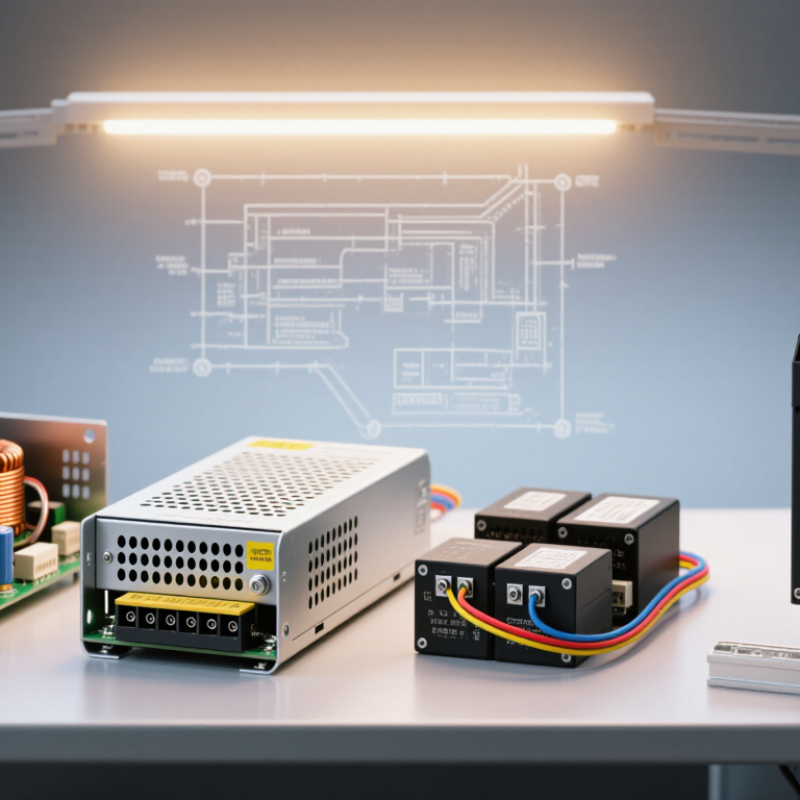
AC-DC Conversion Basics: Mains Input Is Typically 50 or 60 Hz
An AC-DC power supply takes alternating current from the wall and delivers direct current to a device. In many regions, mains electricity cycles at 50 or 60 hertz. That figure describes how often the input waveform repeats, not the final DC output. The supply must convert the changing voltage into a steadier level suited to its load. That distinction matters.
In a linear supply, a transformer commonly adjusts the mains voltage before rectification and filtering. In a switch-mode supply, the input is usually rectified first, then switched at a much higher frequency. A capacitor smooths much of the ripple, while regulation helps keep the output stable as the load changes. With full-wave rectification, residual ripple often appears at 100 or 120 hertz, depending on mains frequency. Real performance also depends on ripple, heat, and the specified input range; a neat voltage label does not tell the whole story.
Tips: Check the input-frequency range on the supply label, especially when using equipment in another region. Match its DC output voltage and current rating to the device. If readings seem unstable, verify the load and measurement setup before assuming the supply has failed.
What Are the Top Types of AC DC Power Supplies? — AC-DC Conversion Basics: Mains Input Is Typically 50 or 60 Hz
| Power Supply Type | How It Converts AC to DC | Typical Characteristics | Common Uses | Key Considerations |
|---|---|---|---|---|
| Linear Regulated | Uses a mains-frequency transformer, rectifier, smoothing filter, and linear regulator. | Usually provides low electrical noise and simple regulation. The transformer can be relatively large and heavy. | Low-noise analog circuits, laboratory equipment, and some audio applications. | Regulation dissipates excess voltage as heat, so efficiency can be low, especially when the input-to-output voltage difference is large. |
| Switch-Mode (SMPS) | Rectifies the mains input, then switches power at a much higher frequency to regulate and convert it. | Typically compact and efficient across a wide range of output powers. May use isolated or non-isolated circuit designs. | Computers, displays, communications equipment, household electronics, and industrial systems. | Switching can create electrical noise; filtering, layout, safety design, and electromagnetic-compatibility testing are important. |
| AC-DC Adapter | Converts mains AC to a low-voltage DC output, commonly using a switch-mode circuit. | Often enclosed in a separate case with a cable or plug. Available with fixed or, in some designs, selectable output voltage. | Small appliances, routers, monitors, and other low-voltage electronic devices. | Match the device’s required output voltage, current capacity, polarity, connector, and safety requirements. |
| Open-Frame Power Supply | Usually uses a switch-mode conversion stage mounted on an exposed circuit board or metal frame. | Designed to be installed inside a larger product rather than used as a standalone enclosed unit. | Built-in equipment, control cabinets, instruments, and embedded systems. | Requires suitable enclosure, airflow, electrical clearances, and protection from contact and environmental hazards. |
| DIN-Rail Power Supply | Typically uses switch-mode AC-DC conversion and mounts on a standard DIN rail. | Designed for installation in electrical control panels; many models include overload and over-temperature protection. | Industrial automation, building controls, and instrumentation panels. | Check the available input range, output rating, panel temperature, ventilation, and required approvals. |
| Battery Charger (AC-DC) | Converts AC mains to controlled DC charging current or voltage for a specified battery chemistry. | Charging behavior may include current limiting, voltage regulation, and charge-stage control. | Rechargeable battery systems, portable equipment, and backup-power applications. | Use a charger designed for the battery chemistry, cell count, and required charging profile; a general DC supply is not automatically a safe charger. |
Mains-frequency note: AC mains frequency is typically 50 Hz or 60 Hz, depending on the electrical system. In many switch-mode supplies, the mains is rectified before a high-frequency switching stage performs the main conversion.
FAQS
Its rectifier and large capacitor can draw narrow current pulses. These pulses create harmonics.
It addresses harmonic emissions from equipment rated up to 16 A per phase on certain public low-voltage systems. Scope matters.
Harmonic limits depend on the equipment class. The wrong classification can lead to an unsuitable assessment.
No. It can shape input current and reduce harmonics, but testing is still needed. Not just wattage.
Assess the complete supply under the applicable test conditions. Load, input voltage, and control behavior can change results.
It sets load-dependent efficiency requirements for covered adapters. Requirements vary with rated output power and configuration.
Common test points are 25%, 50%, 75%, and 100% of rated output. No-load power is checked separately.
A device may draw far below 30 watts for much of the day. Cable losses, temperature, and changing demand also affect outlet performance. I can miss that detail too.
Conclusion
An AC DC Power Supply converts alternating current from the mains into the direct current needed by electronic devices. Since mains electricity typically operates at 50 or 60 Hz, the supply must transform and condition the incoming power before delivering a stable output. Linear designs use a transformer and are valued for their low switching noise, while switch-mode supplies use high-frequency switching to achieve compact size and efficient operation. Their input-current harmonics may be subject to IEC 61000-3-2 requirements for equipment drawing up to 16 A per phase.
Different applications also have distinct efficiency considerations. For PC power supplies, the 80 PLUS Gold benchmark specifies 92% efficiency at 230 V and 50% load. External AC-DC adapters are evaluated under DOE Level VI, which sets load-dependent efficiency limits, including requirements that account for operation at light loads. Choosing among these supply types involves balancing noise, size, efficiency, and the needs of the intended device.